

On this page
The modern world runs on cars, but the journey to personal motorised transport began with a single three-wheeled machine. On January 29, 1886, Karl Benz submitted a historic application to the Imperial Patent Office in Berlin. His design, officially granted as patent number 37435, was for a "vehicle with gas engine operation" (Wikipedia). Unlike earlier attempts to modify horse-drawn carriages, Benz's Motorwagen was the very first vehicle designed from the ground up to be propelled by an internal combustion engine.
What was the Karl Benz first car patent motorwagen 1886?
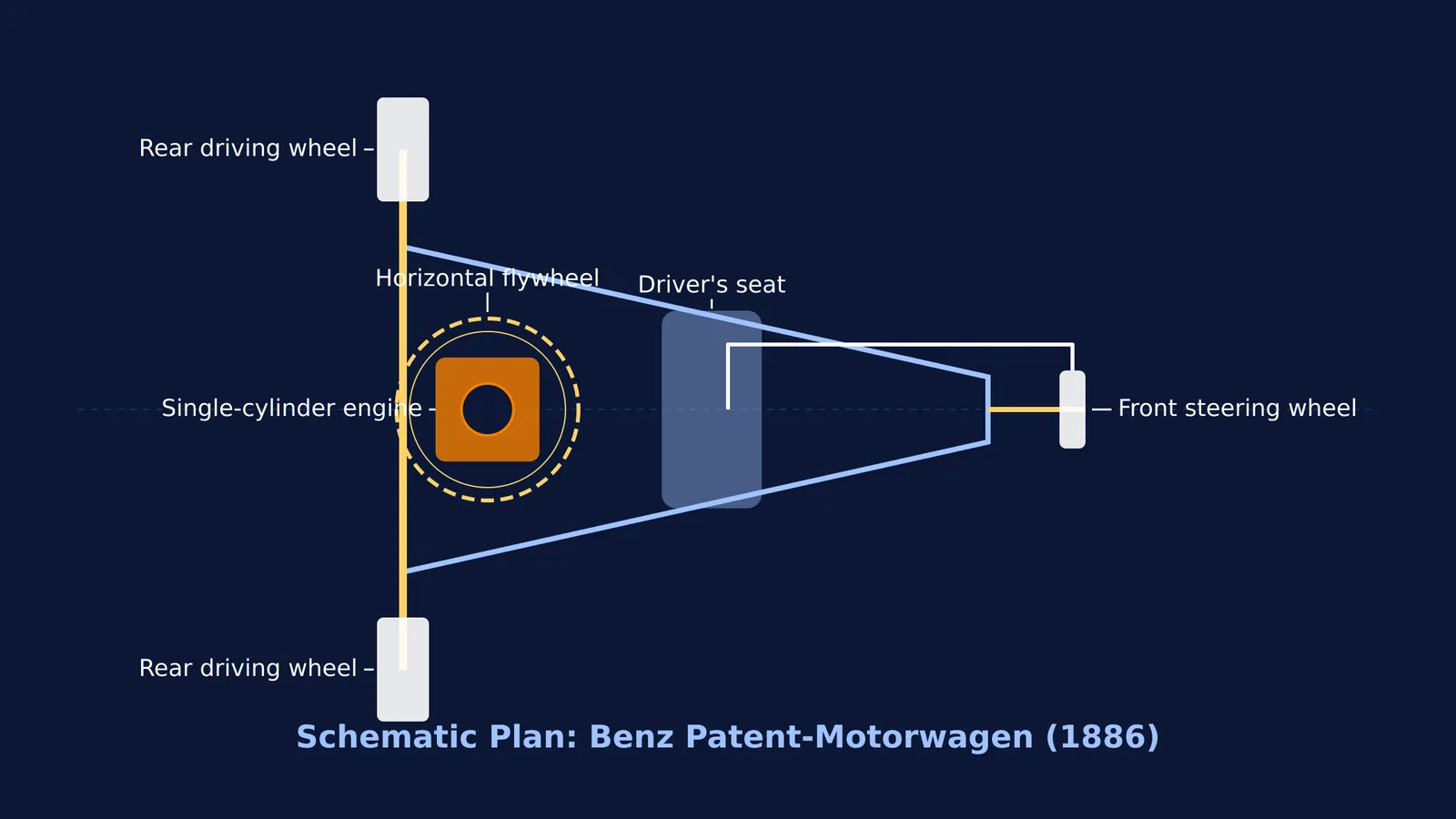
Before 1886, inventors across Europe had experimented with putting heavy steam engines or rudimentary electric motors onto traditional horse carriages. Benz took a fundamentally different approach. He designed a completely new, lightweight three-wheeled chassis built of steel tubing with wooden panels, ensuring the vehicle could easily be steered by a single front wheel.
The heart of the machine was a 954 cc single-cylinder engine. It produced about 0.67 horsepower and reached a top speed of 16 km/h (Wikipedia). While those numbers might sound tiny compared to modern vehicles, the Benz Patent-Motorwagen successfully proved that a self-propelled petrol vehicle was not only possible, but practical for human transport.
How did Karl Benz's first car patent work?
Benz's engine was a four-stroke petrol engine based on the Otto cycle. It had a spark plug for electric ignition and an evaporative carburettor to mix fuel and air. Because the single-cylinder engine fired only once every two revolutions (Wikipedia), the power delivery was jerky. Benz solved this by mounting a large, heavy flywheel horizontally on the chassis. The momentum of the spinning flywheel kept the engine turning smoothly between power strokes.
To cool the engine, Benz used a water jacket. However, it lacked a closed radiator. Instead, it used evaporative cooling—the water simply boiled away as the engine ran, meaning the driver had to constantly add water to keep the engine from melting. The engine's power was then sent to the rear wheels using a belt and chain drive.
The physics of the four-stroke cycle
The Motorwagen's engine generated power by compressing a mixture of fuel and air and igniting it. The rapidly burning gas expanded, pushing the piston down. In physics, we can plot this on a pressure-volume graph. The area inside the loop of the cycle tells us the net work in irreversible expansion done by the engine during one cycle.
Here is a worked example of the energy it produced. Benz's engine generated about 500 watts (0.67 hp) of power at 400 revolutions per minute (rpm) (Wikipedia). Since a four-stroke engine fires once every two revolutions, the engine completed 200 power strokes per minute, or 3.33 per second. Dividing the total power (500 joules per second) by 3.33 cycles per second shows that each combustion stroke delivered about 150 joules of work to the crankshaft.
Visualising how pressure and volume change as the piston moves can be challenging. If engine cycles are a hard-to-picture idea, the Fermi Simulation Lab provides interactive simulations for ideas that are easier to see than read.
The journey to a practical car
While Karl Benz was an engineering genius, his first tests were short and often ended with the car breaking down or running out of fuel. It was his wife, Bertha Benz, who proved the vehicle's true worth. In 1888, she took the Motorwagen on a 106-kilometre trip without her husband's knowledge (Wikipedia), fixing mechanical issues along the way and proving that the automobile was useful for real travel.
Just as George Stephenson and the friction that made railways work solved the mechanics of trains, and The Wright brothers' first flight conquered the air, Karl Benz's Motorwagen laid the foundation for human mobility. His 1886 patent remains the birth certificate of the modern car.


