On this page
You write dy/dx in almost every maths class and ∫ every time you integrate. Both symbols come from Gottfried Wilhelm Leibniz, not Isaac Newton, even though Newton had his version of calculus first. Here is how both can be true.
Who invented calculus, Newton or Leibniz?
Both did, working separately. The MacTutor biography of Newton from the University of St Andrews says that Newton, at home after the plague closed Cambridge, "laid the foundations for differential and integral calculus, several years before its independent discovery by Leibniz." He called it the method of fluxions.
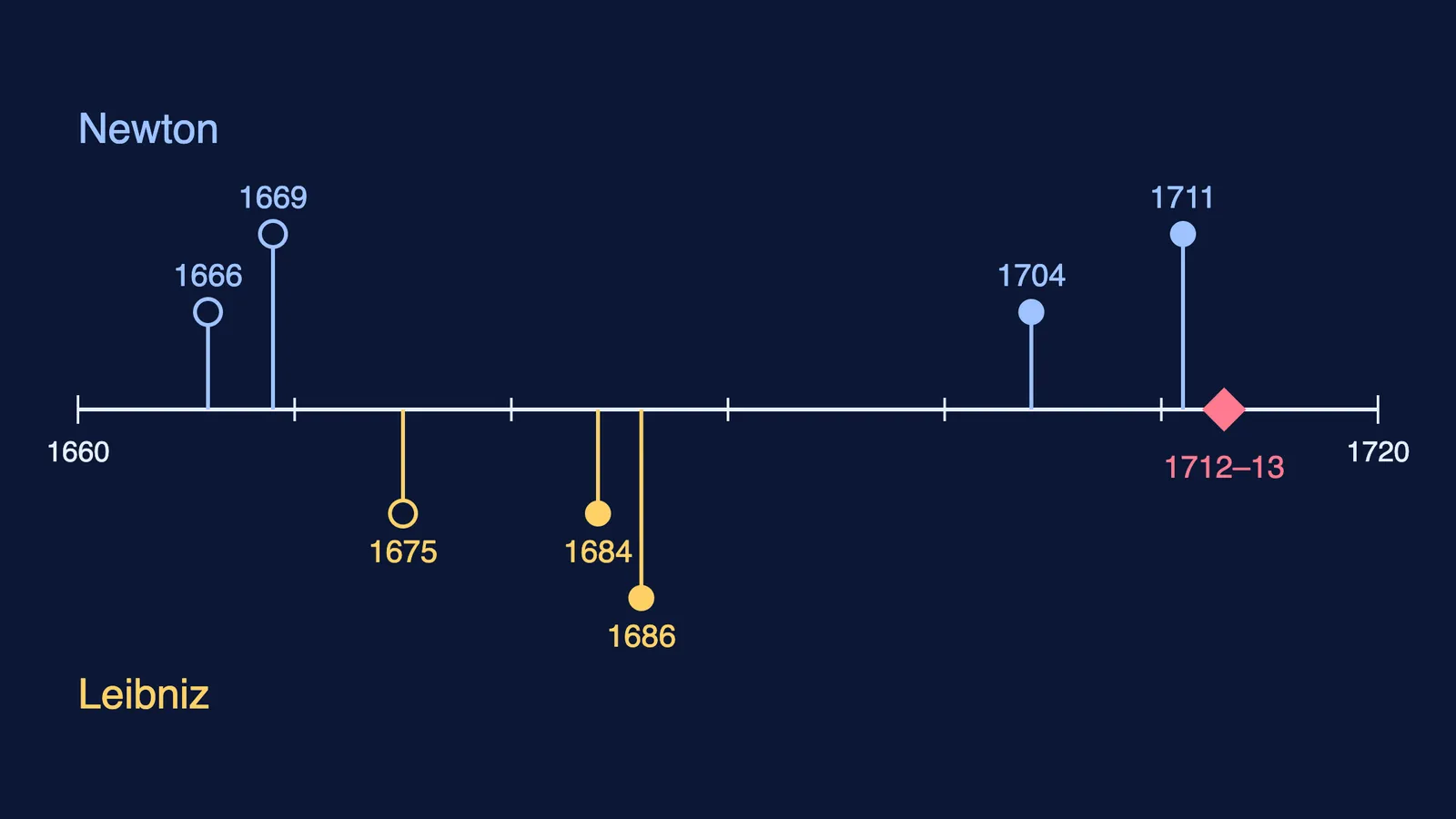
Newton wrote a tract on fluxions in October 1666, according to MacTutor's history of calculus. Leibniz first wrote the ∫ notation in a manuscript dated 21 November 1675, says MacTutor's Leibniz biography.
Their approaches differed. As the same MacTutor history puts it, "For Newton the calculus was geometrical while Leibniz took it towards analysis."
Who published first?
Leibniz did. Here is the order of print, from the MacTutor pages linked above:
1684: Leibniz publishes his differential calculus, Nova Methodus pro Maximis et Minimis, in the Leipzig journal Acta Eruditorum.
1686: Leibniz publishes a paper on integral calculus in the same journal, the first appearance of ∫ in print.
1704: Newton's tract on the quadrature of curves, written in 1693, appears as an appendix to his Opticks.
1711: Newton's Analysis, written in 1669 and passed around in manuscript, is finally printed.
1736: Newton's work on series and fluxions, written in 1671, appears in an English translation by John Colson.
Newton had shared results privately. In July 1669 Barrow sent Newton's De Analysi to Collins in London, and in 1676 Newton wrote to Leibniz through Oldenburg of the Royal Society. The Leibniz biography notes that the first letter "listed many of Newton's results but it did not describe his methods."
What did the Royal Society report say?
The dispute came to a head in 1711, when Leibniz read a paper by Keill in the Royal Society's Transactions accusing him of plagiarism, says his MacTutor biography. Leibniz wrote to the Society, and it set up a committee. Newton had been the Society's President since 1703.
The committee's report, the Commercium Epistolicum, was published around the end of 1712, according to the Trinity College Dublin edition of Newton's Account; MacTutor dates it to early 1713. It found for Newton. MacTutor is blunt: the committee "was totally biased, not asking Leibniz to give his version of the events," and its report "was written by Newton himself."
Newton then reviewed the report, anonymously, in the Philosophical Transactions of the Royal Society. He wrote that the committee found "Mr. Newton had the Method in or before the Year 1669, and it did not appear to them that Mr. Leibnitz had it before the year 1677." One line sums up his attitude: "second Inventors have no Right."
Whose notation do we use today?
Leibniz's. His d and ∫ "highlighted the operator aspect which proved important in later developments," says MacTutor's history of calculus, and his 1675 ∫ y dy = ½y² is "written exactly as it would be today." Newton wrote a dot over a letter for a rate of change with time, and you will still meet it in physics.
Britain held on to the dots. Cambridge undergraduates including Charles Babbage and George Peacock formed the Analytical Society in 1811 or 1812 and in 1816 translated Lacroix's French calculus textbook, records MacTutor's Babbage biography. Babbage joked about meetings "for the propagation of d's." Peacock set Cambridge examinations in Leibniz's notation in 1817 and again in 1819, after which it became standard practice, says his MacTutor biography.
Why does the notation matter in your exam?
Take y = x², with x changing in time. In Newton's notation the rule is ẏ = 2xẋ. In Leibniz's you write dy/dx = 2x, then dy/dt = (dy/dx)(dx/dt) = 2x(dx/dt). Same answer. But Leibniz's form shows the chain rule on the page: the dx's look as if they cancel, which tells you what to multiply next.
Use that when a rates problem stalls:
Write every rate as d(something)/d(something), with both variables named.
If the variable you need is missing, chain through one you know: dV/dt = (dV/dr)(dr/dt).
Check units: what is left after the "cancelling" should match the units of the answer.
In physics, read ẋ as dx/dt, so a dot always means "per unit time".
If the chain rule itself is the gap, the Fermi Concept Library has a lesson for every concept in mathematics, each with its place in the map. For practice, the Fermi Problem Library has worked problems with a step-by-step solver that explains the reasoning rather than printing an answer.
For more from both men, read about Newton's generalised binomial theorem and Leibniz's binary arithmetic, then put dy/dx to work with the second derivative test, visualised.