On this page
Most animals treat a reflection as a stranger. A few use the mirror to inspect their own bodies. Since 1970, scientists have turned that difference into a test, and the list of animals that pass it keeps changing. Here is who passed, and how to judge a new claim yourself.
What is the mirror test, and who invented it?
The mirror test, also called the mark test, checks whether an animal uses its reflection to touch or inspect a mark on its own body that it can see only in a mirror. The psychologist Gordon Gallup Jr. introduced it in a two-page paper in Science in 1970, Chimpanzees: Self-Recognition. Its abstract reports that, after long mirror exposure, chimpanzees marked with red dye showed evidence of recognising their reflections, while monkeys did not.
As the Wikipedia article on the mirror test summarises the method, four young wild-born chimpanzees each had a full-length mirror for a total of 80 hours. At first they made threatening gestures at the image; later they used it to groom parts of their bodies they could not otherwise see. Gallup then anaesthetised them, painted red dye (which once dry gave virtually no smell or touch cues) on an eyebrow ridge and the top of the opposite ear, and counted mark touches with and without a mirror.
The anaesthesia is the clever part. A chimp that never felt the mark being made, and cannot feel the dried dye, has only one way to know it is there: the face in the mirror is its own.
Every experiment needs that comparison; see why experiments need a control group.
Which animals pass the mirror test?
The evidence, from the original papers:
Chimpanzees: the first species to pass, in Gallup's 1970 study.
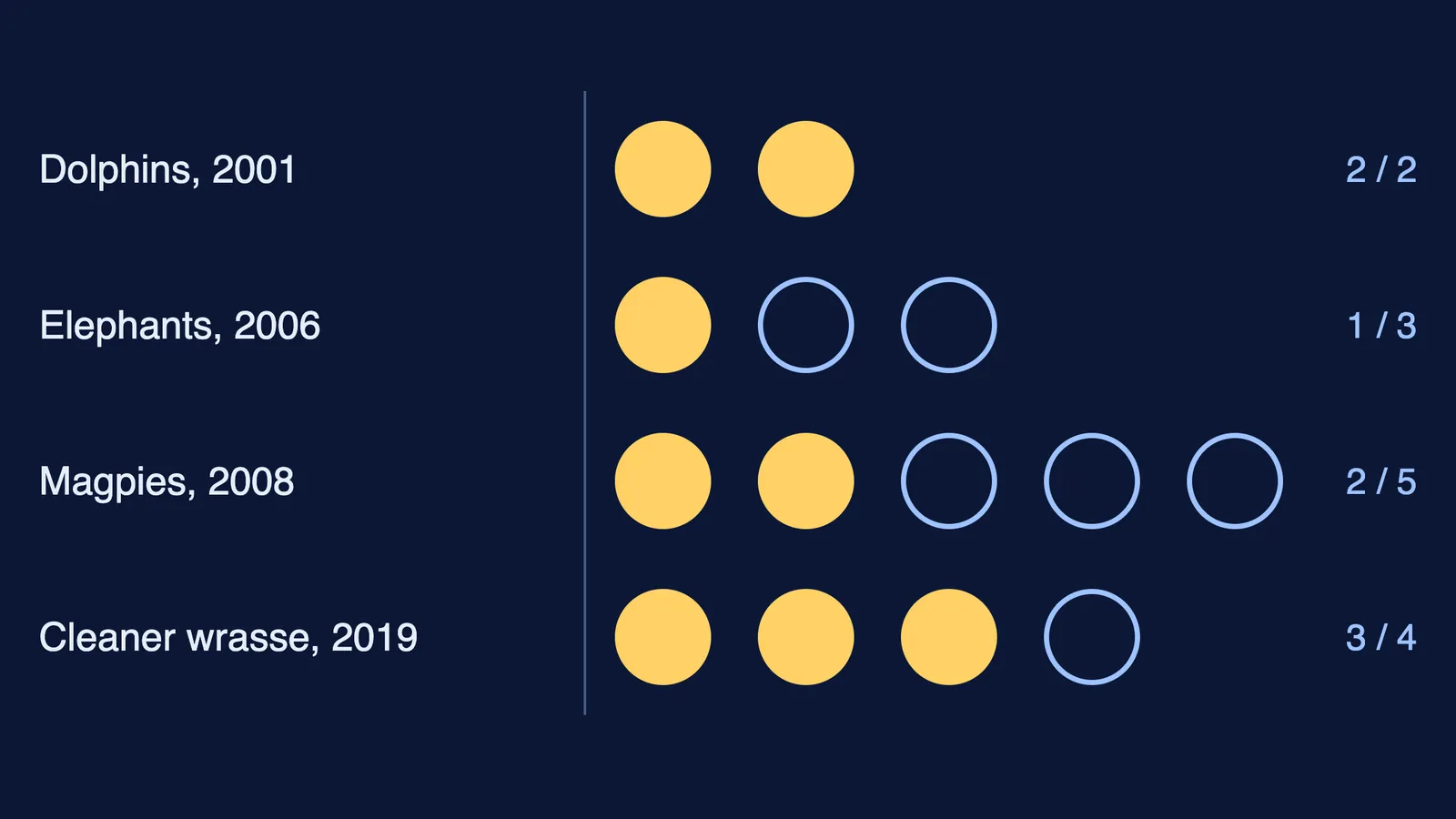
Bottlenose dolphins: in Reiss and Marino's 2001 study, two dolphins were exposed to reflective surfaces and both used them to inspect marked parts of their bodies. Only humans and great apes had convincingly passed before, the authors write; they call this cognitive convergence.
Asian elephants: Plotnik, de Waal and Reiss (2006) tested three elephants at the Bronx Zoo; as BBC News reported, one of them, Happy, repeatedly touched a painted X on her head with her trunk.
European magpies: in Prior, Schwarz and Güntürkün's 2008 study, mark-directed behaviour was significantly higher with the mirror and mark in two of five birds, Gerti and Goldie. The authors note that corvids and primates diverged about 300 million years ago, and argue that the neocortex is not a prerequisite for self-recognition.
The elephant paper describes four stages that animals with mirror self-recognition typically go through: social responses, physical inspection such as looking behind the mirror, repetitive testing movements, and realising they see themselves. The first stage resembles the threat displays covered in our post on territorial behaviour in animals.
Why do scientists still argue about the mirror test?
First, a replication. Soler and colleagues (2020) repeated the magpie experiment with more birds and a very similar protocol. During the mark test, their magpies showed more self-directed behaviour in front of a cardboard control than the mirror, so it failed to confirm the 2008 result.
Second, a fish. Kohda and colleagues (2019) injected a small brown mark under the skin of the throat in four cleaner wrasse. Three of the four scraped their throats against the tank floor once the mirror was back, and none did so without the mirror or with a transparent mark. The journal published the paper with a note that expert reviews were both positive and negative.
If a fish passes, either fish recognise themselves or the test can be passed without self-recognition. In a commentary, Frans de Waal (2019) argued that the test has encouraged a yes-or-no view of self-awareness, that the wrasse results fall short because of ambiguous behaviour and physically irritating marks, and that a gradualist model is needed.
How can you judge a new mirror-test claim?
Before believing a headline about a new species, ask five questions drawn from the magpie and wrasse debates:
How many animals were tested, and how many passed? Two of five is a result worth replicating, not a species-wide fact.
Was there a sham mark the animal could feel but not see?
Did touching the mark rise only when the mirror was present?
Could the mark itself itch or irritate, giving a reason to scratch without seeing it?
Has another lab repeated it?
Worked example: the wrasse study passes questions 2 and 3, with transparent marks and mirror-free controls. Question 1 gives three of four fish. Question 4 is where de Waal challenges it. On question 5, it was a first report. Verdict: interesting evidence, not settled. Run the magpies through the same list and the 2020 replication tips question 5 against them.
The same habit works far from mirrors, as in Charles Henry Turner's experiments on bees learning colour and pattern. If ideas like convergent evolution or control groups are still fuzzy, the Fermi Concept Library covers every concept in biology, so you can check a term before you judge the evidence.