

On this page
Warming up and limbering down sit together in the Class 11 physical education course. In the Delhi Directorate of Education's Class XI Physical Education support material for 2020-21, “Warming-up & limbering down” is topic 10.3, inside the chapter on training and doping in sports. Syllabi change, so check the current unit list with your teacher; the science below does not.
What is warming up, and what are its types?
Warming up is light, gradually harder activity before the main effort, done to get the body and mind ready for it. In a review in *Sports Medicine*, exercise scientist David Bishop sorted warm-up methods into two main types, passive and active.
Passive warm-up raises muscle or core temperature by an outside means, without using up the body's energy stores.
Active warm-up raises temperature through exercise: jogging, skipping, drills.
Active warm-up is the one you will use in PE, and it usually has more than one part. A 2011 review by David Behm and Anis Chaouachi describes a typical warm-up as light aerobic activity, then stretching, then sport-specific activity. The first two parts suit any sport, which makes them a general warm-up. The last copies the movements of your own game, such as dribbling or a bowling run-up, which makes it a specific warm-up.
Why does warming up work?
Bishop's review attributed most warm-up effects to temperature. A warmer muscle is less stiff, nerves carry signals faster, the force-velocity relationship changes and more anaerobic energy is supplied; the body also works harder to shed heat. The review notes proposed mechanisms that do not depend on temperature, including a raised baseline oxygen uptake and postactivation potentiation, where earlier contractions make later ones stronger, and a hypothesised psychological effect, a feeling of being ready. Bishop noted that warm-ups are well accepted despite limited scientific evidence for their effectiveness.
Evidence on injuries comes from trials of structured programmes. In a cluster randomised trial in the *BMJ*, 1,892 female footballers aged 13-17 from 125 Norwegian clubs were followed for one eight-month season. Players in clubs that did a warm-up programme to improve strength, awareness and neuromuscular control had a lower risk of injuries overall (0.68) and of severe injuries (0.55), relative to the control group. The main outcome, lower-limb injuries, fell but not by a statistically significant margin, which is worth saying if you quote this study.
Should you stretch before exercise?
It depends on the kind of stretch. Static stretching means holding a muscle in a lengthened position without moving. Dynamic stretching means moving a joint through its range under control, as in leg swings or walking lunges.
Behm and Chaouachi point to many studies in which static stretching before activity reduced performance, and to many that found no harm, which may be linked to stretches being short (under 90 seconds in total) and below the point of discomfort. Dynamic stretching either had no effect or improved performance. Their recommended order is light aerobic activity, then large-range dynamic stretches, then sport-specific movements, with longer static stretching kept for a separate session, where it can improve range of motion.
What is limbering down, and is cooling down necessary?
Limbering down, or cooling down, is easy activity after exercise, such as slow jogging and walking, that brings the body gradually back towards rest. Its evidence is weaker than most notes suggest. A 2018 review by Bas Van Hooren and Jonathan Peake found that an active cool-down clears lactate from the blood faster, though not necessarily from the muscle, and may help the heart, lungs and immune system recover. But it was largely ineffective for same-day or next-day performance, did not appear to prevent injuries, and in most studies did not reduce muscle soreness.
So a cool-down is still a sensible, gradual way back to rest. Just do not write that it “removes lactic acid and stops soreness” as if that were settled.
A 40-minute PE period, minute by minute
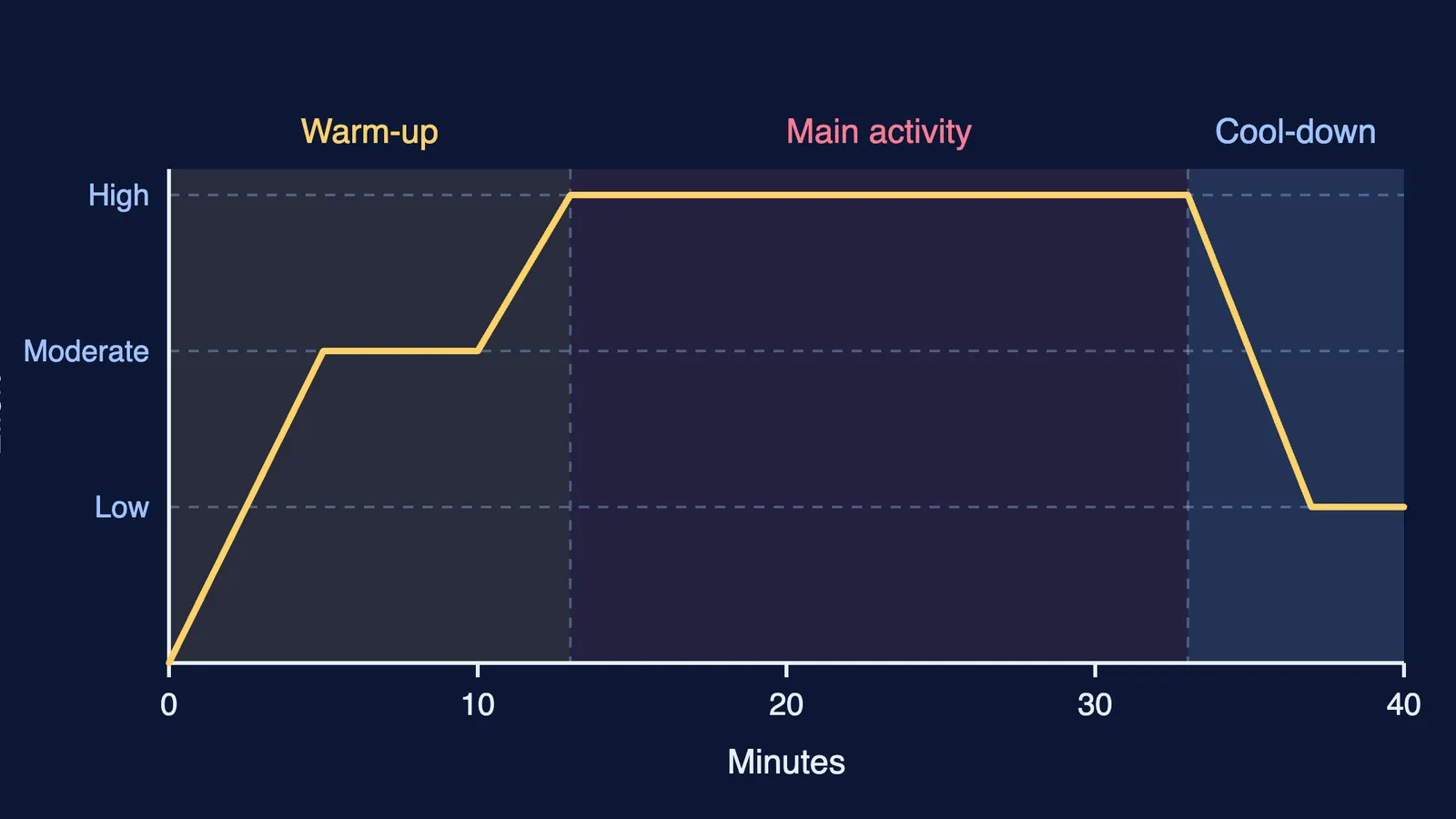
The warm-up order is the one Behm and Chaouachi recommend; the timings are our own example, not from the studies. The diagram above draws it.
Minutes 0-5: pulse raiser, an easy jog or skipping, building from easy to moderate.
Minutes 5-10: dynamic stretches such as leg swings, walking lunges and arm circles.
Minutes 10-13: sport-specific drills that build towards full speed.
Minutes 13-33: the main activity or game.
Minutes 33-37: an easy jog slowing to a walk.
Minutes 37-40: gentle static stretches for the muscles you used, never to the point of pain.
If something hurts during or after exercise, stop and tell your PE teacher.
How should you revise this topic?
Learn it as cause and effect. For each step of the plan, write which effect it targets: muscle temperature, oxygen uptake, readiness, or a gradual return to rest. Then practise one long answer that defines each term, gives its types and explains the physiology.
If terms such as nerve conduction or muscle contraction still feel shaky, the Fermi Concept Library has its own lesson for every concept in biology, so you can fill the gap before you write the answer.


