On this page
In the summer of 1910, in a field west of O'Fallon Park in St Louis, a high school science teacher named Charles Henry Turner put honey on red cardboard discs and watched what the bees did. His answer, published that October, was that honeybees can tell colours apart and learn what they mean (Turner 1910, Biological Bulletin). A year later he showed they can tell patterns apart too.
Who was Charles Henry Turner?
Turner was an African American zoologist who studied the behaviour of ants, bees, cockroaches and other invertebrates. A review by Charles Abramson in the Annual Review of Entomology says he made important advances in insect learning "while eking out a living as a high school science teacher", including work on colour and pattern vision in honeybees and the first demonstration of Pavlovian conditioning in an insect.
His doctoral thesis, The homing of ants, was published in 1907. Both of his bee papers are signed from Sumner High School, St Louis. A 2021 review in Apidologie notes he was the first African American to earn a graduate degree at the University of Cincinnati.
How did Turner show that honeybees see colour?
In Turner's day, the researcher Plateau argued that insects find flowers by smell rather than sight. Turner tested this with discs of coloured cardboard six centimetres across, and later with cardboard cones (cornucopias) and small boxes with an entrance (Turner 1910).
At first, bees ignored honey-covered red discs for more than an hour. Once bees had found honey on them, they kept returning to red objects and passed over green and blue ones. Then Turner ran his controls:
Smell: he held up a red box that had never contained honey, and bees still hovered around it; two went inside (Experiment 32).
Brightness: bees that had learned red boxes in the shade of weeds went straight to red boxes in full sun and under cloud, where their brightness was very different. Turner reasoned that redness was the only thing common to all three.
Place: in one experiment he rearranged the boxes once every ten minutes, so a fixed position could not be the only clue.
His conclusion was that, to the bees, "those strange red things had come to mean 'honey-bearers'". That is learning: a neutral object gains a meaning from experience.
Can bees recognise patterns?
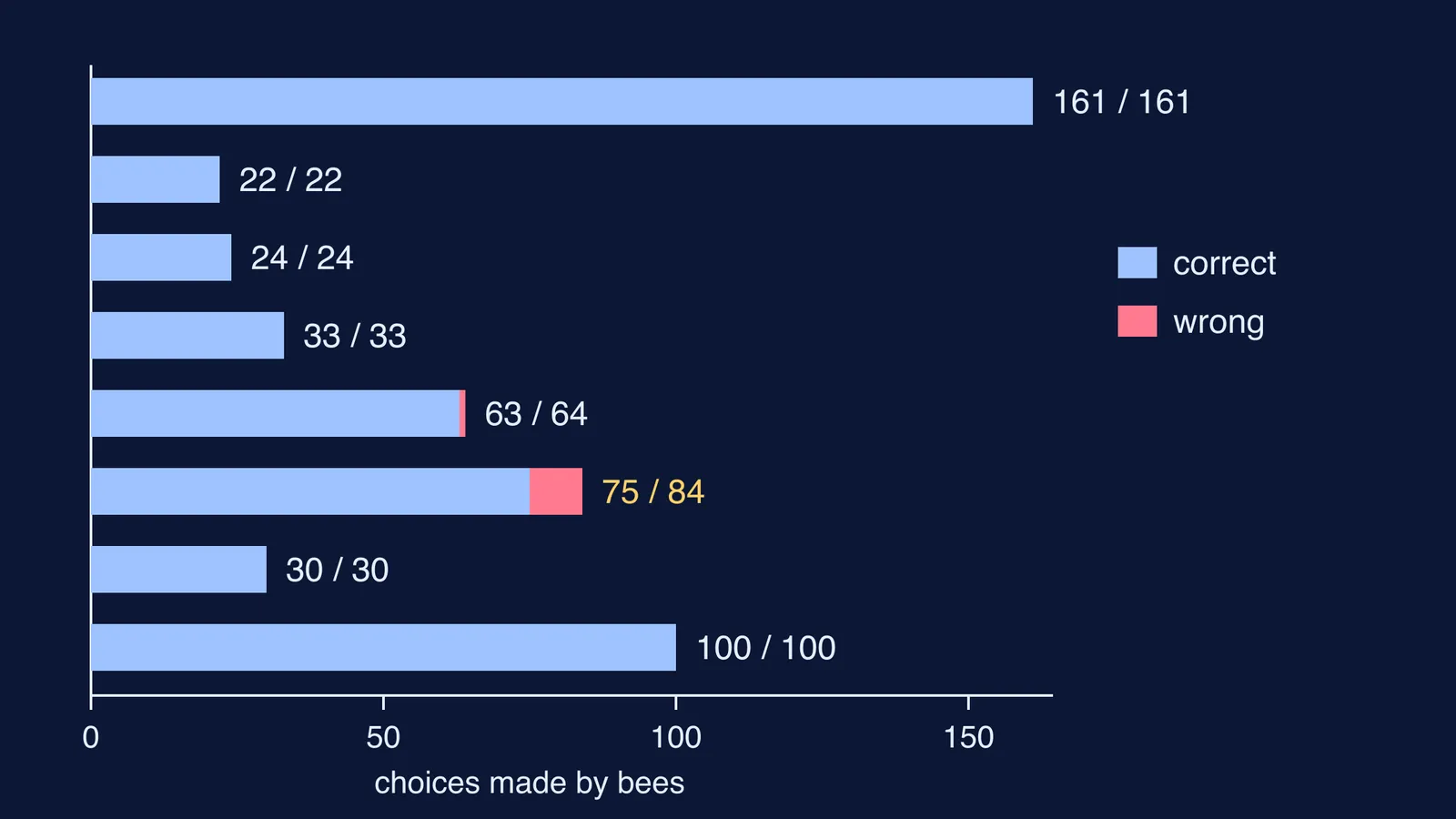
In 1911 Turner trained bees on cardboard discs, cornucopias and boxes marked with red and green stripes about five millimetres wide, then mixed them with plain red, plain green, mottled, and black-and-white striped ones (Turner 1911, Biological Bulletin). His results table records 518 trials with 508 correct choices and 10 mistakes.
How do you read Turner's results table?
Work through his numbers yourself, using the table on page 263 of Turner 1911:
Overall: 508 ÷ 518 = 0.981, or about 98.1%. The printed table says 98.5%, a small arithmetic slip that does not change the result.
The hardest test: the target sat among five other objects (plain red, plain green, mottled, black-and-white stripes, and red-and-green stripes running the other way), and only the target held honey. Bees chose correctly 75 times in 84, which is 89.3%.
Compare with guessing: with six objects, a bee picking at random would be right about 1 time in 6, or 16.7%. The bees did more than five times better.
Look at the mistakes: 6 of the 10 errors were picking red-and-green stripes running across the box instead of along it: same colours, different direction.
How can you design a fair test the Turner way?
Turner's method suits a Class 9 to 12 project, such as testing whether ants prefer a coloured card:
Train before you test. Turner wrote that a lack of response "does not mean that that stimulus has not been noticed" but that "it has not yet acquired a meaning" (Turner 1911).
Take the reward away in test trials, so smell or taste cannot explain the choice.
Change the light (sun, shade, cloud) so brightness cannot explain it.
Move things around between trials so the animal cannot rely on memory of a place.
Count every choice, including mistakes, and compare your success rate with what guessing would give.
Keep sessions short and harmless. If anyone in your group reacts badly to stings, pick ants instead, and ask your teacher before working near a hive.
Why does Turner's work still matter?
Bees choosing a colour because it once paid off is the idea you meet as conditioning in biology. Read next how haplodiploidy decides which honeybee eggs become males, how ant colonies split work between queen, workers and soldiers, and how to check your independent and dependent variables before you start.
If terms like conditioning or compound eyes feel shaky, the Fermi Concept Library gives every concept in biology its own lesson and shows where it sits in the map. And if you are planning a project and do not know where to begin, Fermi's AI tutor can work out what you already know and build a plan for the session.
Start with one coloured card, one reward and a notebook, the way Turner did.