

On this page
Setting up a science experiment means making choices about what to change, what to measure, and what to keep exactly the same. Identifying these variables correctly is the foundation of any valid scientific claim, yet it remains a common stumbling block for students attempting to design a fair test.
A 2019 study of 2,229 Norwegian 10th-grade students highlighted this difficulty, finding that those in the lower quartile of scientific literacy were not proficient enough to identify a basic health claim in a brief news report [[1]](https://doi.org/10.1136/bmjopen-2018-028781), let alone isolate the variables behind it. Whether you are prepping for a Class 10 board practical or a complex JEE physics question, mastering these definitions is essential for interpreting data accurately.
What are the three types of variables in an experiment?
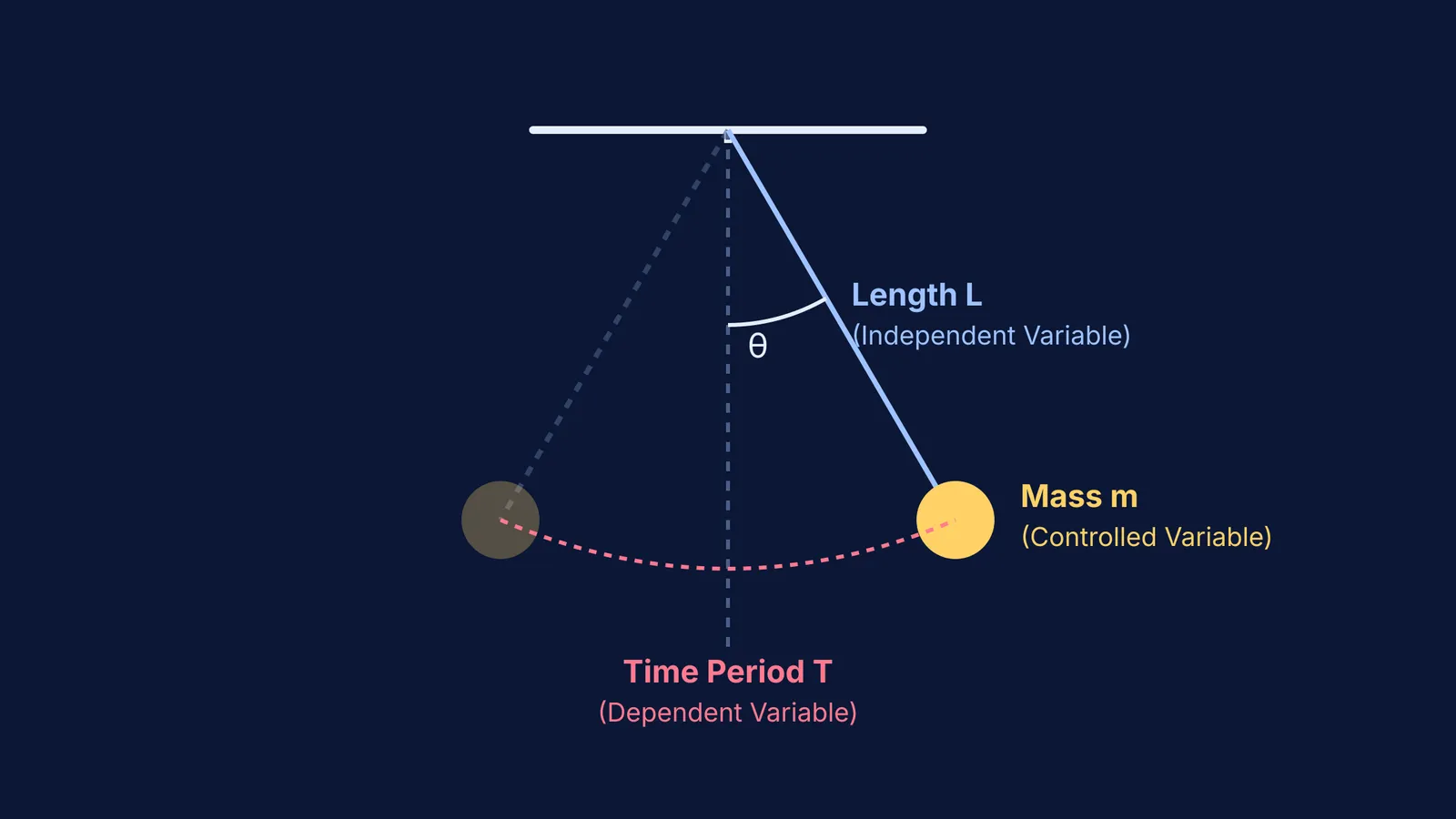
Every scientific investigation relies on three categories of variables to ensure the results are trustworthy. To see how they work together, imagine you are investigating how a seconds pendulum's period changes with length.
Independent variable: The one factor you change on purpose. In the pendulum experiment, this is the length of the string. You decide before the experiment starts what lengths you will test (for example, 0.5 m, 1.0 m and 1.5 m).
Dependent variable: The outcome you measure. This variable "depends" on the changes you made to the independent variable. For the pendulum, the dependent variable is the time it takes for one complete swing (the time period).
Controlled variables: The factors you keep exactly the same to ensure a fair test. If you want to know how length affects the swing, you must control the mass of the bob, the angle you release it from, and the location (to keep gravity constant).
What are common mistakes when identifying variables?
Students frequently make predictable errors when designing experiments or answering exam questions about experimental design.
The most common mistake is swapping the independent and dependent variables. If a student is asked how temperature affects the rate of a chemical reaction, they might accidentally state that the reaction rate is the independent variable. Another frequent error is confusing the measuring instrument with the variable itself. For example, a student might list "the stopwatch" as the dependent variable, rather than "the time taken".
Finally, students often overlook the importance of controlled variables. They might assume that as long as they measure the outcome accurately, the test is inherently fair. They forget that a slight breeze in the laboratory or a subtle change in room temperature could skew the results entirely. This is why listing your controlled variables before starting is just as important as knowing what you plan to change.
Can AI identify independent dependent control variables?
Yes, an AI can easily list the variables for any standard experiment. However, asking an AI to simply hand you the answers skips the crucial learning process. Instead, you can use AI to verify your own thinking and catch the misunderstandings mentioned above before you write up your final lab report.
If you are confused by a lab manual or a homework prompt, Fermi's AI tutor works out what you already know, builds a plan for the session, and teaches through it — checking your understanding of the experimental design as it goes.
Instead of pasting your assignment and asking "What are the variables?", try using this script to check your work:
*"I am doing an experiment to see how the temperature of water affects how fast sugar dissolves. I think the independent variable is the water temperature, the dependent variable is the time it takes to dissolve, and the controlled variables are the amount of sugar and the volume of water. Is my reasoning correct? If not, guide me to the right answer without just giving it to me."*
Can you show a worked example for the prism practical?
Let us apply this checking method to a standard optics experiment. In the deviation vs incidence prism practical, you shine a ray of light into a glass prism and measure how much the ray bends.
Independent variable: The angle of incidence. You purposefully draw different angles on your paper before placing the prism on the board.
Dependent variable: The angle of deviation. This is the result you measure with a protractor after tracing the emergent ray and extending the lines.
Controlled variables: The material of the prism, the prism angle (which is typically 60° for an equilateral prism), and the colour or wavelength of the light used.
How can you test your understanding further?
Another excellent way to practice is by looking at biological experiments, where controlling variables can be especially challenging because living organisms are involved. Imagine an experiment to determine if a specific fertiliser increases plant growth.
Independent variable: The amount of fertiliser added to each plant.
Dependent variable: The increase in plant height over a set period, such as two weeks.
Controlled variables: The amount of water given to each plant, the type of soil, the amount of sunlight, the initial size of the plants, and the temperature of the room.
If you ever get stuck, ask yourself two questions. "What am I in control of before the experiment starts?" That is your independent variable. "What am I measuring as a result of that choice?" That is your dependent variable. Using an AI tutor to review these answers builds critical thinking for exam day and beyond.


