On this page
Here is a puzzle a Class 6 student can follow and no mathematician has solved. Pick any positive whole number. If it is even, halve it. If it is odd, multiply by 3 and add 1. Repeat. Does every starting number eventually reach 1?
What is the Collatz conjecture?
The Collatz conjecture is the claim that this halve-or-triple-plus-one rule always reaches 1, whatever positive whole number you start with. The MacTutor biography of Lothar Collatz says he proposed the problem in 1937 and states the question the same way: does the sequence always reach 1, for every starting value?
Collatz was born in 1910 in Arnsberg, Germany, and earned his doctorate in Berlin in 1935, according to the same MacTutor biography.
Jeffrey Lagarias's survey of the 3x + 1 problem traces the idea to a Collatz notebook dated 1 July 1932 and says he circulated such problems at the International Congress of Mathematicians in 1950. As it passed from person to person it picked up other names: Helmut Hasse proposed the name Syracuse problem, and Shizuo Kakutani and Stanislaw Ulam spread it among colleagues.
What happens if you start at 27?
Try 7 first, using the rule as set out in Wikipedia's Collatz conjecture article. You get 7, 22, 11, 34, 17, 52, 26, 13, 40, 20, 10, 5, 16, 8, 4, 2, 1. That is 16 steps, and the numbers climb to 52 before they fall.
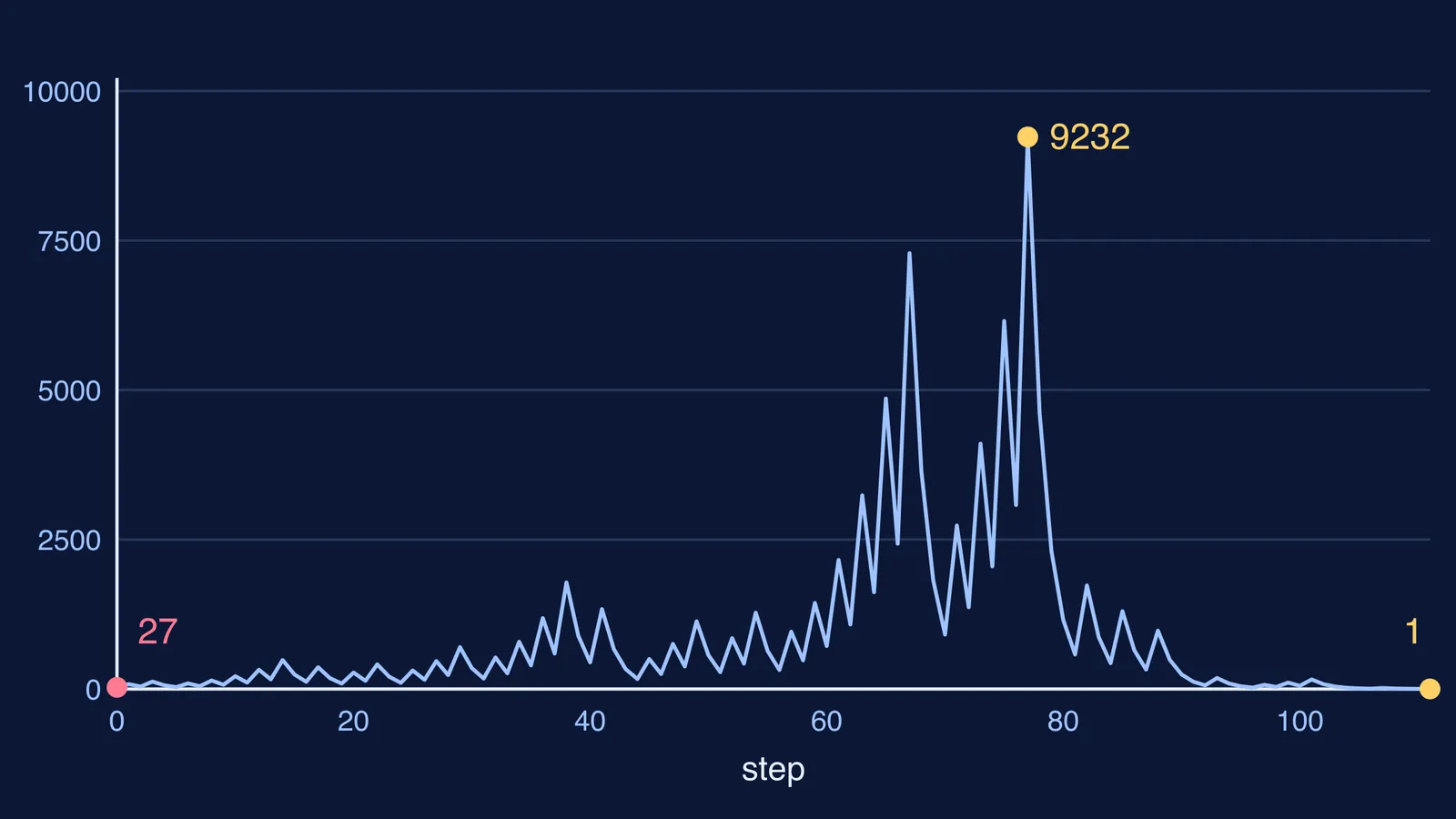
Now try 27, a small number with a wild path. Starting from 27, the sequence takes 111 steps to reach 1 and climbs as high as 9232 on the way, as listed in Wikipedia's article. We computed the full sequence to draw the chart at the top of this page; the peak comes at step 77.
You cannot tell from the start how high a number will climb or how long it will take, and that unpredictability is what makes a proof so hard.
How far have computers checked the 3n + 1 problem?
Very far. In 2025, David Barina reported in The Journal of Supercomputing that every starting number up to 2^71 reaches 1. That is about 2.36 × 10^21 numbers. His abstract says the tasks were distributed to thousands of parallel workers on several European supercomputers.
None of that is a proof. A counterexample could be a number far beyond 2^71 that climbs forever, or one that falls into a loop that never touches 1. Checking more numbers makes a counterexample less likely to be small, not impossible.
Has anyone come close to proving it?
Paul Erdős once said of it, "Mathematics is not yet ready for such problems," as quoted in Lagarias's survey.
One of the biggest steps in recent years came from Terence Tao. His paper, Almost all orbits of the Collatz map attain almost bounded values, posted in 2019 and published in Forum of Mathematics, Pi in 2022, proved that almost every starting number eventually drops below any bound that grows with the starting number, however slowly. Quanta Magazine put it plainly: 99% or more of starting values eventually reach a value quite close to 1. "Almost all" still leaves room for exceptions, so the conjecture stays open. Tao told Quanta: "I wasn't expecting to solve this problem completely. But what I did was more than I expected." If his name is familiar, it may be from the Green-Tao theorem on primes in arithmetic progressions.
Collatz is in good company. Another simple-sounding question, from 1742, is still open too: read the letter that started the Goldbach conjecture.
How can you explore the Collatz conjecture yourself?
You do not need a supercomputer. Here is a short plan for a student, or a parent and child together.
Run the rule by hand for every start from 1 to 15 and note the number of steps.
Look for patterns. Which numbers fall fastest? Why do neighbours such as 6 and 7 behave so differently?
Make one claim and test it on five new numbers. For example: a power of 2 reaches 1 in as many steps as its exponent.
Try to prove your claim for every case, as the callout above does for odd numbers. If you cannot, you have learned why Collatz is hard.
For step 3, our guide on checking a number pattern rule shows how to test a rule without letting a computer do the thinking for you.
If proof by induction or sequences still feel shaky, the Fermi Concept Library has a lesson on every mathematics concept. And if you are not sure where to start, Fermi's AI tutor can work out what you already know and build a plan for the session.
Start with 27 tonight, and you will see why mathematicians keep coming back to this puzzle.