On this page
In the summer of 1742, a Prussian mathematician named Christian Goldbach sent a letter to Leonhard Euler, the most prolific mathematician of his day. Inside was a passing thought about prime numbers. Goldbach suspected that numbers could be built by adding primes together.
Euler's reply simplified the idea into a rule that is famously easy to understand. Yet, nearly three centuries later, it remains one of the oldest unsolved problems in mathematics.
Here is what Goldbach wrote, how Euler refined it, and what this 300-year-old puzzle teaches students about getting stuck and finding a way forward.
What did the 1742 letter to Euler actually say?
On 7 June 1742, Goldbach wrote his famous letter to Euler. He proposed that every integer that can be written as the sum of two primes can also be written as the sum of as many primes as you wish, until all terms are ones. At the time, mathematicians still considered 1 to be a prime number.
In the margin of the same letter, Goldbach added a second idea: it seems every integer greater than 2 can be written as the sum of three primes.
Euler replied on 30 June 1742, reminding Goldbach of an earlier conversation they had shared. He distilled Goldbach's thoughts into a sharper statement: every positive even integer can be written as the sum of two primes. Euler wrote, "That ... every even integer is a sum of two primes, I regard as a completely certain theorem, although I cannot prove it" (Wikipedia).
Because modern mathematics no longer counts 1 as a prime, the idea is now split into two parts. The weak Goldbach conjecture says every odd integer greater than 5 is the sum of three primes, which Harald Helfgott finally proved in 2013. The strong version—Euler's statement—asserts that every even natural number greater than 2 is the sum of two prime numbers.
Why is Goldbach's conjecture so hard to prove?
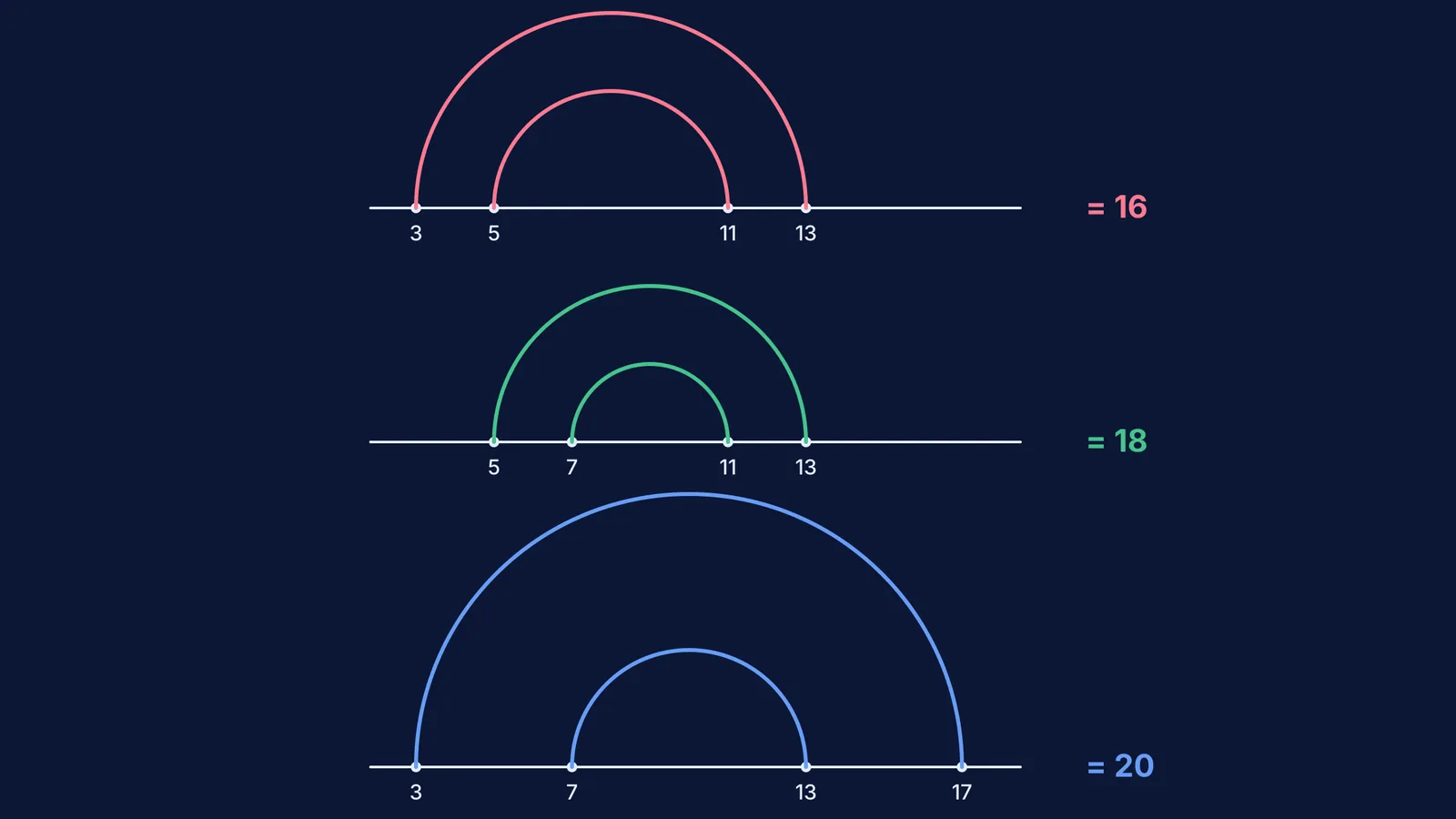
You can test the conjecture easily with a pencil and paper. Take 10: it is 5 + 5, or 3 + 7. Take 20: it is 3 + 17, or 7 + 13. The larger the even number, the more pairs of primes you can usually find.
Computers have taken this brute-force checking to extreme lengths. In 2013, Tomás Oliveira e Silva ran a distributed computer search that verified the conjecture holds for all natural numbers up to 4 × 10¹⁸ (Wikipedia).
But verifying numbers one by one is not a proof. Mathematics requires a logical argument that shows the rule must be true for every even number, out to infinity. Prime numbers are the building blocks of multiplication, but the conjecture asks how they behave under addition. This mismatch between adding and multiplying is why the pattern is so hard to pin down in a universal rule, much like Grigori Perelman's long path to proving the Poincaré conjecture.
How to get unstuck on a maths problem?
If Euler could not prove his own theorem, it is perfectly normal for you to get stuck on a difficult proof or numerical problem in your own study. The key is how you respond to hitting a wall.
Even great mathematicians collaborated when stuck. Goldbach and Euler exchanged ideas to refine the conjecture, setting a precedent for how Paul Erdős linked mathematicians to solve problems centuries later. Other deep challenges in number theory, such as S. S. Pillai's work on Waring's problem, show how progress is often a shared effort.
When you do not know where to start today, staring at a blank page rarely helps. Fermi's AI tutor can work out what you already know and build a plan for the session.
If you are stuck on a specific mathematical proof, the Fermi Problem Library provides worked problems with a step-by-step solver that explains the reasoning rather than printing an answer. The tutor holds a line of reasoning across a whole session, notices where you are stuck, and decides whether to explain, ask, or show the next step.
Mathematics is not about never getting stuck; it is about building the tools to puzzle your way out.