

On this page
An arithmetic progression is a sequence of numbers where each term increases by the same fixed common difference, such as 3, 7, 11, 15. In school mathematics, students explore these sequences in arithmetic progressions in Class 10 to calculate nth terms and sums. Prime numbers, by contrast, appear unpredictably without any simple repeating formula.
For centuries, mathematicians wondered whether prime numbers could contain arithmetic progressions of arbitrary length. On April 8, 2004, mathematicians Ben Green and Terence Tao posted a preprint on arXiv, later published in the Annals of Mathematics, proving that primes contain arithmetic progressions of any finite length. Known as the Green-Tao theorem, this result proved that no matter how long a target sequence you choose, primes of equal spacing exist to match it.
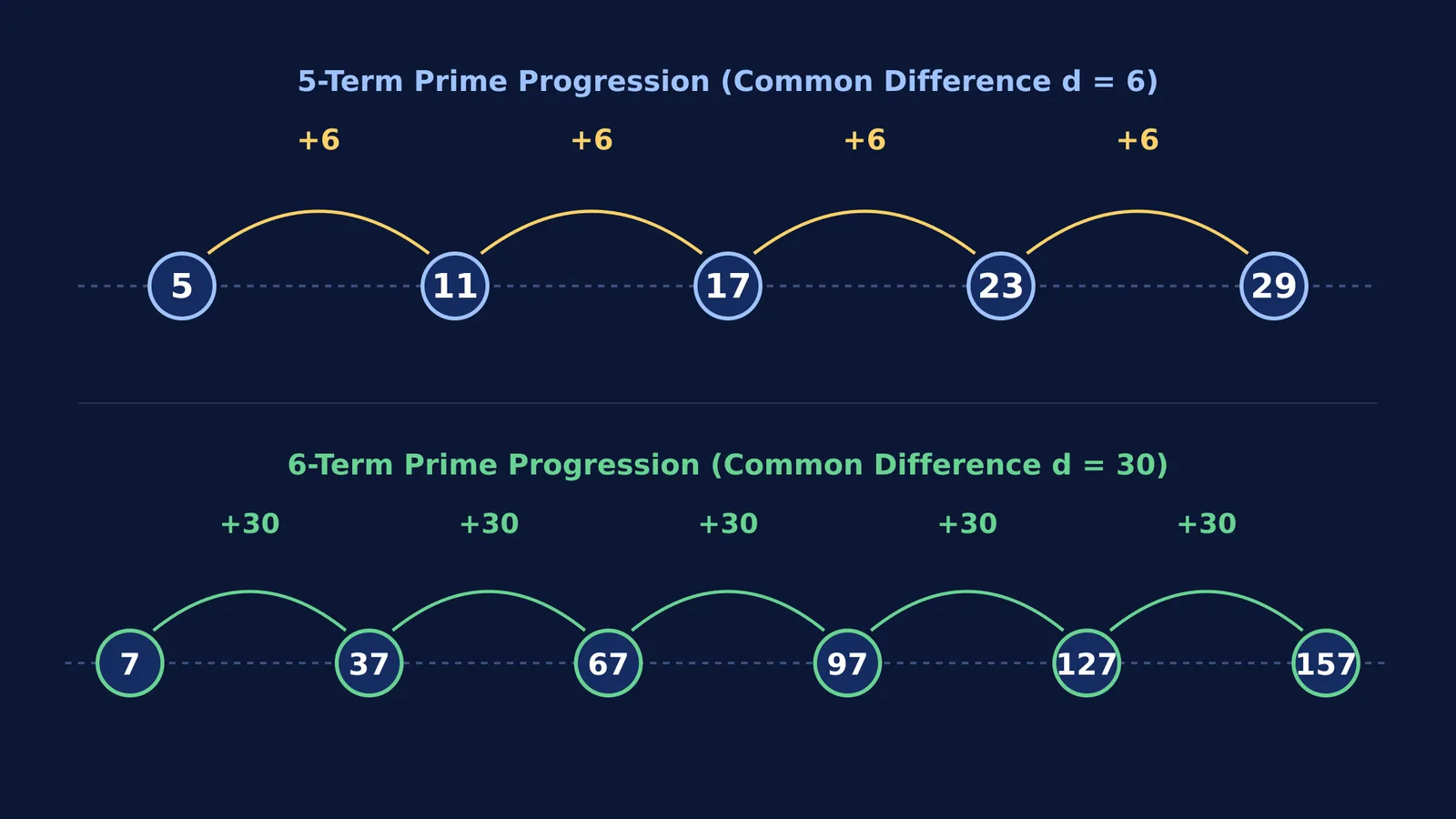
Examples of prime progressions include:
Length 3: 3, 5, 7 with common difference 2
Length 5: 5, 11, 17, 23, 29 with common difference 6
Length 6: 7, 37, 67, 97, 127, 157 with common difference 30
Length 10: 199, 409, 619, 829, 1039, 1249, 1459, 1669, 1879, 2089 with common difference 210
The theorem is non-constructive: it proves these progressions exist without providing an algorithm to generate them. According to the PrimePages record database, computational searches have confirmed prime progressions up to a record length of 27 primes, discovered in September 2019.
Why could Szemerédi's theorem not apply directly to primes?
In 1936, Hungarian mathematicians Paul Erdős and Pál Turán conjectured in the Journal of the London Mathematical Society that any set of integers with positive upper density contains arbitrarily long arithmetic progressions. Erdős spent decades advancing combinatorial number theory, as seen in Paul Erdős and collaborative mathematics.
In 1953, Klaus Roth proved the conjecture for progressions of length 3 in the Journal of the London Mathematical Society. In 1975, Endre Szemerédi proved the full conjecture for any length in Acta Arithmetica. Szemerédi's theorem, however, required positive density—meaning the subset must make up a permanent, non-zero percentage of the integers.
Primes fail this condition. According to the Prime Number Theorem on PrimePages, the count of primes up to N is approximately N / ln N. As N grows, the density of primes among integers drops toward 0%. Because primes thin out to zero density, Szemerédi's theorem could not be applied to them directly.
How did Green and Tao prove arithmetic progressions exist?
Green and Tao overcame this barrier in their Annals of Mathematics paper using the Transference Principle. Instead of examining primes inside all integers, they embedded them inside a pseudorandom superset of "almost primes"—numbers with few prime factors, constructed using sieve methods developed by Daniel Goldston and Cem Yalçın Yıldırım.
Green and Tao proved that this superset distributes like a random set of integers. They then transferred Szemerédi's theorem into this sparse environment, proving that any subset holding a positive relative fraction of a pseudorandom set contains arbitrarily long progressions. Because primes make up a positive relative fraction of almost primes, long progressions were guaranteed.
In August 2006, the International Mathematical Union awarded Terence Tao the Fields Medal for his mathematical contributions, highlighting his work in additive number theory. Understanding prime structures also underpins modern cryptography, as shown in how RSA locks a message with primes.
Why must the common difference share factors with small primes?
The structure of prime progressions reveals a modular arithmetic rule directly accessible to school students. As documented in Wolfram MathWorld, the common difference of a prime progression must share factors with small primes to avoid composite terms.
For an arithmetic progression of k primes, a, a+d, a+2d, ..., a+(k-1)d, where the starting prime a is strictly greater than k, the common difference d must be divisible by every prime p ≤ k:
If a prime p ≤ k does not divide d, the terms a, a+d, ..., a+(p-1)d leave distinct remainders modulo p.
One term must have remainder 0, making it a multiple of p.
Since every term is prime and strictly greater than p, this is impossible unless p divides d.
Therefore, d must be divisible by all primes p ≤ k, meaning d is a multiple of the primorial k#.
For a 5-term progression starting above 5, d must be a multiple of 2 × 3 × 5 = 30. For a 10-term progression starting above 10, d must be a multiple of 2 × 3 × 5 × 7 = 210.
How can you solve sequence and divisibility problems?
When tackling sequence and divisibility problems for competitive exams like JEE, follow this systematic framework:
Check modular constraints: Test small moduli (2, 3, 5) to spot terms forced into composite values.
Verify initial terms: Check whether the first term is a small prime before computing minimal common differences.
Match primorial multiples: Ensure the common difference accounts for all prime divisors below the sequence length.
Map steps logically: Write each algebraic step explicitly to verify no modular collisions arise.
If you are preparing for exams like JEE and get stuck on progression proofs, Fermi's AI tutor can work out what you already know and build a plan for the session so you sit down to a clear next step. When practising sequence problems, the Fermi Problem Library provides worked problems with a step-by-step solver that explains the reasoning rather than printing an answer. To strengthen foundational knowledge across algebra and number patterns, the Fermi Concept Library maps every concept in physics, chemistry, biology, mathematics and computing, each with its own lesson and place in the map.


