On this page
Your Class 6 maths book already asks you to do this. In the first chapter of NCERT's Ganita Prakash, you write the next three numbers of each sequence and then "write in your own words what is the rule for forming the numbers in the sequence" (NCERT, Ganita Prakash Grade 6, Chapter 1). The same chapter describes mathematics as "in large part, the search for patterns, and for the explanations as to why those patterns exist."
AI can help with the checking. The skill is in the finding, so keep that part for yourself.
Why should you find the rule before asking AI?
If you type a sequence into a chatbot and ask "what's the rule?", you skip the thinking the exercise is there to build. If you find the rule first, the AI becomes a checker instead of an answer key.
For parents: this works best with an adult nearby for the first few sessions. Our guide to supervised AI study for Class 6 to 8 covers how to set that up.
What goes wrong when you only check examples that fit?
In 1960 the psychologist P. C. Wason gave 29 young adults a simple rule-finding task in which the examples were numbers (Wason, Quarterly Journal of Experimental Psychology, 1960). Only 6 of the 29 reached the correct rule without first reaching a wrong one. According to the paper's abstract, those who reached two or more wrong conclusions were "unable, or unwilling to test their hypotheses."
The lesson for a Class 6 student is simple. Examples that fit your rule cannot prove it. You learn the most from a case that could break it. That is why the most useful question to ask an AI is not "am I right?" but "show me where my rule fails."
Can a pattern start 1, 2, 4, 8, 16 and stop doubling?
Say you are given 1, 2, 4, 8, 16. Your rule: each number is double the one before. Your predictions: 32, 64, 128. The AI will probably agree, and so does your textbook, which lists 1, 2, 4, 8, 16, 32, 64 as the powers of 2 (NCERT, Chapter 1, Table 1).
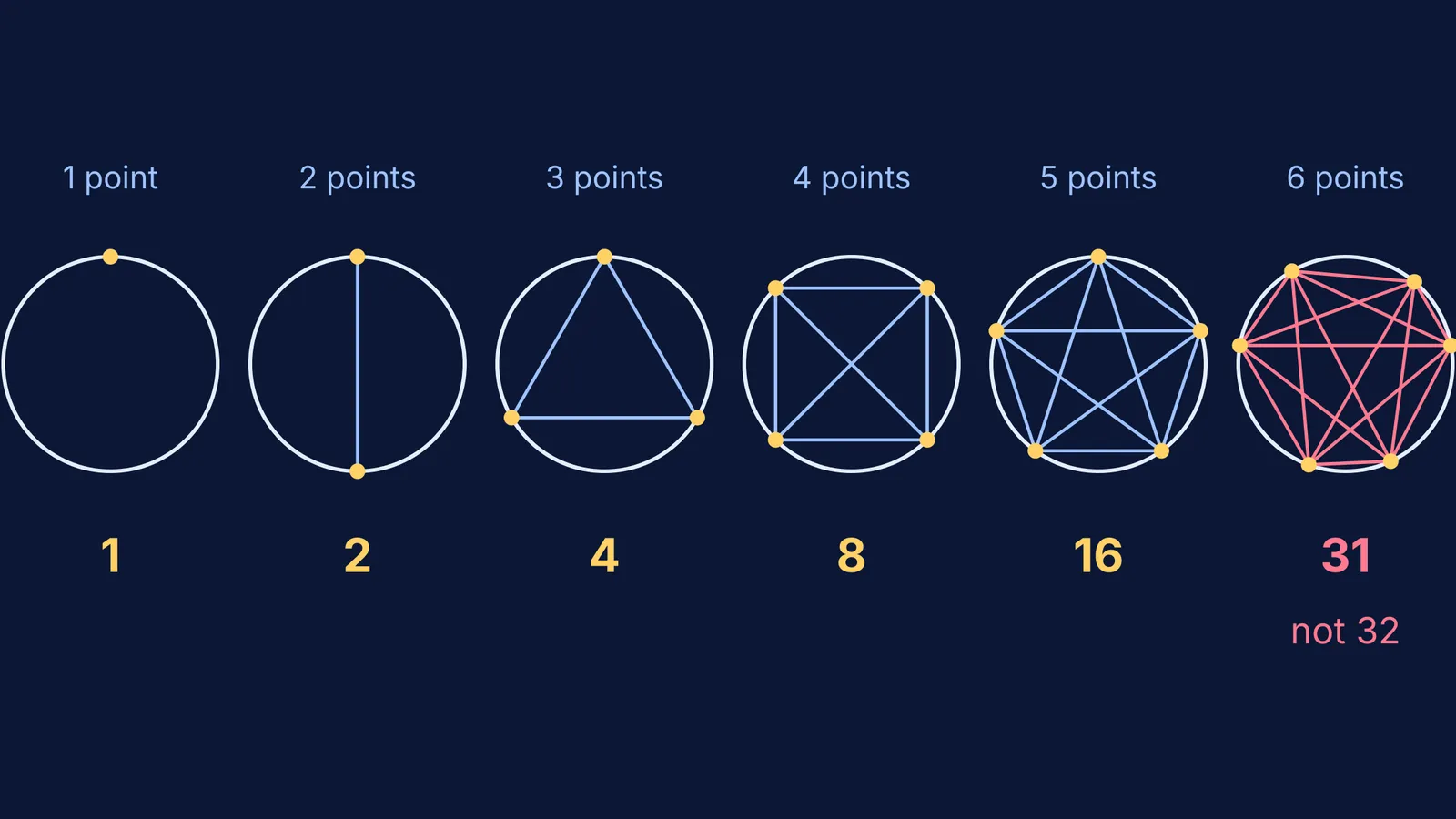
Now ask for a pattern that starts the same way but breaks your rule. A good answer is the circle-and-chords puzzle. Mark points around a circle, join every pair with a straight line, and count the regions inside. With 1, 2, 3, 4 and 5 points, the most regions you can get are 1, 2, 4, 8 and 16. With 6 points the most is 31, not 32 (OEIS A000127).
The count follows a different rule: 1, plus the number of lines, plus the number of points where two lines cross. With 6 points there are 15 lines and at most 15 crossings, so 1 + 15 + 15 = 31.
Try drawing it yourself. Space the six points unevenly. If they are evenly spaced, three lines meet at the centre and you only get 30 regions (OEIS A006533).
Your doubling rule fits the powers of 2. The first five terms just cannot tell the two patterns apart.
What should you type into the AI?
Here is a script for the triangular numbers 1, 3, 6, 10, 15, which are also in Table 1 of the chapter.
"Here is a sequence: 1, 3, 6, 10, 15. My rule is: add 2, then 3, then 4, and so on. My next three terms are 21, 28, 36. Do not give me a new rule. Just check whether my terms follow my rule."
"Test my rule on the next five terms and show each addition."
"Give me a sequence that starts with the same numbers as mine but breaks my rule later. Explain the other rule in words a Class 6 student can follow."
"Ask me one question that would help me explain why my rule works."
Then check the AI's working. It can make arithmetic slips, so redo one or two additions by hand and draw any example it gives before you believe it.
How do you know your rule is really right?
Before you write the rule in your notebook, check:
Your rule is written in words a friend could follow without asking you.
You predicted the next terms before checking them.
You tested at least one case that could have failed.
You can explain why the rule works, ideally with a picture. The chapter draws triangular numbers as triangles of dots, and each new row has one more dot than the row above it.
For more practice, see how to find the nth term of matchstick patterns and how to test a sequence for a constant difference.
If you get stuck on the "why" part, Fermi's AI tutor is built to teach rather than just answer. It notices where you are stuck, decides whether to explain, ask or show, and draws the figure as it goes, so the explanation stays yours.
Next time you meet a pattern, write your rule first, then make the AI try to break it.