

On this page
Matchstick patterns bridge the vital gap between counting physical objects and writing formal algebra. By observing how a geometric shape grows step by step, students learn to find the "nth term"—a general mathematical rule that predicts the exact number of sticks needed for any shape in a sequence without ever having to draw it out.
This visual approach is central to early algebra. According to the CBSE Class 6 Mathematics syllabus, finding the common difference in a matchstick sequence is the very first step to writing a linear expression. Once students master this, they can translate physical rules into variables.
What is the rule for a matchstick pattern?
When a matchstick pattern grows by the exact same amount each time, it forms an arithmetic sequence. The rule for this uniform sequence is always written in the linear form an + b.
n: The step number or position in the pattern (Shape 1, Shape 2, Shape 3...).
a: The common difference (the constant number of matchsticks added to build each new shape).
b: The starting adjustment (a constant added or subtracted to make the rule work for the very first shape).
Once you have this algebraic rule, you can instantly find the total sticks for the 100th or 1,000th shape without counting. This foundational logic also appears in other early topics, such as the numerical sequences taught in Patterns in mathematics: Class 6 Ganita Prakash, Chapter 1.
How do you find the nth term of a matchstick pattern?
To find the an + b rule for any linear pattern, follow this two-step framework:
Find the common difference (a): Count the matchsticks in the first few shapes. Find out exactly how many sticks are added from one shape to the next. Because this addition happens for every new step n, this constant difference becomes the multiplier in front of n.
Find the adjustment (b): Test your new rule on the first shape (n = 1). Multiply your common difference by 1. If the result does not match the actual number of sticks in the first shape, find the difference and add or subtract it to get b.
How do you find the rule for connected squares?
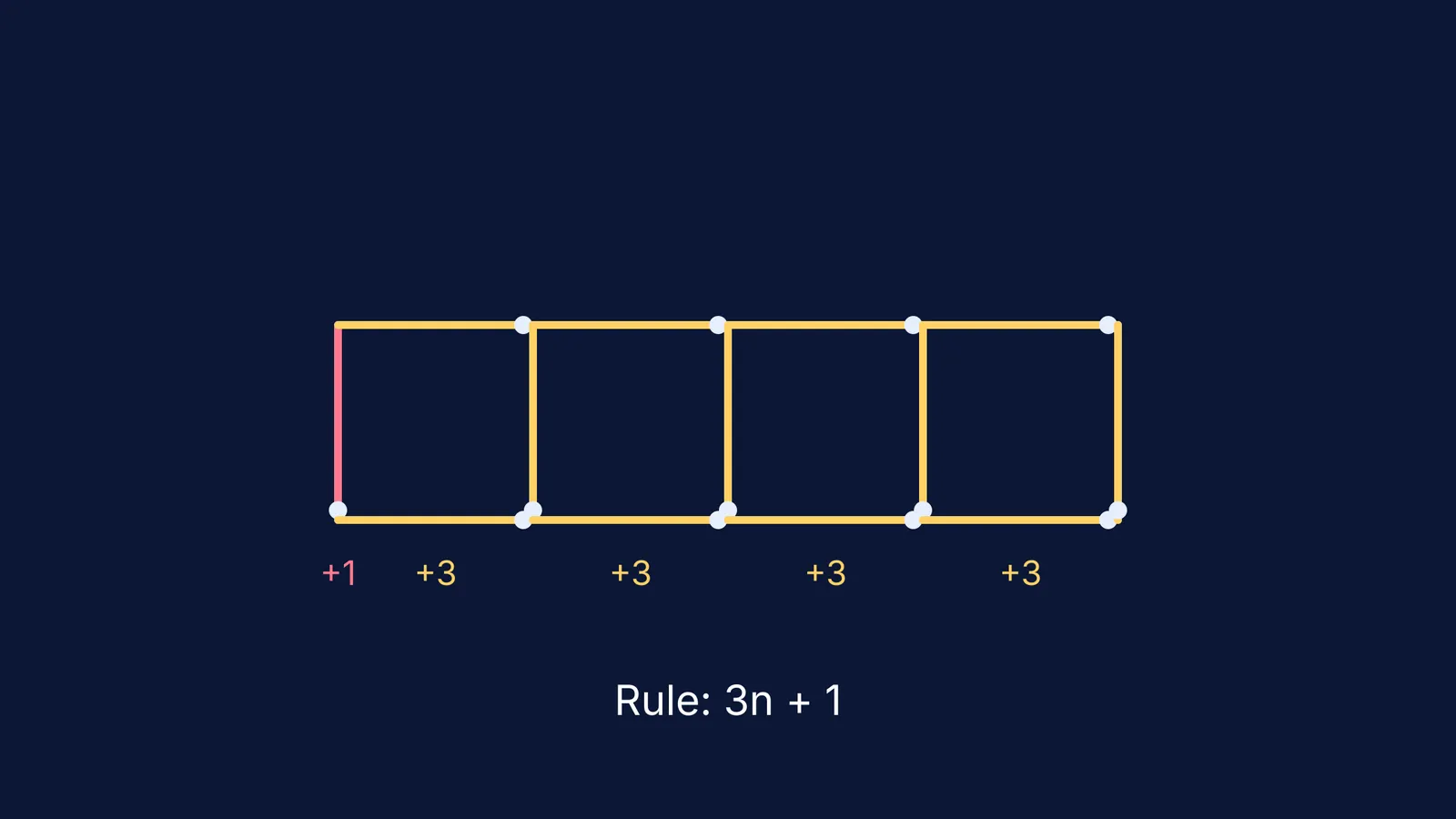
Connected shapes share common matchsticks, which completely changes the counting logic from isolated shapes. Exercise 11.1 in the NCERT Class 6 Mathematics textbook asks students to find the rule for a row of connected squares.
Here is how the shapes grow:
Shape 1 (1 square): 4 matchsticks
Shape 2 (2 squares): 7 matchsticks (they share one vertical side)
Shape 3 (3 squares): 10 matchsticks
Step 1: Find the difference. Going from 4 to 7, and 7 to 10, the pattern adds exactly 3 sticks each time. Therefore, the common difference a = 3, and the rule starts with 3n.
Step 2: Find the adjustment. For Shape 1 (n = 1), the rule 3n calculates 3 × 1 = 3. However, the first shape actually requires 4 sticks. To turn 3 into 4, you must add 1. Therefore, the adjustment b = 1.
The final rule is 3n + 1.
Visually, this means you need 1 starting vertical stick, plus 3 matchsticks (a "C" shape) for every square n you want to build. You can use similar logic for larger geometric areas later on; Squares and square roots in Class 8: patterns and methods builds directly on this algebraic thinking.
How do you apply the rule to connected triangles?
The exact same framework works for any regular polygon. Imagine a pattern of connected triangles lined up in a row.
Shape 1 (1 triangle): 3 matchsticks
Shape 2 (2 triangles): 5 matchsticks
Shape 3 (3 triangles): 7 matchsticks
Following the framework, we first find the common difference. The sequence 3, 5, 7 grows by 2 each time, meaning a = 2. Next, we test the rule 2n on the first shape. For n = 1, 2 × 1 = 2. Because the first shape actually has 3 sticks, we must add 1 to make the formula work. The rule is therefore 2n + 1.
Why is finding the nth term hard?
While middle school students are often successful at finding the next terms in a geometric pattern by adding a constant, they frequently struggle to write the formal algebraic rule that links the step number directly to the total. It is easy to notice "+3", but much harder for a beginner to understand why it translates into the algebraic term 3n instead of n + 3. The leap from seeing a recursive pattern to writing a functional equation requires a fundamental shift in how students think about variables.
When a student is stuck on a sequence, Fermi's AI tutor does not just hand over the an + b formula. Instead, it asks them to physically build the next shape and count the difference. If they can spot the +3 but cannot write the final expression, the tutor draws the pattern on its interactive board, highlighting the starting stick to connect the physical shapes directly to the algebra. For more guided practice with linear sequences and formal rules, students can explore the step-by-step solver in the Fermi Problem Library.


