On this page
India's first home-built aircraft carrier meant solving three problems: a warship steel India had long imported, a hull too big to build in one piece, and engines strong enough to push about 45,000 tonnes through the sea. Here is how each was handled, plus a physics problem built from the ship's own numbers.
How was INS Vikrant built, step by step?
The carrier was designed by the Navy's in-house Directorate of Naval Design and built by Cochin Shipyard Limited in Kochi, according to the Ministry of Defence release on its delivery. The same release gives the key facts:
INS Vikrant is 262 m long, with a full displacement of close to 45,000 tonnes.
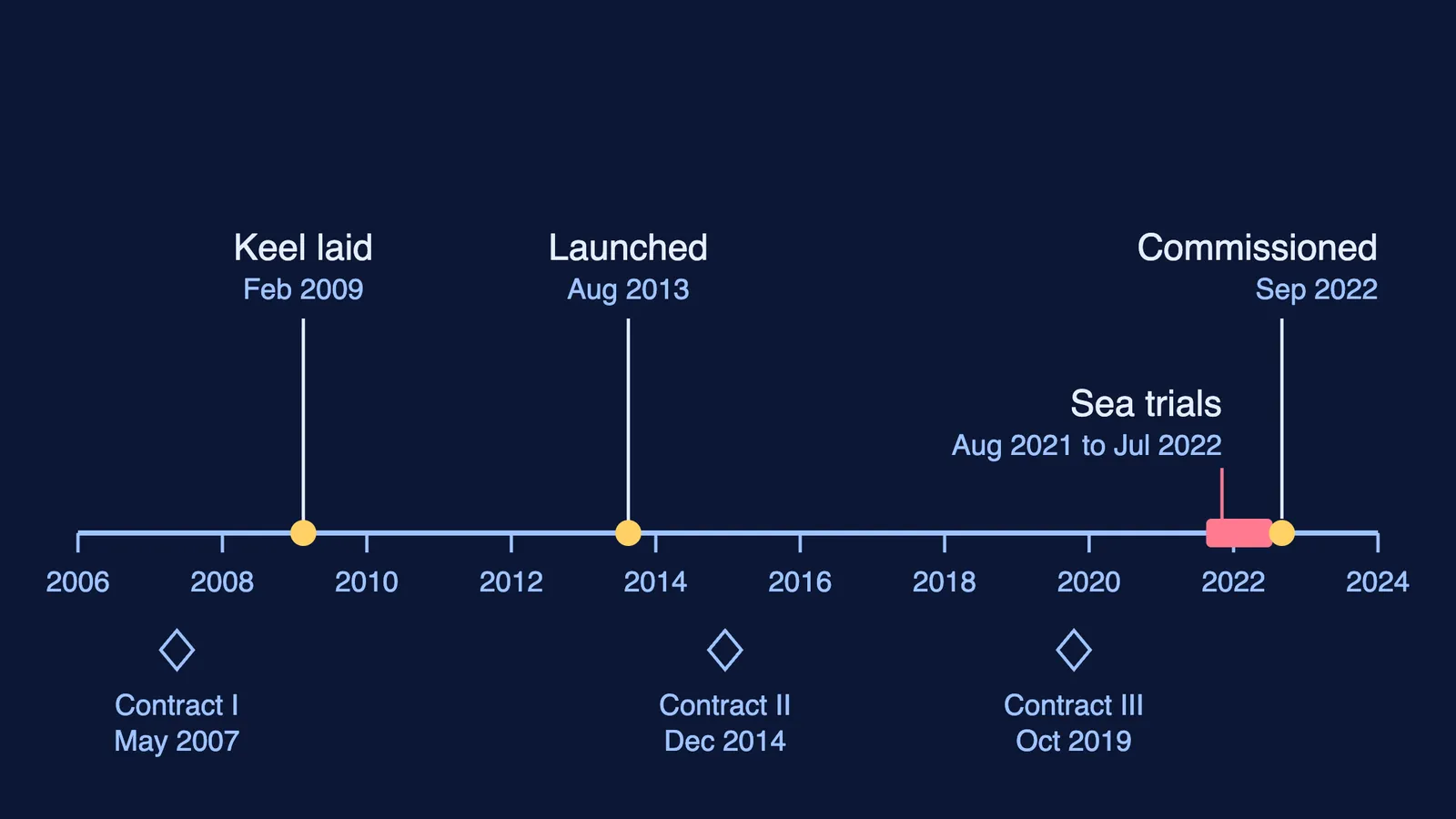
The project ran in three contract phases, signed in May 2007, December 2014 and October 2019.
The keel was laid in February 2009 and the ship was launched in August 2013.
User acceptance trials ran from August 2021 to July 2022, and the ship was delivered on 28 July 2022.
The overall cost was close to Rs 20,000 crore, with an indigenous content of 76%.
The ship was commissioned on 2 September 2022, as GE's press release that day records.
What is special about warship steel?
Warship steel must be hard and also tough, stay that way at minus 60 degrees Celsius, and resist seawater corrosion, as Business Standard reported from the Bhilai Steel Plant in 2013. India long imported it. In 1999 DRDO began a project to make it at home: Russia supplied the chemical formula of a warship steel called ABA, and DRDO's Defence Metallurgical Research Laboratory worked with SAIL to turn that formula into plate at scale. Bhilai developed a continuous casting route that made the steel affordable, while Rourkela's Special Plate Plant quenches and tempers thicker plates, up to 120 mm.
Vikrant uses three grades, according to that report:
DMR 249A for the hull and body.
DMR 249B, a more resilient grade, for the flight deck, which takes the repeated impact of 20-30 tonne fighters landing.
DMR Z25 for the floors of compartments holding engines and generators.
SAIL plants at Bhilai, Rourkela, Durgapur and Bokaro made 26,000 tonnes of this steel for the ship, the report says. SAIL's then chairperson, C S Verma, told the paper: "Our steel costs twice as much as normal steel, but is still half the cost of imported warship steel." By 2022 the Ministry of Defence said every warship being built in India used indigenous steel.
How do you build a ship from blocks?
The hull was made as large steel blocks that are fabricated separately and then erected, or joined, in the building dock. A PIB feature written at the 2013 launch lists "the fabrication and erection of the large blocks" among the project's challenges. It says Cochin Shipyard developed new weld procedures, introduced automation to ensure the quality of welding, and used "grand assembly of blocks and pre-outfitting" to raise production rates.
The structure holds about 2,300 compartments, the feature says, and by the launch over 80% of it had been fabricated and over 75% erected. Elecon in Gujarat supplied the main gearbox.
What engines drive INS Vikrant?
Four LM2500 gas turbines give the ship 88 MW and a maximum speed of 28 knots, according to GE's commissioning release. The turbine kits were made at GE's Evendale, Ohio facility and assembled and tested by HAL's Industrial and Marine Gas Turbine Division in Bangalore.
A gas turbine compresses air, burns fuel in it and lets the hot gas spin a turbine: the Brayton cycle behind gas turbine power plants. On a ship, that turbine turns propeller shafts through a gearbox instead of a generator.
Worked example: what force do 88 MW push against?
You can estimate the water's resistance at top speed with P = Fv, the same relation used in JEE power problems.
Convert speed. One knot is 1852 m per 3600 s (UK Metric Association table of non-SI units), so 28 knots = 28 × 1852 / 3600 = 14.4 m/s.
Rearrange: F = P / v = 88,000,000 W / 14.4 m/s.
Result: F is about 6.1 × 10^6 N, or 6.1 meganewtons.
Sense check: the ship's weight is 45,000,000 kg × 9.8 m/s² ≈ 4.4 × 10^8 N, so the push is roughly 1/70th of its weight.
This is an upper limit: P = Fv assumes every watt becomes forward push, but gearboxes and propellers lose some of it. Try it yourself: if drag grows roughly as v², power grows roughly as v³. Estimate the power needed at 14 knots (answer: about 11 MW).
If you get stuck setting up P = Fv or converting units, the Fermi Problem Library has worked problems with a step-by-step solver that explains the reasoning rather than printing an answer.
Next, see why a tall, heavy hull stays upright in how container ships stay stable, and what the ship is for in how jets take off and land on an aircraft carrier.