On this page
Hubble was launched on 24 April 1990, and its first pictures were blurred. NASA's account of Hubble's mirror flaw says that two months later, on 27 June 1990, the agency announced the telescope was flawed. How a tiny error was found and cancelled in orbit is a lesson in measurement.
What exactly was wrong with Hubble's mirror?
Hubble's primary mirror is a 2.4-metre disk of ultra-low-expansion glass, according to NASA's Hubble mirror flaw page. It was polished to the wrong shape: too flat near its outer edge.
The mirror's edge was flattened by a depth of 2.2 microns, roughly one-fiftieth the thickness of a human hair, according to NASA's Servicing Mission 1 page.
That sounds like nothing until you compare it with light. The NASA failure report states the mirror's error in waves of red light of wavelength 632.8 nanometres. 2.2 microns is 2,200 nanometres, and 2,200 ÷ 632.8 ≈ 3.5, so the edge was out by about three and a half wavelengths of that light. NASA says the error was 10 times larger than the specified tolerance the design needed (NASA).
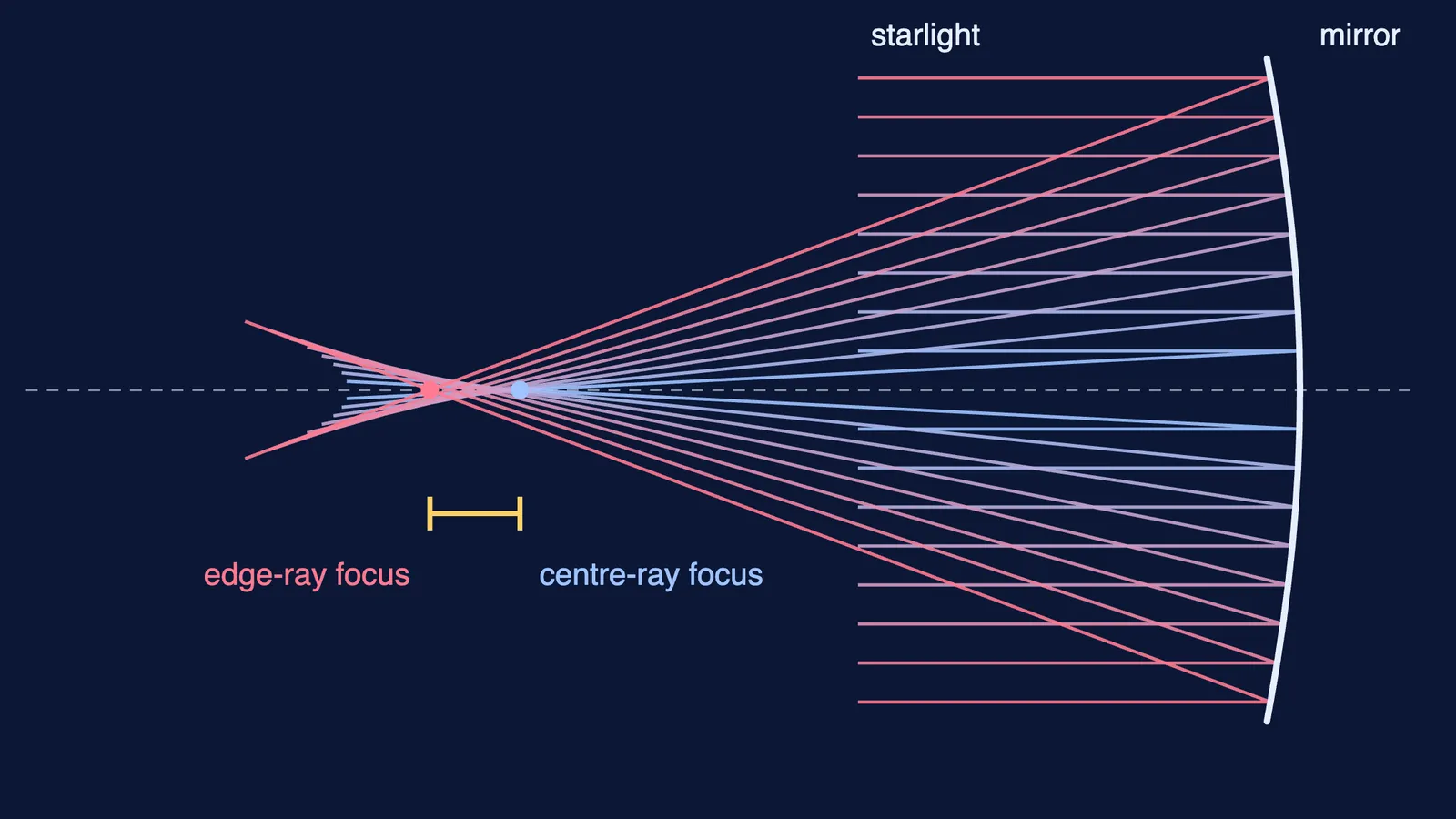
The result is called spherical aberration. Light reflected from the edge of the mirror comes to a focus at a different distance from light reflected near the centre, so no single position gives a sharp image. You may have learned that mirrors have no chromatic aberration while lenses do; Hubble shows that a mirror can still blur light if its shape is wrong.
If ray diagrams like this are hard to picture from a textbook, the Fermi Simulation Lab has interactive simulations for ideas that are easier to see than to read.
How did astronomers work out what had gone wrong?
The first clue was in the pictures. Both of Hubble's imaging cameras showed the same characteristic distortion, according to NASA, so the fault had to lie in the telescope's mirrors, not in either camera.
On 2 July 1990 NASA formed the Hubble Space Telescope Optical Systems Board of Investigation. The mirror was in orbit, so the board worked from evidence on the ground. The key piece was the null corrector, the device used at the factory to test the mirror's curve. Investigators found it undisturbed, in the same configuration as when the mirror was tested nine years earlier (NASA).
The board's report, The Hubble Space Telescope optical systems failure report (NASA, November 1990), found that a lens in this reflective null corrector was incorrectly spaced from its mirrors. The measured error, 1.3 mm, "accounts in detail for the amount and character of the observed image blurring." The polishers had shaped the mirror to match a faulty reference.
The most uncomfortable finding is that there were warnings. The same report says an inverse null corrector "clearly showed the error in the reflective null corrector", and a second null corrector "clearly showed the error in the primary mirror." Both indicators of error were "discounted at the time as being themselves flawed." The report adds that great concern about cost and schedule discouraged independent tests.
How was Hubble fixed in 1993?
Because the error was known so precisely, it could be cancelled. NASA says the team building the Wide Field and Planetary Camera 2 (WFPC2) redesigned it to include internal optics that brought Hubble's blurry data into focus. NASA describes the second device, COSTAR, as acting like a pair of eyeglasses for Hubble's other instruments.
COSTAR placed five pairs of corrective mirrors in front of the Faint Object Camera, the Faint Object Spectrograph and the Goddard High Resolution Spectrograph, according to ESA/Hubble.
Space Shuttle Endeavour launched on mission STS-61 on 2 December 1993, and astronauts needed five back-to-back spacewalks totalling 35 hours and 28 minutes to finish the work (NASA Servicing Mission 1). With COSTAR installed, all of Hubble's scientific instruments received focused light.
What can your own lab work learn from Hubble's mistake?
Your physics practicals hold the same trap: a systematic error, where the measuring tool itself is off, so every reading agrees and every reading is wrong. A five-step check from the Hubble story:
Test the tester. Check the zero error of a vernier calliper or screw gauge before measuring anything.
When two methods disagree, find out why. Hubble's two warnings were dismissed as faulty.
Get an independent check, as in finding the error in g from a simple pendulum.
Record your setup: each instrument, its least count and its position. The untouched null corrector is what let investigators find the slip.
Measure the error, then correct for it. A known zero error is subtracted from every reading, just as Hubble's optics cancelled a known flaw.
When a numerical goes wrong because of the method rather than the arithmetic, the Fermi Problem Library has worked problems with a step-by-step solver that explains the reasoning rather than printing an answer.
To see why astronomers go to such lengths to get above the air at all, read why observatories are built on high mountains.