On this page
A magnifying glass focusing a bright light often leaves a faint coloured rim; a concave mirror does not. The reason fits in one line of physics, and it explains why the largest telescopes are built around mirrors.
Why does a mirror's focal length not depend on wavelength?
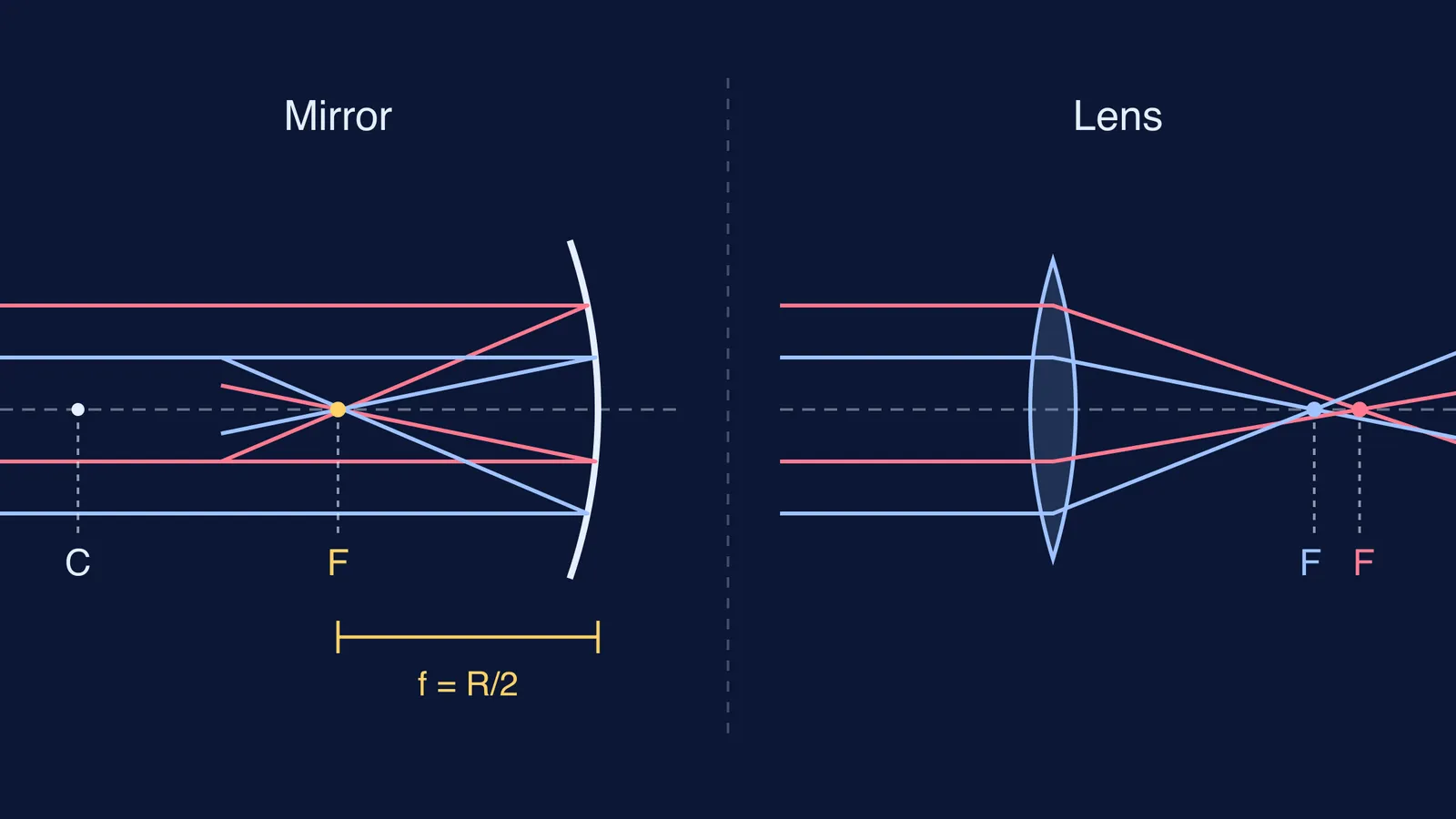
For a concave spherical mirror, the focal length is half the radius of curvature, f = R/2, for rays close to the axis (OpenStax University Physics, Spherical Mirrors).
Only geometry goes into that result. The normal at every point of a spherical mirror passes through the centre of curvature C, and the angle of reflection equals the angle of incidence. With small angles, that puts the reflected ray through the point halfway between C and the mirror. No property of the light appears in the derivation.
The law of reflection is independent of wavelength, so mirrors do not suffer from chromatic aberration (OpenStax College Physics, Aberrations). Red, yellow and blue light all reflect at the same angle and meet at the same focus.
One caveat: a spherical mirror that is large compared with its radius of curvature still shows spherical aberration, because far-out rays do not cross at the same point (OpenStax, Spherical Mirrors). That is a shape problem, the same for every colour.
Why do lenses have chromatic aberration?
A lens works by refraction, and for a thin lens in air its focal length comes from the lensmaker's equation, 1/f = (n − 1)(1/R1 − 1/R2) (OpenStax University Physics, Key Equations). The radii are fixed by the shape of the glass, but n is not one number.
Because the refractive index of glass depends on wavelength, a lens forms images of different colours at different places and with different magnifications (OpenStax College Physics, Aberrations). This is dispersion, the effect that lets a prism split white light.
For SCHOTT N-BK7, a common crown glass, the refractive index is 1.52238 at 486.1 nm (blue), 1.51680 at 587.6 nm (yellow) and 1.51432 at 656.3 nm (red) (SCHOTT N-BK7 data). Blue bends more, so it focuses closer to the lens.
Worked example: how far apart are the colour foci?
Take an N-BK7 lens with R1 = +20 cm and R2 = −20 cm. Then 1/R1 − 1/R2 = 2/20 = 1/10 per cm, so f = 10 cm ÷ (n − 1). Using the SCHOTT N-BK7 indices:
Blue (486.1 nm): f = 10 ÷ 0.52238 ≈ 19.14 cm
Yellow (587.6 nm): f = 10 ÷ 0.51680 ≈ 19.35 cm
Red (656.3 nm): f = 10 ÷ 0.51432 ≈ 19.44 cm
The blue and red foci sit about 0.30 cm, or 3 mm, apart. Now take a concave mirror with R = 40 cm: f = R/2 = 20 cm for blue, yellow and red alike. No colour spread at all. With a sensor at the yellow focus, the lens turns blue and red points into small blurred discs: the coloured fringe around bright edges.
Why do big telescopes use mirrors instead of lenses?
Colour was the first reason. Isaac Newton concluded that any lens would disperse the colours of light, so the image of a white star would always show a smear of colours, and he presented a reflecting telescope to the Royal Society in January 1672 (AIP, Early Reflectors). Better glass later revived refractors, but size settled the question.
A lens can only be held at its edges, so a big lens sags under its own weight; a mirror can be supported across its whole back face (Wikipedia, Lens sag).
Light has to pass through a lens, and thicker glass stops more of it; a mirror only needs a good reflecting surface (NASA Space Place).
It is much easier to make a large, near-perfect mirror than a large, near-perfect lens (NASA Space Place).
The 40-inch (about 1 m) Great Refractor at Yerkes Observatory, dedicated in 1897, remains the largest refracting telescope in the world (Astronomy magazine). India's largest telescope for optical astronomy, the 3.6 m Devasthal Optical Telescope in Nainital district, has a primary mirror 3.6 m across and was commissioned in 2016 (ARIES). ESO's Extremely Large Telescope has a 39-metre main mirror made of 798 segments (ESO ELT facts).
How do you write this answer in an exam?
A CBSE or JEE Main short answer needs three links in the chain:
Mirror: f = R/2 comes from reflection and geometry; no refractive index appears.
Lens: f depends on n, and n depends on wavelength (dispersion), so f differs by colour.
Conclusion: lenses show chromatic aberration; mirrors do not, though spherical mirrors can show spherical aberration.
Do not write "mirrors have no aberration"; they have no chromatic aberration. If you lose marks on reasoning questions like this, the Fermi Problem Library has worked problems with a step-by-step solver that explains the reasoning rather than printing an answer. If the gap is dispersion itself, the Fermi Concept Library gives every concept in physics its own lesson and its place in the map.
Next time you spot a coloured fringe, ask whether the light went through glass or bounced off a mirror.