On this page
Hermann Grassmann spent nearly his whole working life teaching school in Stettin, the Prussian port where he was born on 15 April 1809 and died on 26 September 1877, according to the MacTutor biography of Grassmann. In 1844 he published a book containing much of the vector algebra you meet in Class 11 and 12. Mathematicians largely ignored it.
Who was Hermann Grassmann?
Grassmann never trained in mathematics: MacTutor records that he studied theology, classical languages, philosophy and literature at the University of Berlin from 1827 to 1830. He became an assistant teacher at the Stettin Gymnasium in 1832, and at Stettin's new Otto Schule he later taught mathematics, physics, German, Latin and religious studies. In 1852 he was appointed to his late father's post at the Stettin Gymnasium, which carried the title of professor. He and his wife Therese had eleven children, seven of whom reached adulthood.
His first vector ideas appeared in an essay on the theory of the tides, for an 1840 teaching examination. MacTutor says it "introduced for the first time an analysis based on vectors, including vector addition and subtraction, vector differentiation, and vector function theory." The examiners accepted the essay and missed what was new in it.
What did Grassmann's 1844 book introduce?
The book was *Die lineale Ausdehnungslehre, ein neuer Zweig der Mathematik*, or "The Linear Theory of Extension, a New Branch of Mathematics". Desmond Fearnley-Sander's 1979 paper Hermann Grassmann and the Creation of Linear Algebra describes the methods Grassmann set out here and refined in 1862, in a passage MacTutor quotes: "He defines the notions of subspace, independence, span, dimension, join and meet of subspaces, and projections of elements onto subspaces." Grassmann also proved the result now called the Steinitz exchange theorem, named after the mathematician who published it in 1913.
MacTutor's history of abstract linear spaces adds that linear independence and dependence "are clearly contained in Grassmann's work as is the idea of dimension (although he does not use the term)." Grassmann also created what is now called exterior algebra.
In plain words:
A linear combination of vectors a and b is any xa + yb, where x and y are numbers.
The span of a set of vectors is every linear combination you can make from them.
Vectors are linearly independent if none of them is a linear combination of the others.
The dimension of a space is the largest number of linearly independent vectors it holds.
Why was Grassmann's work ignored?
MacTutor reports that August Möbius "did not understand the significance" of Grassmann's approach and declined to write a review. In 1847, when Grassmann sought a university post, Ernst Kummer read his 1846 prize essay on geometric analysis and found "commendably good material expressed in a deficient form". That report ended his hopes of a university post. His 1862 rewrite of the book fared no better.
Grassmann's recognition came from languages instead. He wrote a dictionary of the Rig-Veda, published in 1873, according to Wikipedia's article on Grassmann. He was elected to the American Oriental Society and given an honorary degree by the University of Tübingen.
The mathematics was taken up by Giuseppe Peano. His 1888 book on Grassmann's calculus gave the first axiomatic definition of a real linear space, and defined dimension exactly: "The number of the dimensions of a linear system is the maximal number of linearly independent objects in the system," as quoted in MacTutor's history of linear spaces.
How do you check linear independence in practice?
The test is a question: can one vector be built from the others? Take a = (1, 2, 3), b = (2, 1, 0) and c = (4, 5, 6).
Ask whether c = xa + yb for some numbers x and y.
Match components: x + 2y = 4, 2x + y = 5, and 3x = 6.
The third gives x = 2, the second y = 1, and the first checks: 2 + 2 = 4.
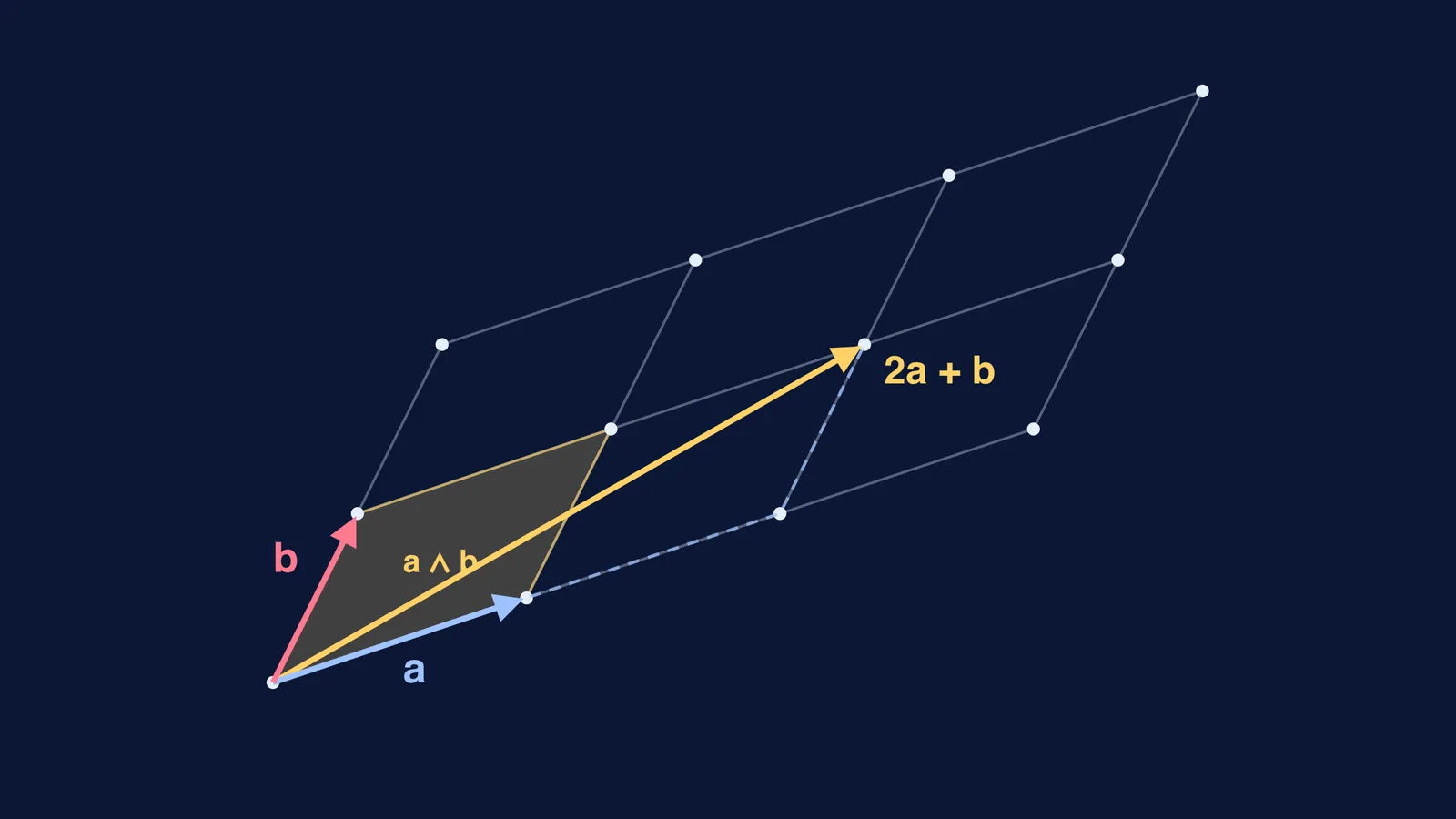
So c = 2a + b. The vectors are dependent and span only a plane, of dimension 2.
Confirm with the determinant of the rows: 1(6 - 0) - 2(12 - 0) + 3(10 - 4) = 6 - 24 + 18 = 0. A zero determinant means dependent.
Now change c to (4, 5, 7). The third equation gives x = 7/3, the first y = 5/6, and the second fails: 14/3 + 5/6 = 11/2, not 5. So the vectors are independent and span all of 3D space. The determinant agrees: 7 - 28 + 18 = -3.
The same idea sits under two exam skills: resolving a vector along two non-perpendicular axes is writing it as a linear combination, and the exterior product a ∧ b stands for the parallelogram on a and b, whose area comes from the cross product method for parallelograms. Next, read how James Joseph Sylvester coined the word matrix.
If span and independence still feel abstract, the Fermi Concept Library gives each concept in mathematics its own lesson and its place in the map, so you see what vectors connect to.
Try the test on three vectors from your textbook before reaching for the determinant.