On this page
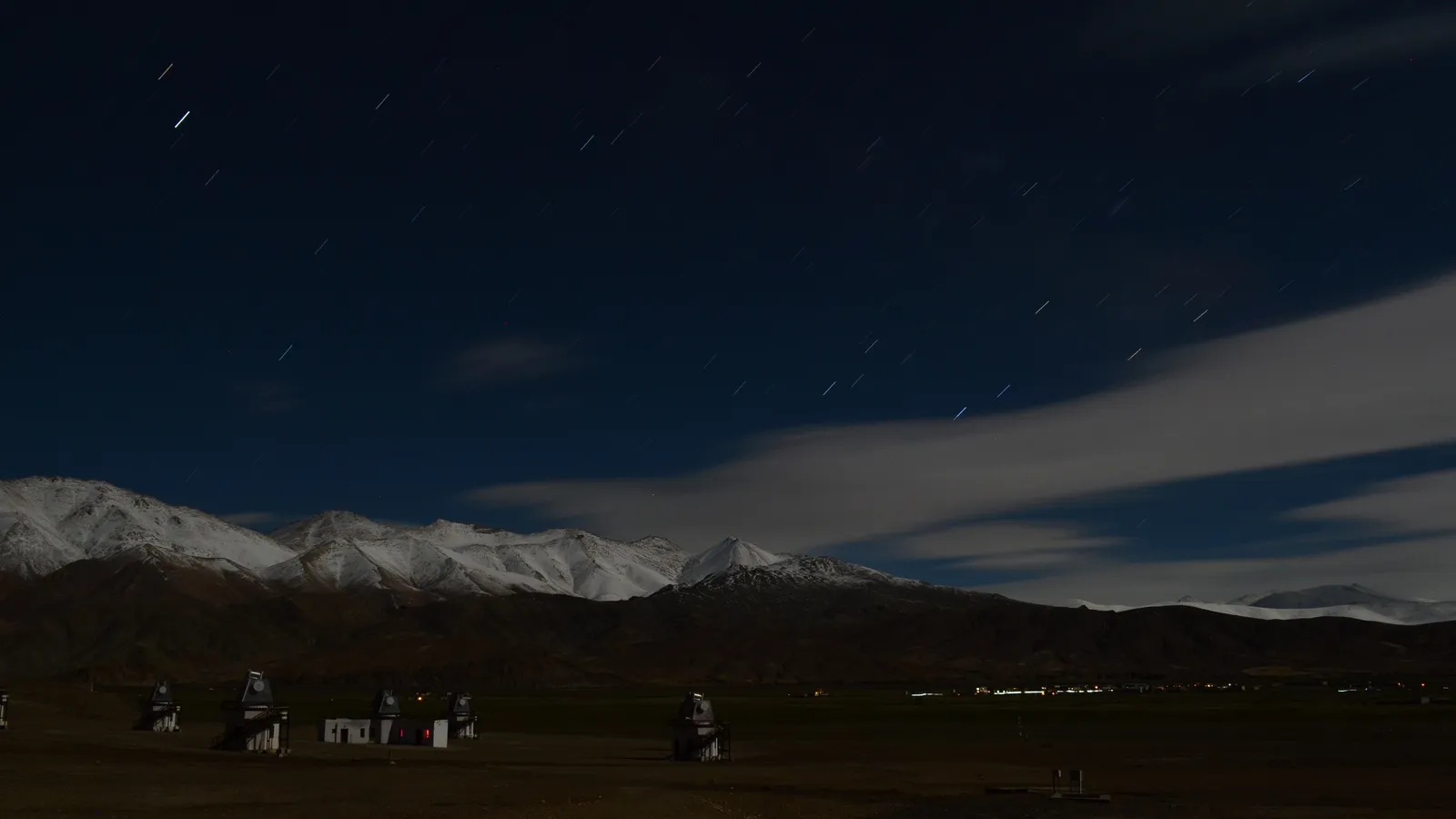
India's dark sky reserve is at Hanle, a high valley in eastern Ladakh. Hanle is also home to the Indian Astronomical Observatory, and the reserve is the country's first.
Where is India's dark sky reserve?
The Hanle Dark Sky Reserve lies around Hanle village in eastern Ladakh. A Press Information Bureau release of 31 March 2023 says the government notified it in December 2022. The same release gives its size: the reserve covers 1,073 square kilometres inside the Changthang Wildlife Sanctuary, next to the Indian Astronomical Observatory.
The Indian Institute of Astrophysics (IIA), which runs the observatory, describes the reserve as a region of radius 22 km around Hanle. It is being put in place under an MoU between IIA, the Union Territory of Ladakh and the Ladakh Autonomous Hill Development Council, Leh. The PIB release says the reserve aims to support astro-tourism livelihoods, spread awareness of astronomy, and boost research by cutting artificial light.
Why is Hanle so good for astronomy?
Astronomers look for three things: height, dry air and many clear nights. Hanle has all three. The IIA site page for the observatory calls it a dry, cold desert whose cloudless skies and low atmospheric water vapour make it one of the best sites in the world for optical, infrared, sub-millimetre and millimetre wavelengths.
The figures below come from that same page:
Height: the Himalayan Chandra Telescope stands at about 4,500 metres above sea level, on a peak in the Hanle valley, which the page puts at 4,250 metres.
Dry air: precipitable water vapour is below 2 mm between October and April. That is how deep the water would be if all the vapour in the air above the telescope condensed into liquid.
Clear nights: about 260 spectroscopic nights and about 190 photometric nights a year. Photometric nights are clear enough to measure brightness precisely, which is the stricter test.
Steady air: median seeing is under 1 arcsecond, so stars blur very little.
Why does this matter? Every kilometre of air above a telescope absorbs and blurs starlight, and water vapour is a strong absorber of infrared light. Our explainer on why telescopes are built on high mountains works through the physics. In the PIB release, Minister of State for Science and Technology Jitendra Singh says Hanle's altitude and its place in the rain shadow across the Himalayas make it ideal for stargazing almost all year.
What is the Himalayan Chandra Telescope?
The Himalayan Chandra Telescope (HCT) is a 2-metre optical-infrared telescope, with a mirror 2.01 metres across, according to IIA's HCT page. It saw first light on 26 September 2000, and astronomers do not sit beside it. They run it remotely from IIA's CREST campus at Hosakote over a dedicated satellite link.
The HCT shares the site with other instruments. IIA's outreach page on the observatory lists the 0.7-metre GROWTH-India robotic telescope, used with IIT Bombay to monitor transients (sudden changes in the sky), and two gamma-ray telescopes: HAGAR (IIA and TIFR) and MACE (BARC).
To escape the air completely, India launched AstroSat, its space telescope.
How are Hanle's skies kept dark?
A dark sky reserve needs its residents on board. Under the MoU, IIA's reserve page says, shades for outdoor bulbs, special bulbs and thick curtains have been given to houses, road delineators have been bought for installation, and high-beam headlights will be prohibited within the reserve.
The same IIA page says 18 telescopes bought so far under the MoU have been handed to the community, and 22 villagers have been trained to use them. These "astronomy ambassadors" run paid night-sky shows for visitors (IIA, the HDSR model), so the dark sky also earns villagers an income.
Compare that with a city, where streetlights scatter off the air and wash out all but the brightest stars. Our post on why city skies show so few stars explains skyglow.
How can you judge a stargazing spot like an astronomer?
You cannot carry a Himalayan observatory home, but you can run Hanle's checks on any place you can reach, such as a terrace, a school ground or a hill-station field.
Height: is the spot above the haze? Even a hill above a town's dusty layer helps.
Dryness: pick a clear night with low humidity.
Darkness: stand with nearby lights behind you. Give your eyes time to adjust, then count the stars you can see in Orion or the Big Dipper.
Steadiness: watch a bright star near the horizon and one high up. Strong twinkling means turbulent air, which astronomers call poor seeing.
A worked example: your city terrace passes on height but fails on darkness; a field outside town passes on darkness. Choose the field on a dry night and compare star counts.
If you visit Hanle, follow the local rules: dip your headlights, keep lights shaded, and book a show with an astronomy ambassador.
If ideas like absorption or seeing are hard to picture, the Fermi Simulation Lab has interactive simulations for ideas that are easier to see than to read. The Fermi Concept Library gives every concept in physics its own lesson, including refraction and resolution, the ideas behind a telescope.