On this page
The gurukul is often held up as a golden age of Indian education. The surviving texts do tell us when a student started, how long he stayed, and how whole texts were kept intact without writing. They also leave big gaps. Here is what the sources say, what they don't, and one habit you can borrow this week.
What was a gurukul?
A gurukul was a way of learning in which the student lived in his teacher's house and studied there for years. The Chandogya Upanishad tells of Shvetaketu, who went to his teacher's house at the age of twelve and came home at twenty-four, having studied all the Vedas. He came back vain. His father asked whether he had learned the teaching by which "what is never known becomes known", and Shvetaketu had to admit that his teachers had never told him.
How did the gurukul system work, day to day?
Much of what we know comes from rulebooks, the best known being the Manusmriti. It sets initiation, the ceremony that began study, in the eighth year from conception for a Brahmana, the eleventh for a Kshatriya and the twelfth for a Vaishya (Ganganath Jha's translation).
The same text says study of the three Vedas under a teacher should last thirty-six years, or half that, or a quarter, or until the student has learned them. Even the rulebook allowed a range: 36, 18 or 9 years, or as long as the learning took.
The end of study had its own moment. In the Taittiriya Upanishad, "having taught the Veda, the teacher then exhorts the pupil": speak the truth, follow dharma, never neglect study. The advice treats study as something that goes on after the student leaves.
How did students memorise the Vedas without books?
They recited them aloud, in several patterns. UNESCO, which lists Vedic chanting as intangible cultural heritage, says practitioners are taught complex recitation techniques from childhood to ensure that the sound of each word remains unaltered.
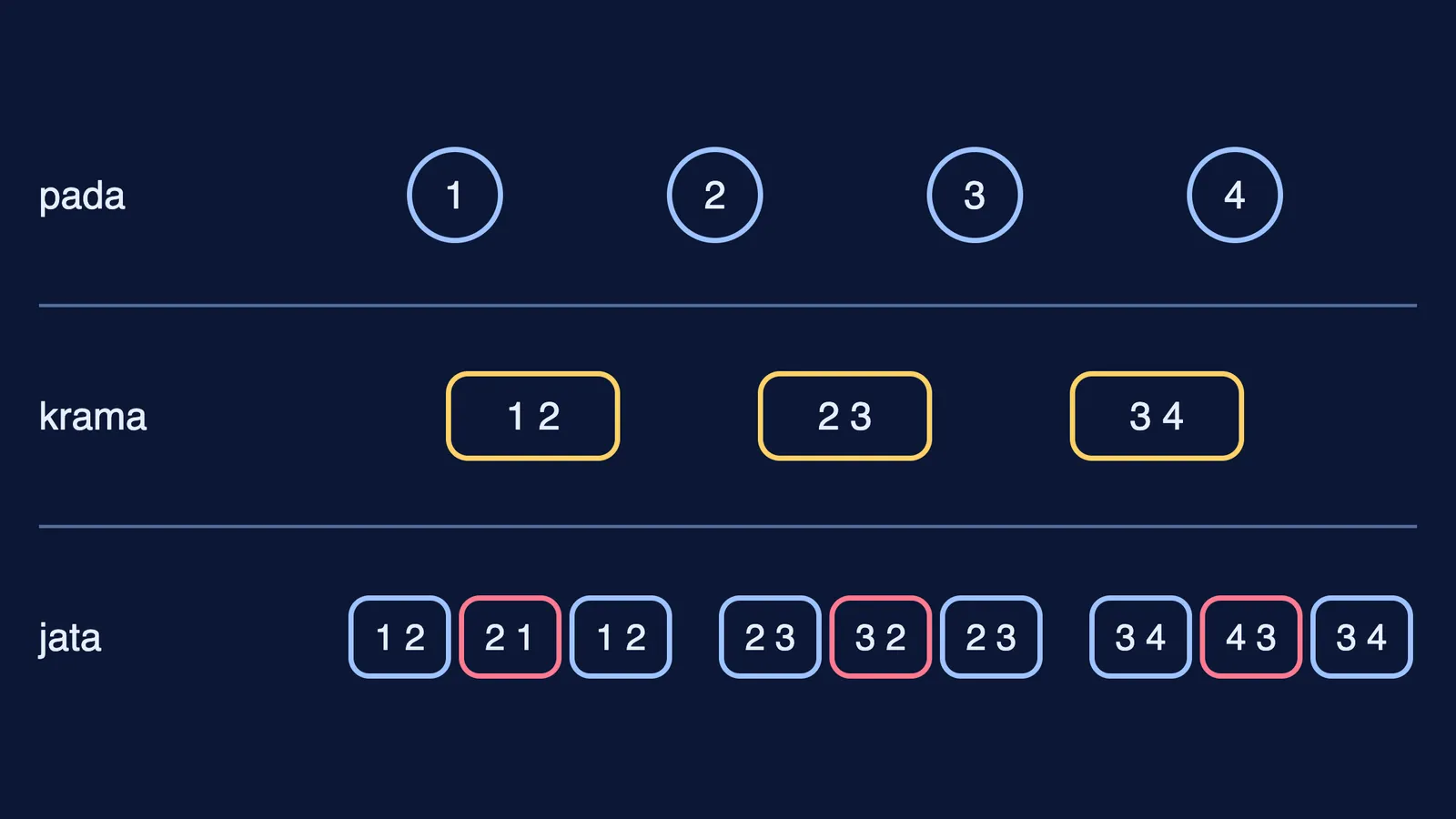
The patterns are described in Hindu Dharma, a collection of talks by the Kanchi Shankaracharya Chandrasekharendra Saraswati:
Pada: each word is said on its own, clearly separated from the next.
Krama: words go in overlapping pairs: 1-2, 2-3, 3-4.
Jata: a pair goes forward, backward, then forward again: 1-2, 2-1, 1-2, then on to 2-3.
The same source says the purpose was to make sure not even a syllable of a mantra changed. One way to see why it helps: every word has been said in several orders, so a slip in one pattern would clash with the others.
Was debate part of gurukul learning?
The most famous scene of argument is not set in a gurukul. In the Brihadaranyaka Upanishad, King Janaka offers a thousand cows with gold fixed to their horns to the most learned Vedic scholar. Yajnavalkya claims them, and the others question him in turn. When Gargi Vachaknavi presses him, he warns her not to "push your inquiry too far, lest your head should fall off".
So the texts show scholars testing each other in public, but at a king's sacrifice, not in a lesson. For a later centre of learning, see what Xuanzang recorded about teaching at Nalanda.
What about the gurukul cannot be verified?
Rules are not records. The Manusmriti says what should happen. No attendance lists or diaries tell us how many students really stayed 12 years, or 36.
Who was left out. The initiation rule above names only three varnas. Other people's access, and how often girls studied, cannot be settled from these passages.
How much survived. UNESCO notes that only thirteen of the over one thousand Vedic recitation branches have survived.
Stories are not data. Shvetaketu and Gargi appear in teaching texts. Their scenes show what the authors valued, not a normal school day.
What can you borrow from the gurukul today?
One habit with modern evidence behind it is saying it back. In a 2006 study, Roediger and Karpicke found that students who took recall tests on a prose passage retained more on final tests 2 days and 1 week later than students who restudied it, even though restudying made them more confident.
Try this krama-style drill on any list you must learn, such as the reactivity series or the stages of mitosis:
Say the list straight through once, book closed.
Say it in overlapping pairs: item 1 with 2, then 2 with 3.
Say each pair forward, backward, forward. Every hesitation is a gap.
Write down only the gaps, check them, and repeat tomorrow.
For long lists, combine this with the memory palace technique for biology lists. For the argument side, our guide to preparing for a science debate shows how to build evidence and rebuttals.
Recitation keeps the words in place; understanding is a separate job, as Shvetaketu found. When the words are there but the idea isn't, Fermi's AI tutor works out what you already know, decides whether to explain, ask or show, and checks understanding as it goes.