On this page
A science debate is not won by whoever speaks fastest. It is won by the side whose claims are tied to evidence the other side cannot shake. That makes preparation a skill you can practise in a week: find sources, turn them into evidence cards, predict the attacks, and rehearse your answers.
Research suggests the effort is worthwhile. In a study of Chicago public high schools from 1997 to 2007, Anderson and Mezuk (2012) in the Journal of Adolescence found that debaters were 3.1 times more likely to graduate from high school than non-debaters.
What does a strong science debate argument look like?
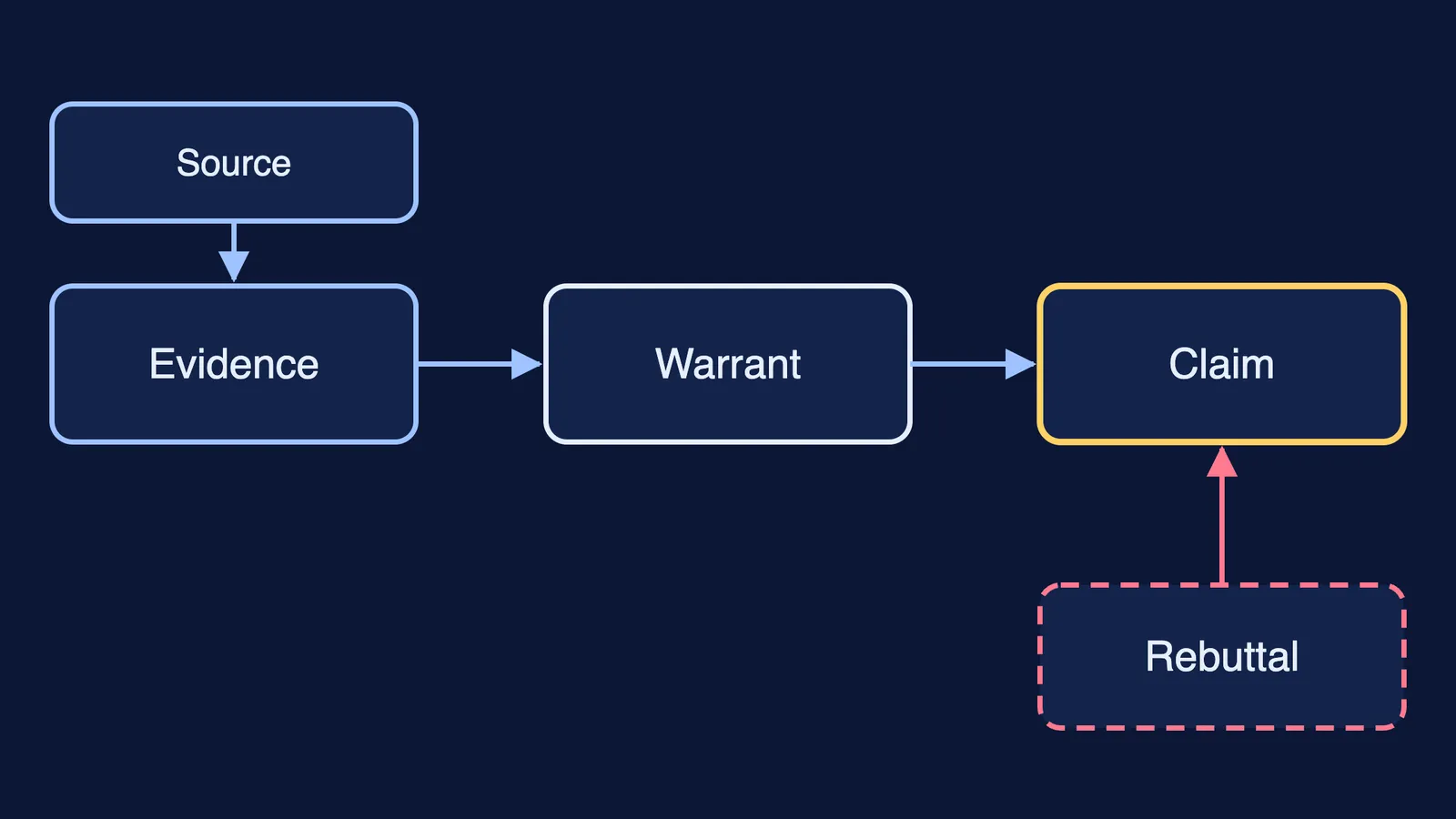
A widely used way to analyse arguments in science education is Toulmin's argument pattern, which includes a claim, the data behind it, the warrant that links the two, and a rebuttal that answers a challenge. In a two-year study in junior high schools in greater London, Osborne, Erduran and Simon (2004) used a Toulmin-based framework to judge student arguments and found their quality improved after lessons on scientific and socioscientific argument.
Every point you make needs four parts:
Claim: what you want the judges to believe.
Evidence: a fact from a named source.
Warrant: why that fact supports the claim.
Rebuttal: your answer to the best attack on it.
Weak speeches often skip the warrant.
How do you make an evidence card?
An evidence card is one fact, written so you can use it under pressure. Give each card five lines.
Here is a worked example for the motion "This house would stop the sale of antibiotics without a prescription", using the WHO fact sheet on antimicrobial resistance:
Tag: Drug-resistant infections already cause harm on a large scale.
Source: World Health Organization, antimicrobial resistance fact sheet.
Evidence: WHO says bacterial antimicrobial resistance was estimated to be associated with more than 4.7 million deaths worldwide in 2021.
Warrant: WHO names the misuse and overuse of antibiotics as one of the main drivers of resistance, so cutting sales without a prescription targets a cause.
Limit: "Associated with" is not "caused by", and the figure is global, not Indian.
The limit line is your shield: if you know a card's weak spot, you can answer it before the other side raises it. For an Indian angle, the same WHO page says resistance is highest in the WHO South-East Asia and Eastern Mediterranean Regions, where 1 in 3 reported infections were resistant. India is part of the South-East Asia Region.
If a motion rests on an idea you only half understand, such as how resistance spreads among bacteria, look it up in the Fermi Concept Library before you write the card.
How do you prepare rebuttals that hold up?
Write the other side's three strongest points first, then answer each with this four-line script:
"My opponent said [their point in one fair sentence]."
"But [the flaw: missing evidence, a weak warrant, or a fact that cuts the other way]."
"Because [your evidence card, with its source]."
"So [why this matters for the motion]."
Example: "My opponent said prescriptions will stop poor families getting medicine. But the motion is about sales without a prescription, not access to doctors. Because WHO lists limited access to medicines and the inappropriate use of antibiotics as separate factors, we can tackle one without worsening the other. So the real question is how to make prescriptions easier to get, not whether to allow unchecked sales."
Practise rebuttals out loud with a friend taking the other side. Explaining your reasoning to a peer also helps you learn, as our piece on why convincing a classmate helps you learn explains. For listening and disagreeing politely in a live room, see how to do well in a group discussion.
Which science debate topics are good for practice?
Each motion has evidence on both sides, so you can prepare either.
This house would stop the sale of antibiotics without a prescription.
This house believes India should expand nuclear power.
This house would allow gene editing of human embryos to prevent inherited disease.
This house would ban all single-use plastics.
This house believes space exploration is worth the cost for developing countries.
This house would make genetically modified crops widely available to farmers.
This house would phase out animal testing in medical research.
This house would make vaccination a condition of school admission.
This house supports research into geoengineering to slow climate change.
This house would require AI chatbots to cite sources when answering science questions.
For bioethics motions such as gene editing and GM crops, you can also use AI as a debate partner and then check what it says. Pick one motion tonight, write your first three cards, and you have started.