

On this page
A group discussion, or GD, is a short, timed conversation in which a small group talks about one topic while someone watches how each of them thinks and works with others. You will meet it in school, in college clubs, and in many placement and admission rounds. The good news is that a GD is a skill, not a personality trait, and a skill can be practised.
What actually makes a group discussion go well?
In a 2010 study in Science, Anita Woolley and colleagues tested 699 people working in groups of two to five on a range of tasks (Woolley et al., Science). The best groups were not simply those with the cleverest members: performance was not strongly linked to members' average or top individual intelligence, but it was linked to how socially sensitive the members were and to how equally they shared turns in the conversation.
A 2021 meta-analysis of 22 studies, covering 5,279 people in 1,356 groups, found that how a group collaborated was the strongest predictor of its collective intelligence, followed by individual skill (Riedl et al., PNAS).
These studies measured groups, not GD marks, but the lesson carries over: the person who talks most is not necessarily the one who helps most. What helps is a clear point, a reason, and a habit of drawing others in.
How should you open a group discussion?
Opening first earns attention, but only if the opening is useful. You have three safe ways to start:
Define the topic. "Before we argue, let's agree what we mean by 'online learning'. I'll take it to mean classes where the teacher is not in the room."
Split it into parts. "We could look at this from three sides: students, teachers and cost."
Give one concrete fact or example you are sure of. If you are unsure of a number, leave it out.
If someone else opens, you lose nothing: later speakers can build on what was said.
How do you add value when everyone has already spoken?
Use a simple three-step pattern for each turn: point, reason, example. Keep each turn short so others have room.
When you run out of new points, these moves still add value:
Connect two speakers: "Riya's point about cost and Arjun's point about access are really the same problem."
Ask a sharp question: "Does that work in a village school without steady electricity?"
Bring in a quiet member: "Kabir, you haven't spoken yet. What do you think?"
Summarise halfway: "So far we agree on X and disagree on Y."
How do you disagree politely in a GD?
The Thinking Together project at the University of Cambridge teaches children exploratory talk, "a way of interacting which emphasises reasoning, the sharing of relevant knowledge and a commitment to collaborative endeavour" (Thinking Together, University of Cambridge). In a 1999 study by Neil Mercer, Rupert Wegerif and Lyn Dawes, 60 British primary school children aged 9 to 10 took part in a teaching programme built around agreed "ground rules" for discussion, and the researchers found that following the rules helped groups solve reasoning problems (Mercer, Wegerif and Dawes, British Educational Research Journal).
In practice, that means you challenge the idea, never the person, and you always give a reason. These lines work:
"I see it differently, because..."
"That's true in cities. Would it hold in smaller towns?"
"I agree with the goal, but I'm not sure about the method."
"Can you give an example? It would help me understand."
If two people start talking over each other, stop, smile and say, "Please go ahead, I'll add after you."
How can you practise group discussion at home or in school?
Get a timer and try these formats, one per week:
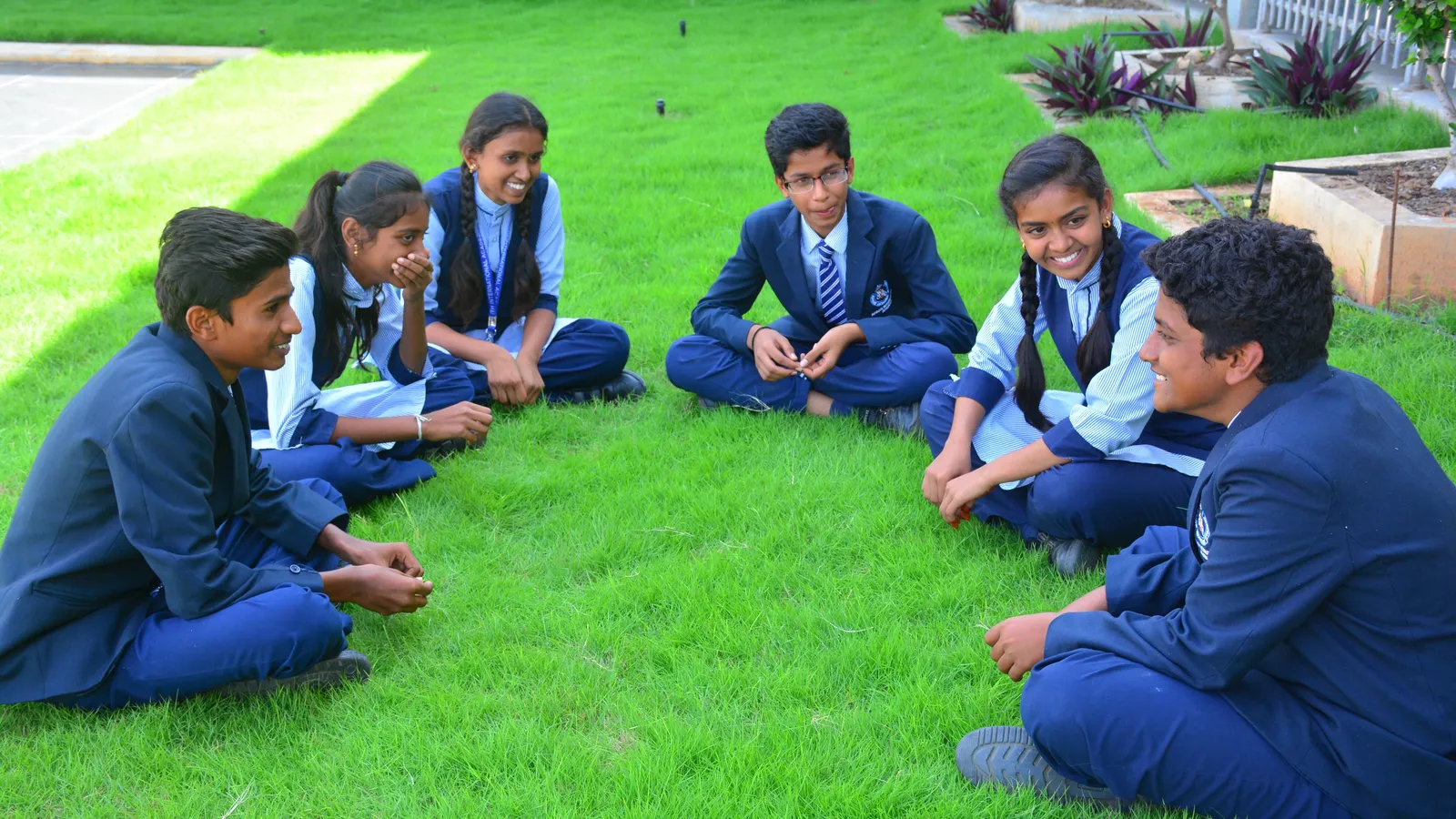
Week 1, the trio round. Three friends, one topic, five minutes. Each person must speak twice and must restate someone else's point once.
Week 2, the fishbowl. Four people discuss while two watch and note who interrupted, who summarised and who stayed quiet. Swap roles.
Week 3, the role card. Each person secretly gets a role: opener, questioner, summariser or devil's advocate. Play it for ten minutes.
Week 4, the full mock. A full group, fifteen minutes, an unseen topic and a short written note afterwards on one thing each person did well.
Record a round on a phone and listen back for speed and fillers like "basically".
GD topics often touch science, such as renewable energy or vaccines, and understanding the idea matters more than rehearsed lines. The Fermi Concept Library has a lesson for every concept in physics, chemistry, biology, mathematics and computing, so you can check the science before you argue about it.
For more on speaking up, read our guide to getting better at public speaking in school. If you are heading towards college, see how campus placements work in Indian colleges, and for the classroom version of learning through talk, read about Eric Mazur and peer instruction.
Pick a topic tonight, gather two friends, and run your first five-minute trio round this week.


