On this page
UNESCO describes Nalanda Mahavihara, in Bihar, as the remains of "a monastic and scholastic institution dating from the 3rd century BCE to the 13th century CE", calls it the most ancient university of the Indian subcontinent, and says it carried on "the organized transmission of knowledge over an uninterrupted period of 800 years" (UNESCO World Heritage listing). What we know about study there comes from the record of the Chinese monk Xuanzang, who studied at Nalanda, and from its excavated buildings. Here is what each shows, and how to borrow Nalanda's entry test.
What was taught at Nalanda university?
According to the Internet Encyclopedia of Philosophy entry on Xuanzang, Nalanda's monks studied "the orthodox Buddhist canon as well as the Vedas, arithmetic, and medicine". The same entry says Xuanzang became the disciple of the abbot Silabhadra in 636 and was initiated into the Yogacara school of Mahayana Buddhism. At Nalanda he also studied:
Sanskrit, the language of the texts
Brahmana philosophy, the thought of the Hindu schools
the Samkhya and Vaisheshika systems, rivals of Buddhism, of which he became a critic
His later studies in India, the entry adds, included hetu-vidya (the Indian discipline of logic) and Madhyamika philosophy.
UNESCO's assessment says Nalanda's "merit-based approach" was said to have embraced all the systems of learning practised in the Indian subcontinent at the time (UNESCO). For India's older mathematical astronomy, read about Lagadha's five-year lunar-solar calendar.
How it was taught matters as much as what. In Samuel Beal's translation of Xuanzang's record, the monks spend the day in argument: "From morning till night they engage in discussion; the old and the young mutually help one another." Anyone who could not discuss questions from the Tripitaka, the Buddhist canon, was "little esteemed" (Beal's translation, digital edition). UNESCO adds that Nalanda's way of teaching is best preserved today in Tibetan monasteries, "where discourses are conducted through debate and dialectics" (UNESCO).
How did admission to Nalanda work, according to Xuanzang?
Xuanzang writes that a long line of kings built monasteries side by side, and that one of them "built round these edifices a high wall with one gate" (Beal's translation). A few lines later he describes who guarded entry: "If men of other quarters desire to enter and take part in the discussions, the keeper of the gate proposes some hard questions; many are unable to answer, and retire."
He gives three details worth noticing:
The bar was breadth: "One must have studied deeply both old and new (books) before getting admission."
The test was spoken. Strangers "have to show their ability by hard discussion".
Most failed: "those who fail compared with those who succeed are as seven or eight to ten."
By Xuanzang's estimate, then, roughly two or three in ten got through (Beal's translation). Even then, he says, those of moderate talent were humbled when their turn came to argue before the assembly. Note what the passage covers: outsiders seeking to join the discussions. It says nothing about fees, age or a written paper.
What does archaeology show at Nalanda?
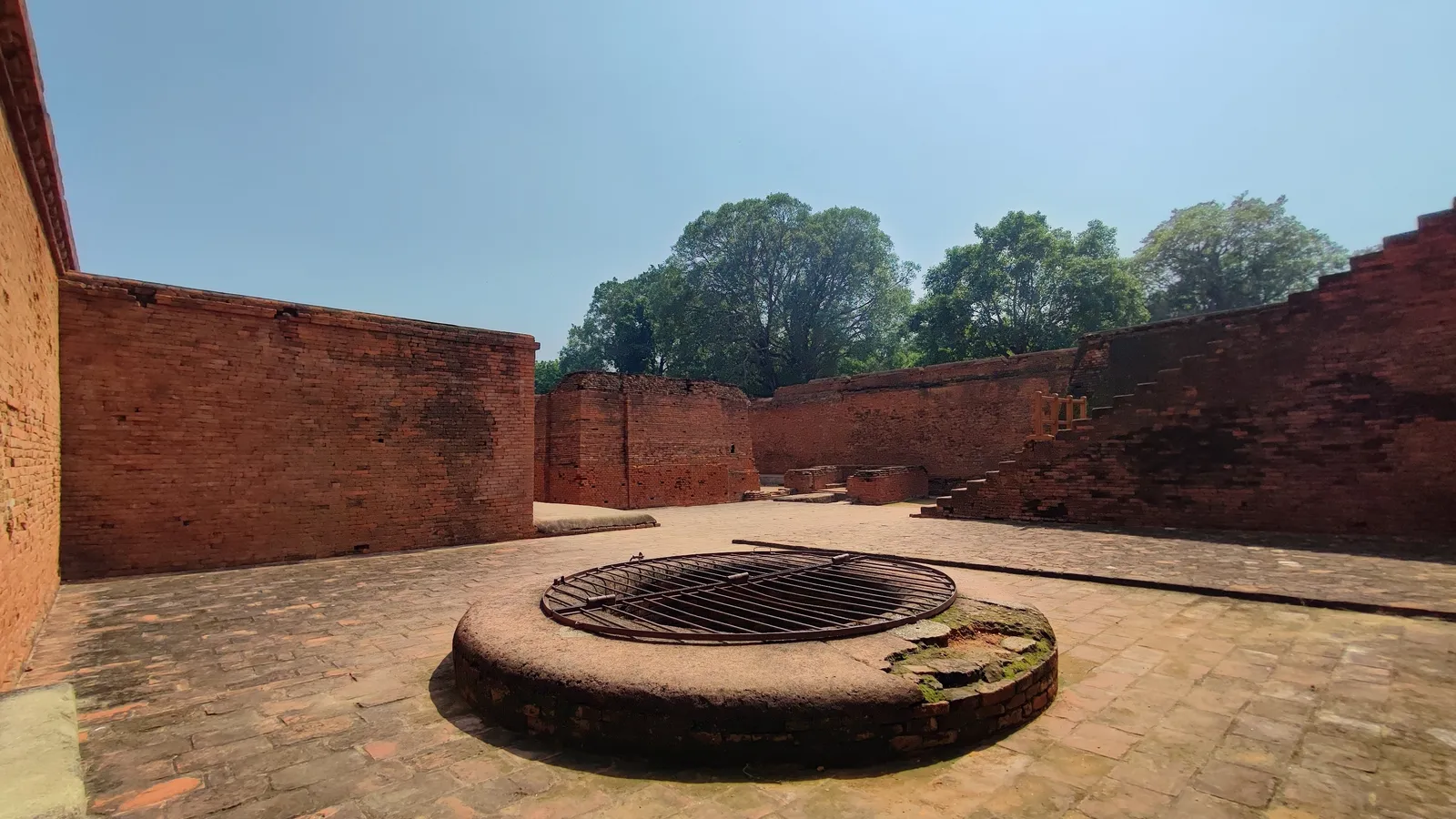
According to UNESCO, the protected property covers 23 hectares and holds 11 viharas and 14 temples, besides many smaller shrines and votive structures, and the original complex was much larger.
Viharas were residential and educational buildings. UNESCO notes the north-south axis of the layout, and that the quadrangular vihara developed here was borrowed by later monastic centres such as Vikramshila, Odantapuri, Jagaddala and Paharpur. The remains lay buried "for over seven centuries" before the Archaeological Survey of India excavated them in the early 20th century, and the site was inscribed as a World Heritage Site in 2016. Their layers of construction, UNESCO says, show the forms changing over time, which is consistent with Xuanzang's account of kings adding one monastery after another.
How can you use Nalanda's gatekeeper test today?
You can run Nalanda's entry test on yourself in about 20 minutes.
Pick one chapter you believe you know well.
Write five "why" questions on it, mixing old material and the newest topic, as Xuanzang's "old and new" suggests.
Hand the questions to a parent, sibling or friend. They read one aloud; you answer aloud, without notes, in two minutes.
Mark each answer pass or fail. Any fail is a topic to revise before you move on.
A worked example for Class 11 gravitation: Why doesn't the Moon fall into the Earth? Why is g larger at the poles than at the equator? Why does escape speed not depend on the mass of the object being launched?
Parents, one line is enough: "Don't read me the book. Tell me why." For follow-up questions, see our guide to evidence cards and rebuttals for a science debate.
If nobody is free to play gatekeeper, Fermi's AI tutor notices where you are stuck and decides whether to explain, ask or show. When a question exposes a gap, look the idea up in the Fermi Concept Library, which covers every concept in physics, chemistry, biology, mathematics and computing.
Pick one chapter tonight and see whether you would have got through Nalanda's gate.