

On this page
You open a safety pin and it springs apart. You squeeze it shut and it stays shut. Both moves come from one bent wire doing two jobs: a spring that stores energy and a lever that turns it into a force at the point. The same two ideas turn up in JEE Main mechanics questions.
How does a safety pin work?
A safety pin has three working parts, and its inventor named all three. Walter Hunt's patent describes “the pin A, the coiled spring B, and the catch D” (US Patent 6,281 on Google Patents). The patent says the point is forced into the catch and “by its own spring securely retained”, and that once freed the pin is “thrown open by the spring”.
So the sequence is:
At rest, the legs sit apart and the coil is relaxed.
You press the legs together; the coil twists and stores energy.
You slip the point under the catch. The coil keeps pushing it outward into the hood, so it cannot slide out.
You press the point down and out; the coil releases its energy and the legs spring apart.
The safety is in step 3: the force that would open the pin is the same force that keeps it locked.
What did Walter Hunt patent in 1849?
Hunt, of New York, received US Patent 6,281, dated 10 April 1849, for an improvement in “Dress-Pins” (Google Patents). His claim was a pin made “from one entire piece of wire or metal”, combining “a coiled or curved spring, and a clasp or catch”, without a joint or hinge. The patent gives the reason: “there being no joint to break or pivot to wear or get loose”.
A clasp pin was not new: Lemelson-MIT calls Hunt's pin an improvement on the fibulae, or brooches, of ancient Roman jewellery (Lemelson-MIT on Walter Hunt). The same page says Hunt made it while he owed a man a $15 debt, and that he sold the rights for $400.
Where is the energy stored in a safety pin?
In the coil. A coil you twist, rather than stretch, is a torsion spring.
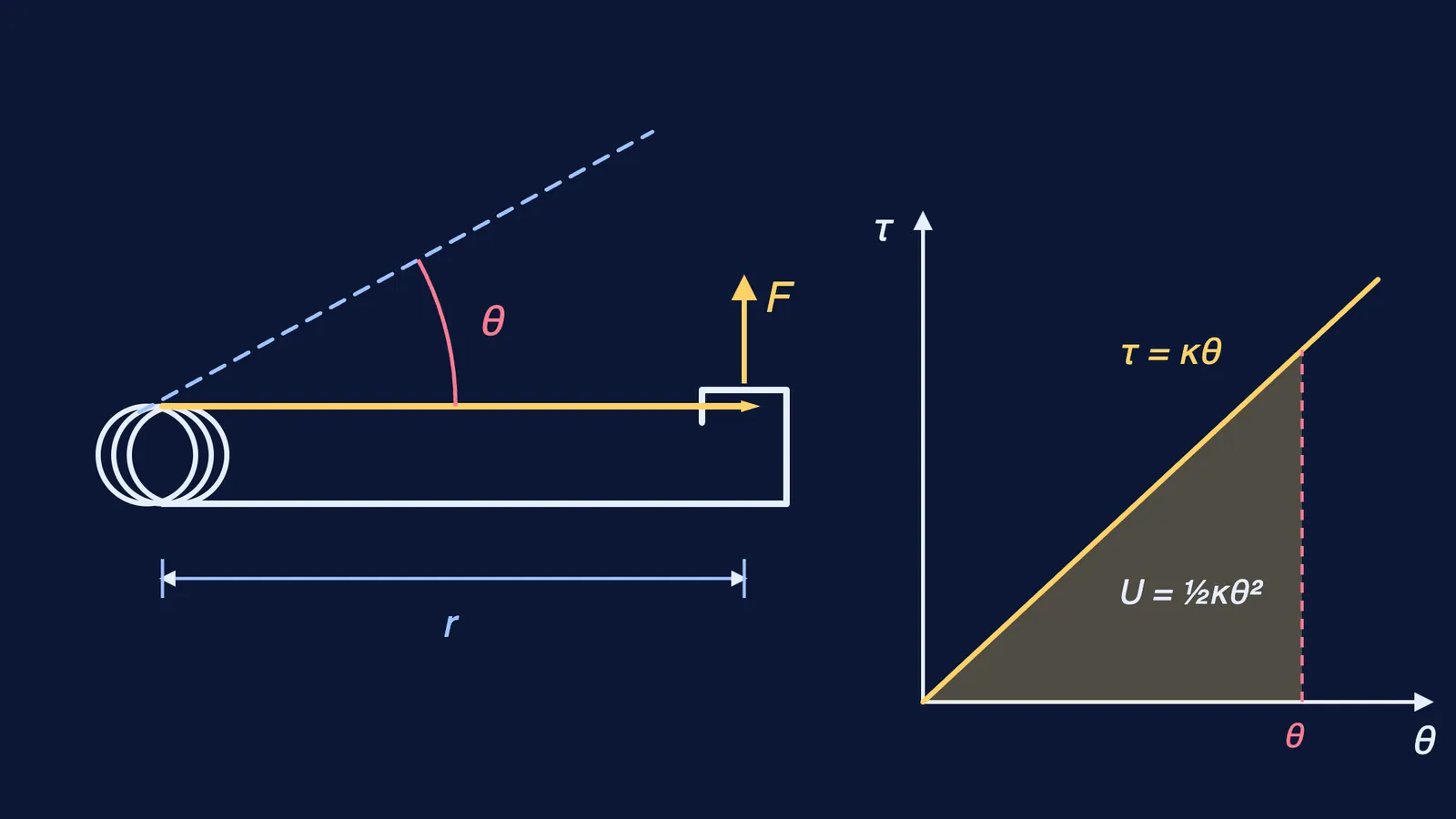
A torsion spring obeys an angular form of Hooke's law, τ = −κθ, where τ is the restoring torque, θ is the angle of twist in radians and κ is the torsion coefficient, the spring's constant in N·m/rad (Torsion spring, Wikipedia).
The energy a torsion spring stores is U = ½κθ² (Torsion spring, Wikipedia), the same shape as the ½kx² for a stretched spring in OpenStax College Physics.
Two things follow. Twist the coil twice as far and it stores four times the energy, because θ is squared. And the law holds only while the wire stays within its elastic limit, as the same Wikipedia page notes. Bend a pin well past that limit and it stays bent.
If ½kx² still feels shaky, our explainer on trampolines, energy and Hooke's law builds it from scratch, and work done by a spring between two extensions takes it one step further.
Is a safety pin a lever?
Yes. OpenStax defines a lever as “a rigid bar pivoted at a fixed place called the fulcrum”, with mechanical advantage set by the ratio of arm lengths, MA = l_i / l_o (OpenStax, Simple machines). Each leg of a safety pin is such a bar, with the coil as its fulcrum. The coil supplies a torque; where you push along the leg decides the force you need.
How much force does a safety pin's coil make?
A worked example. These numbers are illustrative, not measurements of a real pin.
Torsion coefficient of the coil: κ = 0.005 N·m/rad
Extra twist when the pin is closed: θ = 0.5 rad, about 29°
Distance from the coil to the catch: r = 4 cm = 0.04 m
Torque from the coil: τ = κθ = 0.005 × 0.5 = 0.0025 N·m.
Force of the point on the catch: F = τ / r = 0.0025 / 0.04 = 0.0625 N.
Squeeze the leg 1 cm from the coil instead and you need F = 0.0025 / 0.01 = 0.25 N, four times more. That is why you close a pin by pressing near its point.
Energy stored: U = ½κθ² = ½ × 0.005 × 0.5² = 0.000625 J, about 0.6 mJ.
Try it at your desk: a five-step check
Close a pin slowly and feel the push grow: that is τ growing with θ.
Close it pressing near the coil, then near the point. Explain the difference with F = τ / r.
Find the surface inside the catch's hood that the point presses on.
Draw a free-body diagram of the closed pin: coil torque, catch force, your finger.
Sketch τ against θ and shade the triangle under the line: that is U = ½κθ².
If picturing torque about a pivot is the hard part, the Fermi Simulation Lab has interactive simulations for ideas that are easier to see than to read. And Fermi's AI tutor can work out what you already know about springs and levers and build a plan for the session.
For the same lever thinking at a bigger scale, read how bicycle brakes and the chain drive trade force for distance.


