On this page
On the morning of 5 December 1952, London woke to a fog that did not lift until 9 December. It killed thousands of people, and Britain learned a costly lesson in physics and chemistry. Here is what happened, with the numbers, and a mole calculation you can do yourself.
What caused the Great Smog of London?
Three things had to happen at once, and the Met Office case study of the Great Smog describes all of them.
Fuel: November and early December 1952 had been very cold, so Londoners burned large amounts of coal at home, and smoke poured from house chimneys as well as factories.
Moisture and still air: early on 5 December the sky was clear, winds were light and the air near the ground was moist, which is ideal for fog.
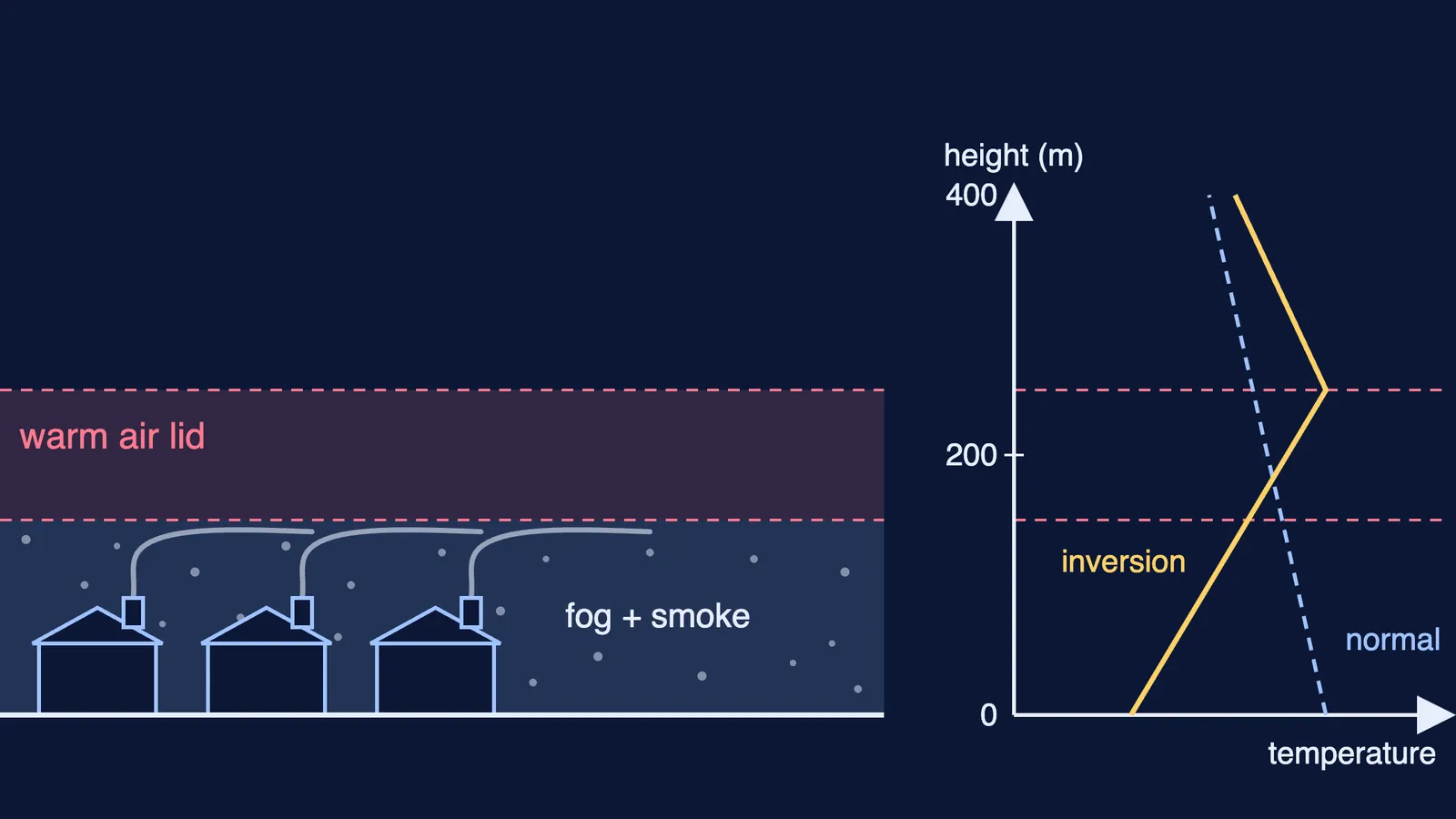
A lid: an anticyclone sat over the region and created a temperature inversion, so the smoke could not rise and escape.
How did a temperature inversion trap the smoke?
Usually air gets colder as you go up, so warm smoke from a chimney keeps rising and spreads out. In an anticyclone, air is pushed downwards and warms as it descends. The Met Office explains that this creates an inversion, where air close to the ground is cooler than the air above it.
Cool air under warm air is stable: the cool air is denser, so it stays put. The very light wind only stirred the saturated air into a fog layer 100 to 200 metres deep, and visibility dropped to a few metres, according to the Met Office.
What chemistry turned the fog into acid?
Coal contains sulphur, and burning it makes sulphur dioxide: S + O2 → SO2. The Met Office estimates that on each day of the fog about 1,000 tonnes of smoke particles, 140 tonnes of hydrochloric acid and 14 tonnes of fluorine compounds were emitted, and that 370 tonnes of sulphur dioxide were converted into 800 tonnes of sulphuric acid.
Why did SO2 turn into acid so quickly? A 2016 PNAS study by Gehui Wang, Renyi Zhang, Mario Molina and colleagues, Persistent sulfate formation from London Fog to Chinese haze, found that nitrogen dioxide oxidises sulphur dioxide efficiently in water. It concluded that the London Fog formed in a way similar to this oxidation inside cloud droplets, helped by high humidity, low temperature and large fog droplets. The paper's overall equation, with the acid written as a molecule, is SO2 + 2NO2 + 2H2O → H2SO4 + 2HONO, where HONO is nitrous acid. Check it: one S, two N, eight O and four H on each side.
That makes 1952 a classical, sulphurous smog, not the sunlight-driven kind found over traffic-heavy cities. Our explainer on photochemical smog vs classical smog sets the two reaction schemes side by side. The same acid, coming down in rain, is what attacks marble, as in acid rain on the Taj Mahal.
Worked example: how much acid can 370 tonnes of SO2 make?
Treat the Met Office figure as a Class 11 mole problem.
Molar mass of SO2 = 32.07 + 2(16.00) = 64.07 g/mol.
Moles of SO2 = 370,000,000 g ÷ 64.07 g/mol ≈ 5.77 million mol.
Each SO2 has one sulphur atom, so it gives at most one H2SO4.
Molar mass of H2SO4 = 2(1.008) + 32.07 + 4(16.00) = 98.08 g/mol.
Maximum pure H2SO4 = 5.77 million mol × 98.08 g/mol ≈ 566 tonnes.
So 370 tonnes of SO2 can make at most about 566 tonnes of pure sulphuric acid. The 800-tonne figure is larger, so it cannot be pure acid made from that sulphur dioxide alone; the Met Office page does not say how it was worked out.
If mole calculations keep going wrong at the same step, the Fermi Problem Library has worked problems with a step-by-step solver that explains the reasoning rather than printing an answer.
How many people died in the Great Smog?
The Met Office says about 4,000 people were known to have died as a result of the fog, and that the true figure could be many more.
A 2001 paper in Environmental Health Perspectives by M. L. Bell and D. L. Davis, Reassessment of the lethal London fog of 1952, used insurance claims, hospital admissions, death records and pollution data from December 1952 to February 1953. It found mortality 50 to 300% above the previous year and estimated about 12,000 excess deaths over those three months.
What did the Clean Air Act change?
The Met Office notes that the response included the Clean Air Acts of 1956 and 1968. These banned emissions of black smoke and required people in urban areas and factory operators to switch to smokeless fuels. Deadly fogs did not stop at once: one in 1962 still killed 750 Londoners.
London was not the first city to link coal smoke with acid. Read how Robert Angus Smith discovered acid rain in Manchester.
An inversion is easier to see than to read about. For ideas like that, the Fermi Simulation Lab has interactive simulations you can try.