On this page
Stand at the end of a railway platform and the rails seem to meet far away. Girard Desargues, a French architect and engineer, asked which properties of a shape survive when you see it in perspective. His answer, a short theorem about two triangles, became one of the foundations of projective geometry, the geometry of what stays true under projection.
What does Desargues' theorem say?
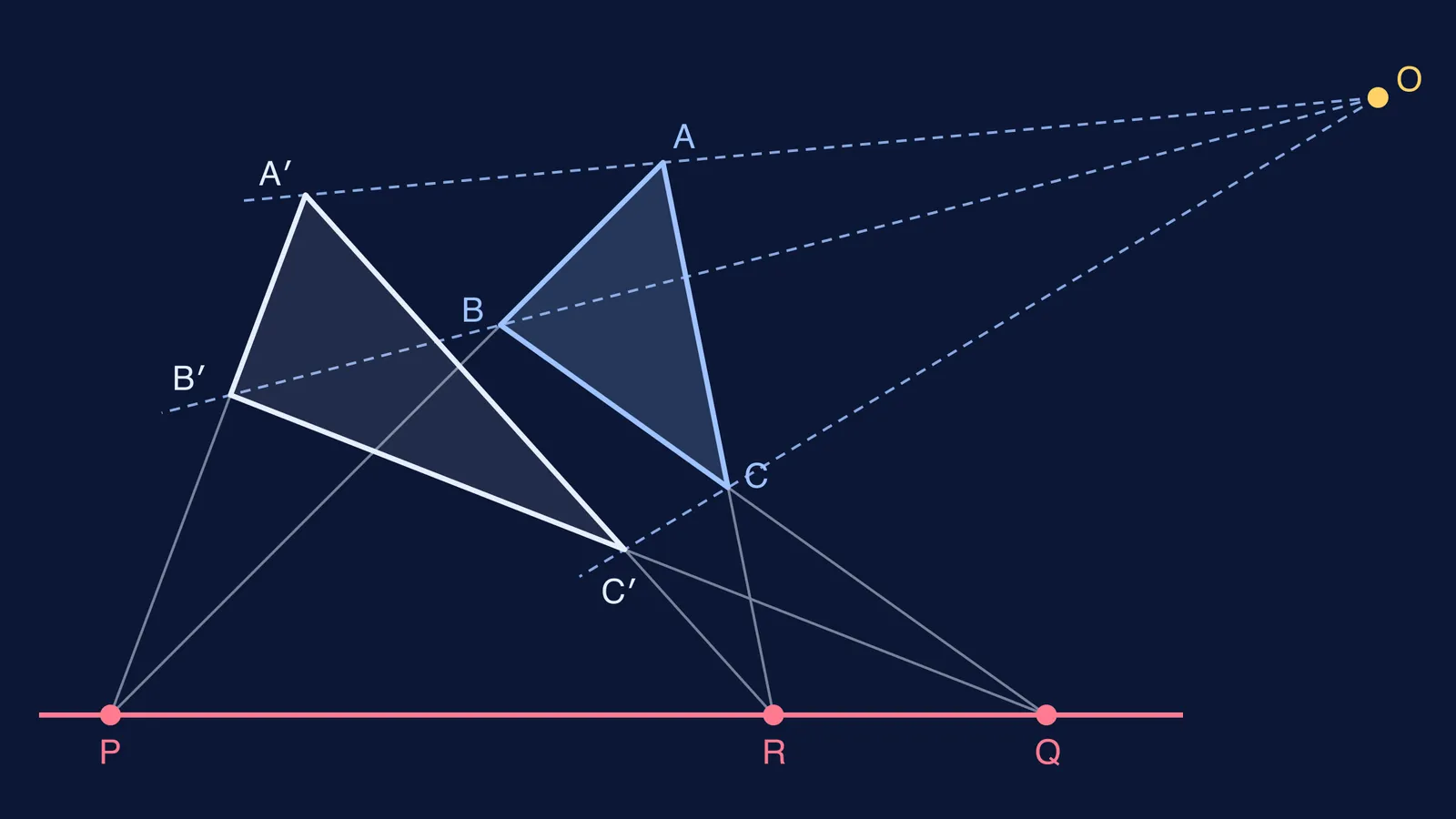
Wolfram MathWorld states it like this: if the three straight lines joining the corresponding vertices of two triangles ABC and A'B'C' all meet in a point, then the three intersections of pairs of corresponding sides lie on a straight line.
The meeting point of the corner-to-corner lines is called the perspector, and the line through the three side crossings is called the perspectrix. In short, two triangles that are perspective from a point are perspective from a line.
Picture a lamp at O shining through a triangular cut-out onto a tilted sheet. The shadow is the second triangle. Extend each side of the cut-out and the matching side of its shadow, and the two cross on the line where the two planes meet. That is the three-dimensional proof described on Wikipedia's page on the theorem.
Who was Girard Desargues?
Desargues was born in Lyon on 21 February 1591 and died there in October 1661, says his MacTutor History of Mathematics biography. He designed a spiral staircase, a new kind of pump and several Paris mansions, and joined the circle of mathematicians around Marin Mersenne.
In 1636 he published a method for drawing in perspective. In 1639 he printed a few copies of the Brouillon project, on what happens when a cone meets a plane. It was long known only through a handwritten copy by Philippe de la Hire, until an original was rediscovered in 1951. The triangle theorem first appeared in 1648, in a perspective book by Abraham Bosse.
Critics attacked his work in print in the 1640s, but Blaise Pascal, aged 16, had already written of Desargues in his 1640 essay on conics:"I owe the little that I have found on this matter to his writings" (quoted in the MacTutor biography).
Why do parallel lines meet at infinity in projective geometry?
The historian Florian Cajori, quoted in the MacTutor biography, credits Desargues with the idea that parallels differ from other pairs of lines only in having their meeting point at infinity, as the rails on the platform suggest.
As Wikipedia notes, in the ordinary Euclidean plane special care is needed when a pair of sides is parallel. Add one point at infinity for every direction and every pair of lines meets exactly once. The result is the projective plane, where the theorem has no exceptions.
How did the theorem become a basis of projective geometry?
Projective geometry was later reinvented by pupils of Gaspard Monge, notes the MacTutor biography of Desargues. One of them, Jean-Victor Poncelet, worked out projective properties of conics while held in a Russian prison from March 1813 to June 1814. His MacTutor biography says his 1822 treatise studied properties that stay the same under projection, and counts him among the founders of modern projective geometry.
Mathematicians have since found many non-Desarguesian planes in which the theorem fails. A projective space satisfies it exactly when it can be described with coordinates from a field or division ring (Wikipedia). In plain words, the theorem tests whether a geometry can be handled with algebra.
For more, read how Brunelleschi's mirror experiment led to the vanishing point, how Gaspard Monge invented descriptive geometry, and how Felix Klein sorted geometries by their symmetries.
How can you check Desargues' theorem yourself?
You need only Class 11 straight-line equations. Take O at the origin, the triangle A(1, 0), B(0, 1), C(1, 1), and stretch each corner away from O by a different factor: A'(2, 0), B'(0, 3), C'(4, 4). The triangles are now perspective from O.
AB is x + y = 1 and A'B' is 3x + 2y = 6. They meet at P(4, -3).
BC is y = 1 and B'C' is y = 3 + x/4. They meet at Q(-8, 1).
AC is x = 1 and A'C' is y = 2x - 4. They meet at R(1, -2).
Test x + 3y at each point: 4 - 9 = -5, then -8 + 3 = -5, then 1 - 6 = -5. All three lie on the line x + 3y = -5.
Now change B' to (0, 2). AB and A'B' become parallel. Redo the steps: Q becomes (-2, 1), R stays (1, -2), and QR is x + y = -1, parallel to AB too. All three lines share one direction, which is what meeting at one point at infinity means.
If finding the meeting point of two lines is where you get stuck, the Fermi Problem Library has worked problems with a step-by-step solver that explains the reasoning rather than printing an answer. To revise the forms of a straight line first, open the lesson in the Fermi Concept Library.