On this page
The Florentine architect Filippo Brunelleschi turned a painting into an experiment: people checked his painted building against the real one through a hole and a mirror. What they saw is the idea behind every perspective drawing.
What did Brunelleschi's mirror experiment involve?
The fullest description comes from Brunelleschi's biographer, probably Antonio di Tuccio Manetti, writing in the 1480s, as art historian Johannes Grave sets out in his study of the perspective panels. The panels did not survive, and their date isn't recorded; scholars suggest anything from about 1401 to 1425.
Brunelleschi painted the Baptistery of San Giovanni as seen from just inside the central door of Florence Cathedral, on a small panel probably about half a braccio square.
Where the sky should be, he put burnished silver, so real clouds were reflected in it and drifted across the painting.
He drilled a hole through the panel at the point of the painted Baptistery directly opposite the eye of someone standing in that doorway, "as tiny as a lentil bean" on the painted side and widening like a cone to about the size of a ducat coin on the back.
The viewer put one eye to the back of the hole and held a flat mirror in front with the other hand, so they saw the painting reflected.
Manetti says these arrangements made sure that "the spectator felt he saw the actual scene when he looked at the painting." As Wikipedia's article on graphical perspective puts it, lifting the mirror between building and painting let the observer compare how similar the two were.
Why did he need a hole and a mirror?
A perspective picture is exactly right from only one point. The peephole fixed one eye there, and Grave concludes that hole and mirror together set the right distance between eye and panel, while the viewer stood on the real spot facing the real building.
A plane mirror swaps left and right, the same lateral inversion that makes the lettering on your shirt look backwards. Grave suggests Brunelleschi either allowed for the flip or accepted it, since the near-symmetrical Baptistery would show it only at the edges.
Grave notes that the panel and mirror sizes, viewing distance and hole position cannot be determined exactly, so modern reconstructions are best guesses.
What is a vanishing point?
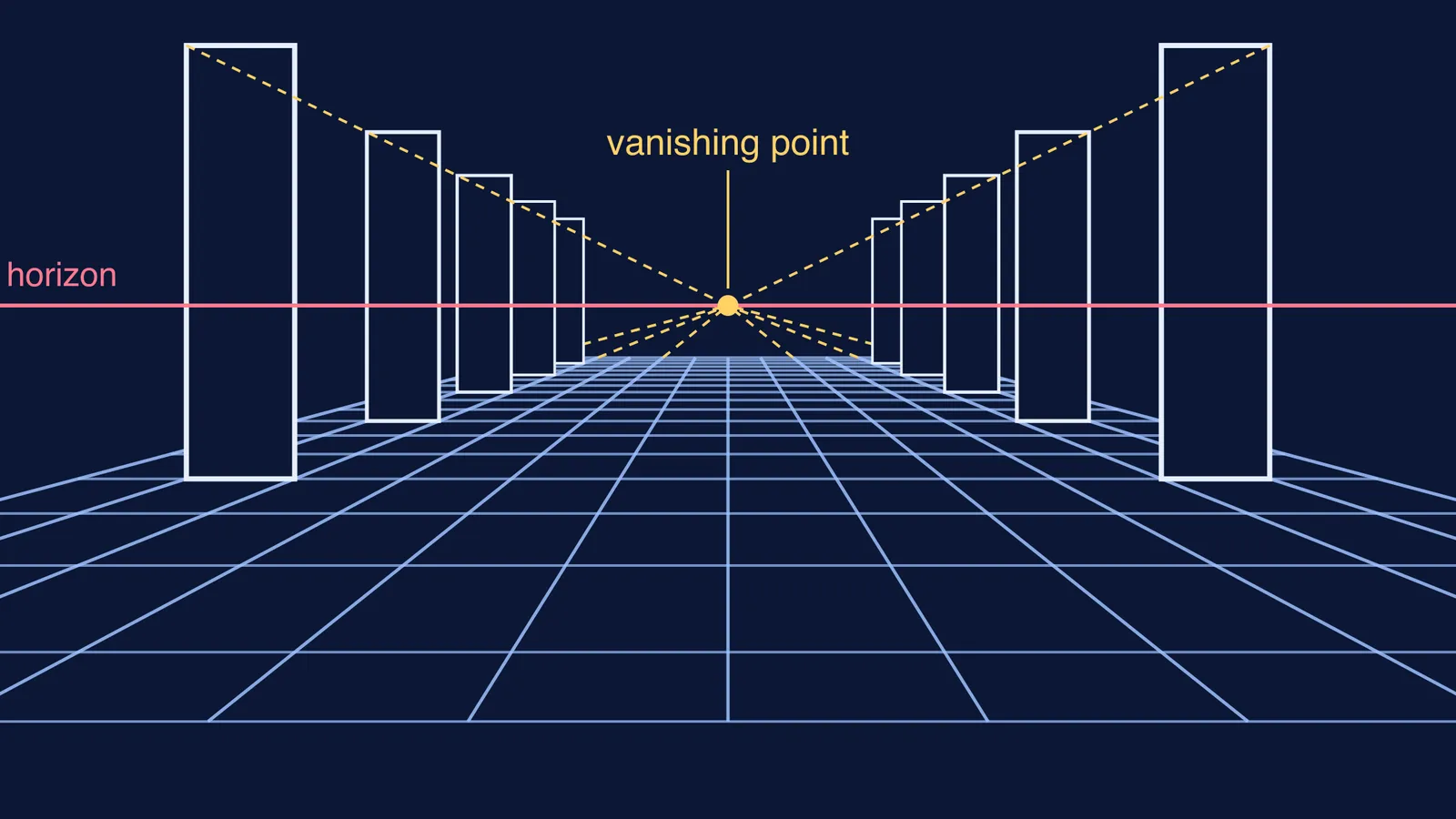
MacTutor's history of mathematics and art credits Brunelleschi with the rule: parallel lines that are not parallel to the picture appear to converge to a single point. Leon Battista Alberti called it the "centric point"; we call it the vanishing point. For level lines, such as floor tiles, it sits on the horizon, at the height of your eye.
Alberti wrote *De pictura* in Latin in 1435 and an Italian version, dedicated to Brunelleschi, the next year. Alberti defined a painting as "the intersection of a visual pyramid at a given distance, with a fixed centre". In plain words, a picture is a window: you paint where each ray from the scene to your eye crosses the glass.
How do you work out perspective with similar triangles?
This is the maths behind the diagram above. It follows from Alberti's window idea and needs nothing beyond the similar triangles you use for shadow and height problems.
Stand at a window with your eye 1.5 m above the floor and the glass 0.5 m in front of you. A line on the floor Z metres away appears on the glass this far below eye level:
drop = 0.5 × 1.5 ÷ Z = 0.75 ÷ Z metres
Floor line 2 m away: 37.5 cm below eye level
3 m away: 25 cm
4 m away: 18.75 cm
6 m away: 12.5 cm
12 m away: 6.25 cm
Equal floor tiles get thinner on the glass with distance, and the drop never reaches zero: the floor approaches the horizon but never touches it. Lines running away from you squeeze sideways the same way, so they all aim at one point on the horizon. Your eye forms its picture from rays too; see how Kepler explained the image on the retina.
If similar triangles still feel shaky, the Fermi Concept Library gives each concept its own lesson and its place in the map.
How can you repeat Brunelleschi's experiment at home?
You need a window, a whiteboard marker and a piece of card.
Tape the card, with a pea-sized hole in it, to a chair back so your eye stays in one place.
Looking through the hole, trace the edges of a building or corridor onto the glass.
Extend the lines that run away from you. They should meet at one point, level with your eye.
Move your head 30 cm sideways. The tracing no longer lines up, which is why Brunelleschi used a peephole.
Sit lower and repeat. The meeting point drops with your eye, because the horizon is at eye level.
Optics is full of ideas that are easier to see than to read, and the Fermi Simulation Lab has interactive simulations for exactly those.