

On this page
In 1604, the astronomer Johannes Kepler published *Astronomiae pars optica* (The Optical Part of Astronomy). While Kepler is most famous for mapping elliptical planetary orbits, this book contained a major step forward in the biology of human vision: he proved mathematically that the eye acts as a camera obscura.
Before Kepler's work, optical theorists such as Witelo and Ibn al-Haytham believed the crystalline lens was the sensitive organ that generated sight. The retina was largely thought to be a source of nourishment for the eye, rather than the screen on which the world is projected.
How does the eye form an image on the retina?
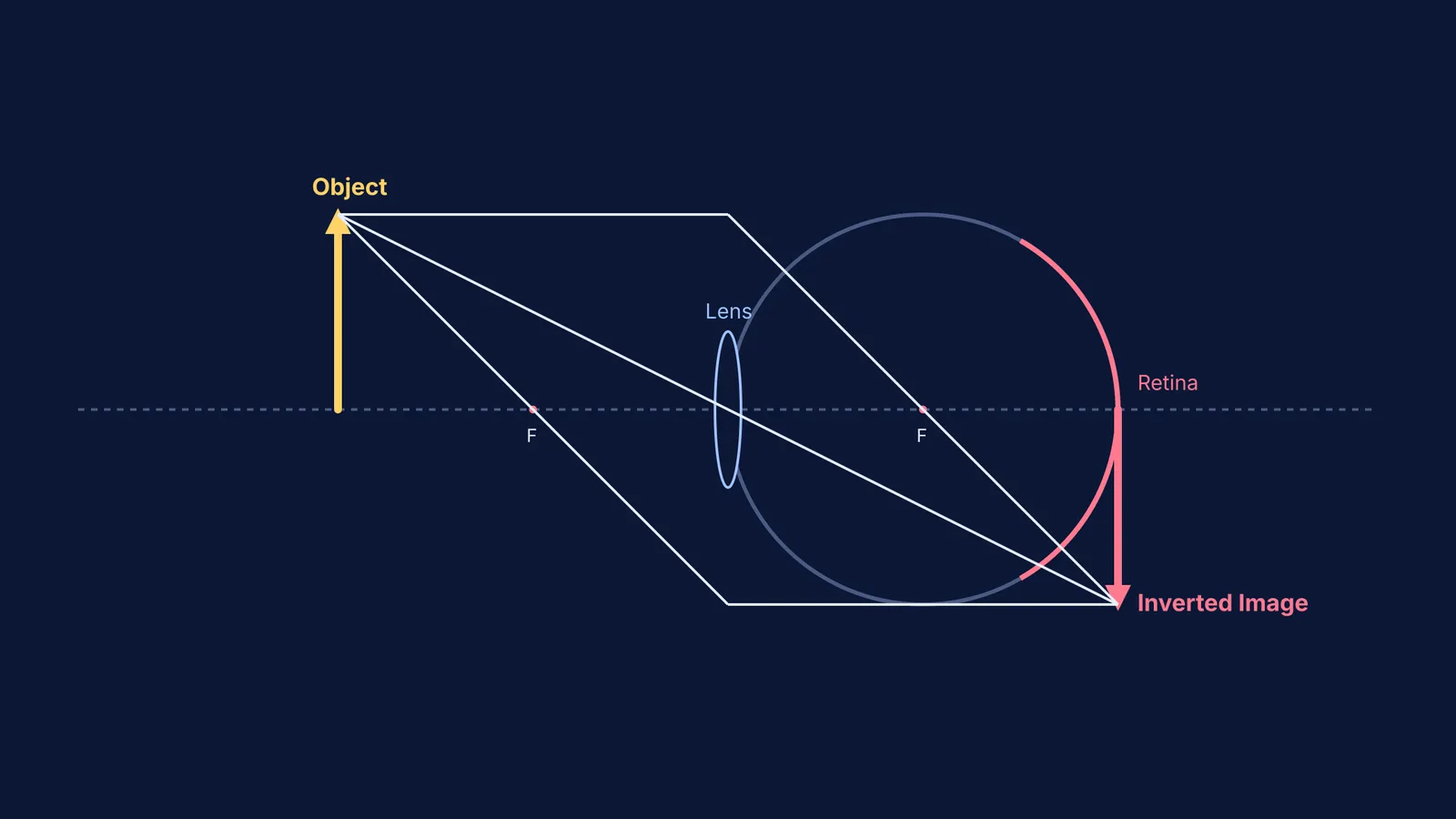
Kepler was the first scientist to correctly identify the retina at the back of the eye as the primary receptor where vision begins. He argued that the transparent humours and the crystalline lens of the eye act together as a refractive system. As light rays enter the pupil, they are bent and focused to form a *pictura* (painting) exactly on the retinal surface.
Today, we can measure this precise bending power. The human eye has a total optical power of approximately 60 dioptres. The cornea (the clear front surface of the eye) does about two-thirds of this bending. The crystalline lens handles the remaining one-third, stretching and relaxing to adjust our focus for objects at different distances.
Why don't we see the world upside down?
If you draw a ray diagram of light passing through the pupil, you run into a mathematical necessity: the image projected on the retina must be inverted (upside down) and reversed left-to-right.
This inversion was exactly why earlier scholars rejected the idea of the retina as a screen. They assumed that if an upside-down image were projected in our eyes, we would perceive the world upside down. Kepler solved this apparent paradox by splitting the problem in two. He treated the physical optics of the eye strictly as geometry, demonstrating that light rays naturally cross over each other inside the eye.
Kepler then left the question of how we perceive the image as upright to the "physicists" (what we would call physiologists or psychologists today). Modern neuroscience has confirmed Kepler's insight: the eye is merely a light-gathering instrument. It is the visual cortex at the back of our brain that flips the image and constructs the continuous, upright world we experience every day. Decades later, the philosopher René Descartes proved Kepler's physical theory by scraping the back of an ox's eye until it was transparent, allowing him to directly observe the upside-down image shining through the retina.
Seeing the steps clearly
If you are studying optics for JEE Main, JEE Advanced, or NEET-UG, drawing ray diagrams and tracking focal lengths can feel incredibly abstract. Optics is a subject where a single misplaced minus sign can put an image on the wrong side of the lens. Having a tool that acts as a sounding board helps you catch these conceptual mistakes before they become ingrained habits.
This is where Fermi's AI tutor helps. When you bring a confusing problem to Fermi, it teaches rather than answers. It works out what the student knows, draws the figure on a virtual board, and teaches through it step-by-step to show how light rays bend through convex and concave lenses.
Once you master a single lens, you can trace rays through more complex setups, such as a lens and mirror set apart, or explore why a lens's object and real image are at least 4f apart. You can even experiment with changing these focal lengths yourself in the Simulation Lab—providing interactive simulations for the ideas that are easier to see than to read.
Worked example: The focal length of the eye
We can use the standard thin lens formula, 1/f = 1/v - 1/u, to see how Kepler's model perfectly matches the anatomy of the human eye.
Find the focal length (f): An optical power of 60 dioptres means the focal length is f = 1/60 metres, which is roughly 1.67 cm.
Set the object distance (u): When you look at a distant tree or a star, the light rays arriving at your eye are parallel, meaning the object distance is essentially infinity (u = −∞).
Calculate the image distance (v): Because dividing by infinity approaches zero (1/−∞ = 0), the formula simplifies to 1/v = 1/f. Therefore, the image distance v exactly equals the focal length.
This calculation shows that the focused image forms exactly 1.67 cm behind the optical centre of the eye. In a healthy human eye, this is precisely the distance from the refractive centre to the retina, confirming Kepler's 400-year-old geometric proof.


