

On this page
If you raise your right hand in front of a mirror, the person in the glass seems to raise their left hand. This classic "left-right flip" is known as lateral inversion, and it is a standard topic in introductory optics. But physics tells a slightly different story: a mirror does not actually swap left and right.
Instead, a plane mirror performs a front-back reversal. Here is how that reversal creates the illusion of lateral inversion, and why it dictates the rules for image distance and size.
What is the physical reality of front-back reversal?
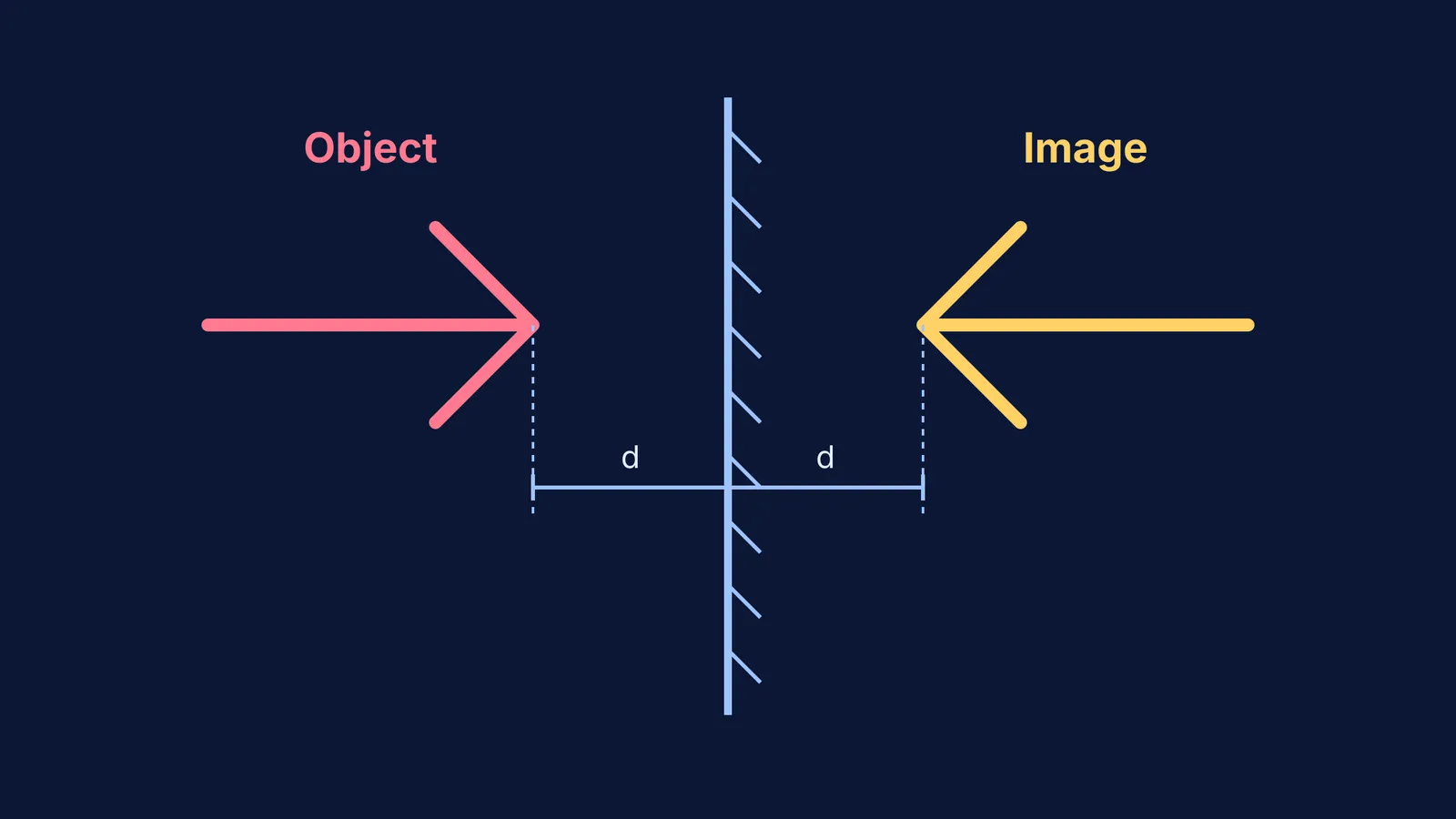
A plane mirror does not physically flip an image horizontally or vertically. Instead, it reverses the object in the direction perpendicular to its surface, creating a front-back reversal.
Think of an arrow pointing directly at the mirror. The tip of the arrow is closer to the glass than the tail. Because the mirror reflects the closest parts first, the image of the arrow will also have its tip closer to the glass. In the real world, an arrow pointing East reflects as an image pointing West. The horizontal (left-right) and vertical (up-down) axes remain completely unchanged.
Why do we perceive a left-right flip?
If the mirror only flips front to back, why does it look like our left and right hands have swapped? The answer lies in human psychology and spatial awareness.
When you look at your reflection, you see what appears to be another person facing you. To actually stand face-to-face with yourself in real life, you would have to physically rotate your body 180 degrees around a vertical axis. Because your reflection has "turned around" to face you without that physical rotation ever taking place, your brain assumes a left-right swap must have happened. We find it much easier to imagine rotating ourselves sideways than turning ourselves inside out or flipping upside down.
If this three-dimensional geometry is hard to picture, the Fermi Simulation Lab has interactive simulations for the ideas that are easier to see than to read. You can rotate objects in front of a mirror to watch exactly how the Z-axis flips.
How do we reflect coordinates in a mirror?
Let's map out front-back reversal using a 3D coordinate system. Imagine a plane mirror lying flat on the X-Y plane (like a mirror on the floor). The Z-axis points straight up.
Suppose you hold an object shaped like the letter 'L' above the mirror. The long vertical stroke goes from z = 5 to z = 10, and the short horizontal stroke is at z = 5 pointing in the positive X direction (from x = 0 to x = 3).
Find the image of the vertical stroke: The point (0, 0, 5) reflects to (0, 0, -5). The point (0, 0, 10) reflects to (0, 0, -10). The image is a vertical stroke from z = -5 to z = -10.
Find the image of the horizontal stroke: The point (0, 0, 5) reflects to (0, 0, -5). The tip of the stroke at (3, 0, 5) reflects to (3, 0, -5).
Analyze the result: The X and Y coordinates are identical for the object and the image. The stroke still points in the positive X direction. However, the top of the 'L' (which was at z = 10) is now at the bottom of the image (z = -10).
Because the mirror is on the X-Y floor, the axis perpendicular to it is the Z-axis. Only the Z-axis coordinates flip their signs.
Why is AMBULANCE written backwards?
Emergency vehicles paint the word "AMBULANCE" in reverse on their bonnets to account for this front-back reversal. When you look at the text directly, it looks flipped. But when you view it in your car's rear-view mirror, the mirror performs its natural front-back reversal. This second reversal undoes the first, allowing you to read the word normally and yield the right of way immediately.
How do we prove the image distance rule?
The rule that image distance equals object distance can be proven using the mirror equation.
Write the mirror equation: The relationship between object distance (d_o), image distance (d_i), and focal length (f) is 1/d_o + 1/d_i = 1/f.
Apply the plane mirror condition: Because a plane mirror is perfectly flat, its focal length is infinity. Therefore, 1/f = 0.
Solve for image distance: The equation simplifies to 1/d_o + 1/d_i = 0, which means d_i = -d_o.
The negative sign indicates the image is virtual (behind the mirror). Because the distances are equal, the linear magnification is exactly 1. This means the image is always the exact same size and shape as the object, regardless of how far away you stand.
If you are confused by sign conventions or ray diagrams in optics, Fermi can help you map out the geometry. The Fermi Concept Library holds every concept in physics, chemistry, biology, mathematics and computing, each with its own lesson and its place in the map. When you dive into a topic, the AI tutor works out what you already know, builds a plan for the session, and teaches through it — writing on a board, drawing the figure, running the simulation, and checking understanding as it goes.


