On this page
At 2:46 pm on Friday 11 March 2011, a magnitude 9.0 earthquake struck off north-east Japan, and the three operating reactors at Fukushima Daiichi, Units 1 to 3, shut down automatically, as designed (World Nuclear Association). Stopping the chain reaction worked. What failed was removing the heat a reactor keeps making after it is switched off.
What happened at Fukushima on 11 March 2011?
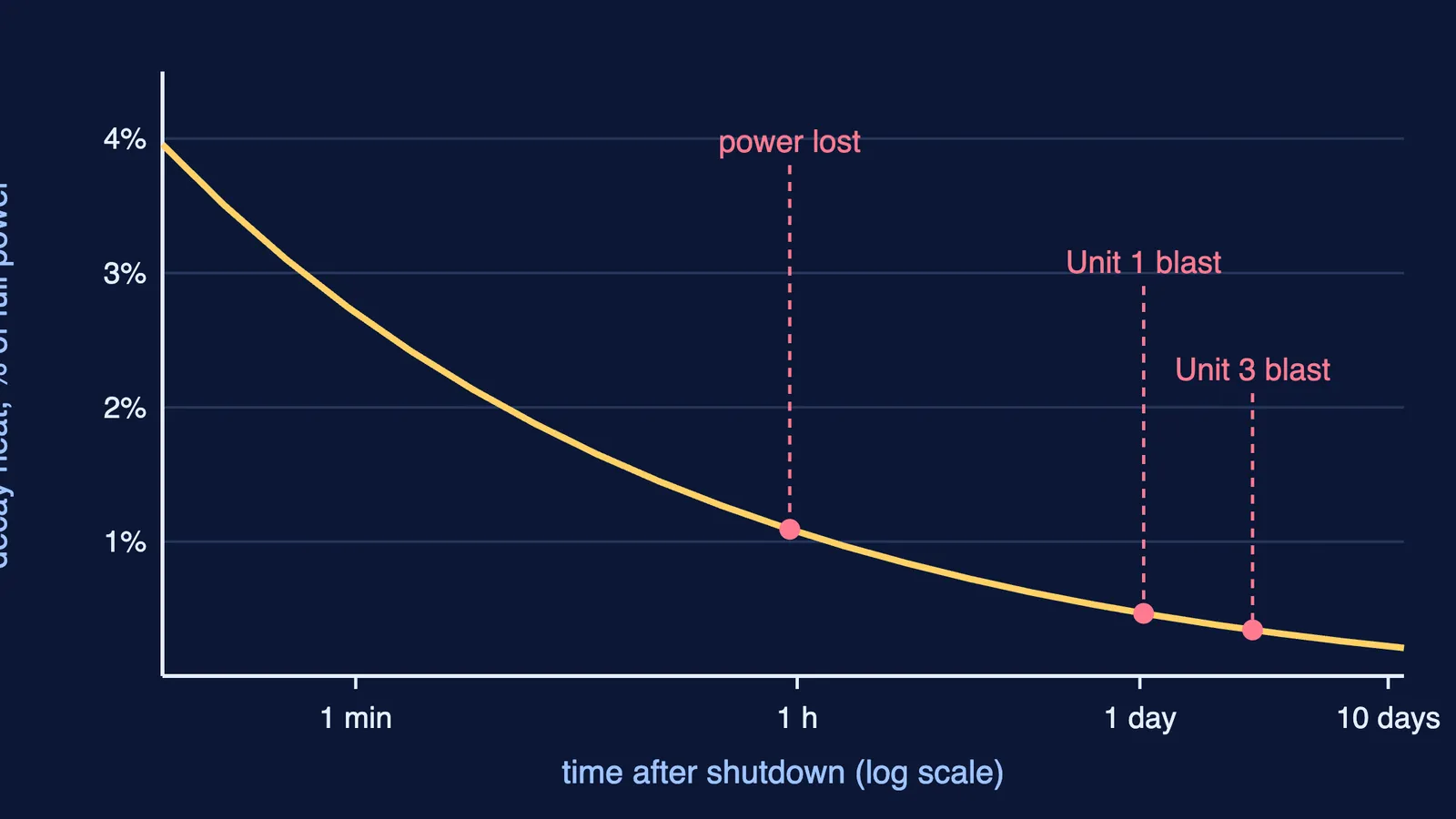
The earthquake cut all six external power supplies to the plant, so emergency diesel generators in the basements of the turbine buildings started up (World Nuclear Association). Then the tsunami arrived, a first wave and a second 8 minutes behind it. By 3:42 pm, almost an hour after the earthquake, the flooded site had lost power.
The tsunami came ashore about 15 metres high, while the site's design basis tsunami had been revised to 5.7 metres in 2002 and 6.1 metres in 2009 (World Nuclear Association). The water drowned the generators, switchgear and batteries, disabling 12 of the 13 backup generators on site.
The US Nuclear Regulatory Commission summarises what followed: steam-driven and battery-powered safety systems at Units 1, 2 and 3 worked for several hours, some for more than a day, then failed, and all three reactors overheated, melting their cores to some degree (US NRC). For how undersea earthquakes launch such waves, see our post on the Andaman Islands and the 2004 tsunami.
Why does a reactor still need cooling after it shuts down?
Decay heat is the energy released by the radioactive decay of fission products that are already in the fuel, and it keeps flowing after the chain reaction stops. Control rods, which our explainer on how a nuclear reactor works describes, stop fission quickly; they cannot stop decay.
Immediately after shutdown, decay heat is roughly 7% of the power the reactor was running at (US DOE Fundamentals Handbook). When the power failed, about one hour after shutdown, the Fukushima cores were still producing about 1.5% of their full thermal power, about 22 MW in Unit 1 and 33 MW in each of Units 2 and 3 (World Nuclear Association). The fall is steep, then slow; Katharine Way and Eugene Wigner's 1948 approximation has it going roughly as t to the power minus 0.2 (Decay heat, Wikipedia).
How much water does decay heat boil?
Take a made-up round number: a core that ran at 1,000 MW of heat. One hour after shutdown, at 1.5%, it still makes 15 MW (World Nuclear Association). Boiling water at 100 °C and atmospheric pressure takes 2,257 kJ per kilogram (Engineering ToolBox).
Heat per second: 15 MW = 15,000 kJ/s.
Water boiled per second: 15,000 ÷ 2,257 ≈ 6.6 kg/s.
Per hour: 6.6 × 3,600 ≈ 24,000 kg, about 24 tonnes.
After a day, decay heat is about 0.4% (Decay heat, Wikipedia): 4 MW, or roughly 6 tonnes of water boiled every hour.
Reactor water is under high pressure, so the real figure differs, but the scale is the lesson: without pumps, the water boils off and the fuel is uncovered.
Why did the Fukushima reactor buildings explode?
These were hydrogen explosions, not nuclear ones. When the water level dropped, the fuel's very hot zirconium cladding reacted with steam, and that oxidation produces hydrogen and gives off heat (World Nuclear Association). The reaction is Zr + 2H2O → ZrO2 + 2H2: zirconium goes from oxidation state 0 to +4, and hydrogen from +1 to 0, a redox pair worth balancing yourself.
Vented hydrogen collected at the tops of the buildings, mixed with air and ignited. Unit 1 exploded at 3:36 pm on 12 March and Unit 3 at 11:00 am on 14 March (World Nuclear Association). At about 6:00 am on 15 March the Unit 4 building, whose reactor was not operating, exploded too, apparently from Unit 3's hydrogen flowing back through shared ducts. The accident was rated level 7 on the International Nuclear and Radiological Event Scale.
How many people did the Fukushima accident harm?
There have been no deaths or cases of radiation sickness from the nuclear accident, while about 19,500 people were killed by the earthquake and tsunami (World Nuclear Association). Over 100,000 people were evacuated, and 2,313 disaster-related deaths were recorded among Fukushima prefecture evacuees, a reminder that evacuation itself carries a cost.
Japan's Ministry of the Environment, summarising the UN scientific committee UNSCEAR, reports that the excess of thyroid cancers found in children does not appear to be linked to radiation, but rather to highly sensitive ultrasound screening (Ministry of the Environment, Japan).
How can you use Fukushima to think through any disaster?
Follow the energy. These four questions work for a reactor, a pressure cooker or the Bhopal gas leak:
Where is energy produced, and can it be switched off? Fission could be; decay could not.
Where must it go? Into water, steam, then the sea.
What carries it, and what powers the carrier? Pumps, which need electricity.
If the path breaks, what happens? Temperature rises, water boils and new reactions start.
If a curve like decay heat is easier to grasp when you can play with it, the Fermi Simulation Lab has interactive simulations for ideas that are easier to see than read. To revise radioactive decay and half-life from the ground up, the Fermi Concept Library covers every concept in physics and chemistry.