

On this page
In 1913 there were dozens of radioactive "elements" and few empty boxes in the periodic table. Alexander Fleck, working in Glasgow on Frederick Soddy's suggestion, took every radio-element that lived long enough to handle and tried to pull it away from the ordinary element it most resembled. Again and again he failed. Uranium-X would not leave thorium, thorium-B would not leave lead, radium-E would not leave bismuth, and thorium-D went with thallium. Those failures were the experimental evidence behind the radioactive displacement law. His tables also give you two exam calculations: a t_max and a half-life.
What did Alexander Fleck publish in 1913?
Two papers in J. Chem. Soc. Trans. 103: "The Chemical Nature of Some Radioactive Disintegration Products", pages 381–399, and Part II, pages 1052–1061. We read both in the scanned 1913 volume and checked every number below against the page images. The papers print only "Alexander Fleck, B.Sc." and "Physical Chemistry Department, Glasgow University"; we have not checked other biographical details. Fleck thanks Soddy "for suggesting this research". Soddy's own story, and the decay chain from uranium-238 to lead-206, are in our post on Frederick Soddy and the displacement law, so they are not repeated here.
This is history and arithmetic only; these materials are dangerous, and no procedure is given.
How do you prove two substances cannot be separated?
There is far too little of a radio-element to weigh. So Fleck mixed it with a weighable carrier, split the carrier into fractions as hard as he could (by precipitation, crystallisation or volatilisation), and measured the activity per gram of each fraction. A different element would be enriched in some fractions. Constant activity per gram means the two travel together.
In his uranium-X test, ten thorium precipitates weighed 0.0225 g to 0.5221 g after ignition, a 23-fold range. Activity per gram (arbitrary units) read 61.95, 52.49, 60.36, 63.08, 63.90, 63.31, 62.30, 62.16, 59.0 and 56.90. The mean is 60.5. Nine of the ten lie within about 6% of it, and the odd one (52.49) is the second, not the last, so there is no drift. Fleck's verdict: "no alteration in the concentration of uranium-X and thorium has taken place."
Compare Soddy's 1909 fractionations, whose material Fleck found to contain no thorium. There the uranium-X "in some cases" came down "almost entirely in the last minute fraction". Add thorium, and it spreads evenly through every fraction.
Which elements did Fleck match the radio-elements with?
His Part I summary, in his words: "uranium-X and radio-actinium are chemically similar to, and non-separable from, thorium; mesothorium-2 is non-separable from actinium; thorium-B is non-separable from lead". Radium-B and actinium-B were "extremely similar to lead, and most probably non-separable from it". The C-products were "very closely allied to bismuth", and radium-E had chemical properties "identical with those of bismuth in all respects".
That overturned "a fairly general belief" that the active-deposit products were "allied to the noble metals". His tests showed "that neither thorium-B nor -C are allied to the noble metals as hitherto supposed"; they behave as lead and bismuth.
By Part II, Russell, Hevesy, Fajans and Soddy had published the displacement law, and Fajans and Soddy had predicted "that the D members should be analogous to thallium". Fleck found that thorium-D came down with thallium platinichloride, and that actinium-D "cannot be separated from thallium". Radium-A behaved as polonium. He ends: "These experiments therefore confirm the correctness of the general theoretical law".
Fleck did not state the law. He supplied the chemistry it had to fit.
How does the displacement law follow from his results?
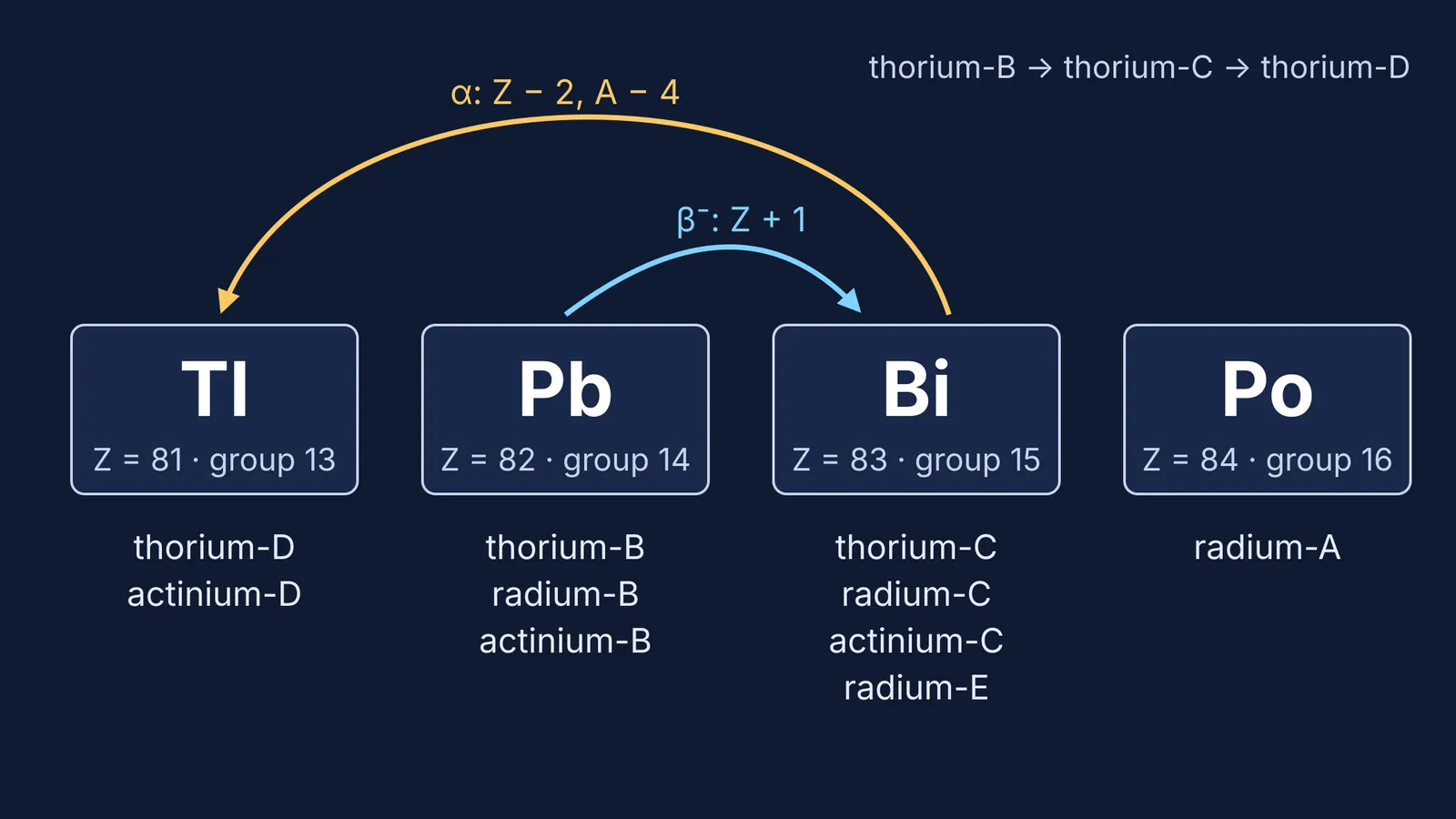
Write each 1913 name as a modern nuclide, using the IAEA LiveChart of Nuclides: thorium-B is Pb-212, thorium-C is Bi-212, thorium-D is Tl-208, radium-E is Bi-210 and radium-F is Po-210.
Worked example 1: the thorium active deposit.
Thorium-B (Pb-212, Z = 82) is a β emitter. ²¹²₈₂Pb → ²¹²₈₃Bi + ⁰₋₁e. Check: A 212 = 212 + 0; Z 82 = 83 − 1. Lead (group 14) becomes bismuth (group 15): one place right.
Thorium-C (Bi-212) can emit an α particle. About 36% of Bi-212 atoms do this, according to the IAEA chart. ²¹²₈₃Bi → ²⁰⁸₈₁Tl + ⁴₂He. Check: A 212 = 208 + 4; Z 83 = 81 + 2. Bismuth (group 15) becomes thallium (group 13): two places left.
Match with Fleck. B with lead, C with bismuth, D with thallium: the sequence he found by precipitation.
Likewise radio-lead (Pb-210) β-decays to radium-E (Bi-210), which β-decays to radium-F (Po-210), polonium. Fleck showed polonium grows from radium-E with nothing in between.
How long does it take for actinium-X to peak?
Radio-actinium (A) decays to actinium-X (B), which decays further. Starting from pure A, the amount of B rises from zero and then falls. Fleck wrote the time to the maximum as θ = ln(λ₁/λ₂)/(λ₁ − λ₂), the t_max of parallel and consecutive reactions in your kinetics chapter.
Worked example 2: t_max from 1913 data. Fleck took the mean lives (1/λ) as 28.1 days for radio-actinium and 15 days for actinium-X.
λ₁ = 1/28.1 = 0.03559 per day; λ₂ = 1/15 = 0.06667 per day.
ln(λ₁/λ₂) = ln(0.5338) = −0.6277.
λ₁ − λ₂ = −0.03108 per day.
θ = −0.6277 ÷ −0.03108 = 20.2 days. The paper prints 20.23.
He saw it too: separated thorium carrying radio-actinium had almost no activity at first, then "rose to a maximum in about twenty days".
Modern IAEA half-lives (Th-227, 18.697 d; Ra-223, 11.43 d) give 20.9 days.
What half-life do his radium-E numbers give?
Fleck split bismuth carrying radium-E into four fractions and measured each on 23 October and on 29 October, six days later. Activity per gram on the first date: 2.67, 2.58, 2.72, 2.68. On the second: 1.099, 1.120, 1.215, 1.084.
Worked example 3: half-life from a decay table.
Mean activity per gram: 2.6625 on 23 October, 1.1295 on 29 October.
Fraction left after 6 days: 1.1295 ÷ 2.6625 = 0.424.
First-order decay: 0.424 = (1/2)^(6/t½), so t½ = 6 × ln 2 ÷ ln(1/0.424) = 4.85 days.
Fraction by fraction, the answers run from 4.59 to 5.16 days.
Fleck states that the β activity "decayed to half value in five days", and the growth curves he compared with used a mean life of 7.25 days, which is a 5.03-day half-life. A 5.0-day half-life predicts a ratio of 0.435 after six days. The IAEA chart gives Bi-210 a half-life of 5.012 days. Four small samples and an electroscope got within 4% of it.
Where does this come up in JEE and NEET?
Class 12 Physics, Nuclei: α and β decay, A and Z bookkeeping, and the law of radioactive decay.
Class 12 Chemistry, Chemical Kinetics: first-order half-life from data.
JEE Advanced kinetics: t_max for consecutive first-order steps.
For more decay and consecutive-reaction problems, the Fermi Problem Library has a step-by-step solver that explains the reasoning. For exam practice, Fermi Test Prep is JEE Main and Advanced preparation with an AI tutor.
Quick checklist
Constant activity per gram across fractions means no separation.
Fleck's chemistry: B with lead, C with bismuth, D with thallium, radium-E with bismuth, radium-A with polonium.
β decay: Z up by 1, one group right. α decay: Z down by 2, A down by 4, two groups left.
t_max = ln(λ₁/λ₂)/(λ₁ − λ₂); with mean lives 28.1 and 15 days it is 20.2 days.
His radium-E table gives t½ ≈ 4.85 days; today's value is 5.012 days.


