On this page
On 10 January 1954, a BOAC Comet 1, registration G-ALYP, broke up over the Mediterranean near Elba, killing all 35 people on board. On 8 April, a second Comet, G-ALYY, came down near Naples, killing 21. The Aerossurance review of the Comet investigation lists both crashes and notes that Comets had returned to service on 23 March, just over two weeks before the second loss. Finding out why taught engineers how metal fails when the same load comes back again and again.
What is metal fatigue?
In materials science, fatigue is "the initiation and propagation of cracks in a material due to cyclic loading" (Fatigue (material), Wikipedia)). The key word is cyclic. Each load can be far too small to break the part, but every cycle can push a tiny crack a little further. When the crack is long enough, the metal that is left snaps suddenly.
The idea was old by the 1950s: the same source records August Wöhler summarising his railway-axle fatigue tests in 1870. Engineers plot fatigue as an S-N curve, stress against cycles to failure: lower stress, more cycles.
Why did the Comet's fuselage fatigue?
A jet cruises where the air is thin, so the cabin is pumped up like a balloon. Aerossurance gives the Comet's working pressure difference as about 8.25 pounds per square inch. Every flight is one cycle: pressurise on the climb, release on the descent.
De Havilland had tested for fatigue. Aerossurance reports a test cabin that failed only after 16,000 cycles, against a safe-life target of 10,000. But that cabin had first been proof-tested to twice the working pressure, which, Aerossurance explains, cold-worked the metal around the stress concentrations and masked the true fatigue weakness of the production Comet.
How did the water tank test find the cause?
Investigators at the Royal Aircraft Establishment (RAE) at Farnborough put a whole Comet, G-ALYU, into a 200,000-gallon water tank and pressurised it over and over (Aerossurance). Water barely compresses, so a rupture would not explode. G-ALYU had already made 1,230 pressurised flights. After 1,830 more cycles in the tank, about 3,060 in all, the cabin split open from the corner of the forward escape hatch.
According to Aerossurance, the Elba break began at the opening for a direction-finding aerial on the top of the fuselage, not at a passenger window: square windows were one of several stress raisers. A Court of Inquiry under Lord Cohen reported on 1 February 1955. About a year later, British rules required fatigue tests on a complete pressure cabin that had not been used for strength tests (Aerossurance), and manufacturers replaced square openings such as windows with oval ones (Fatigue (material), Wikipedia)).
Why do square corners concentrate stress?
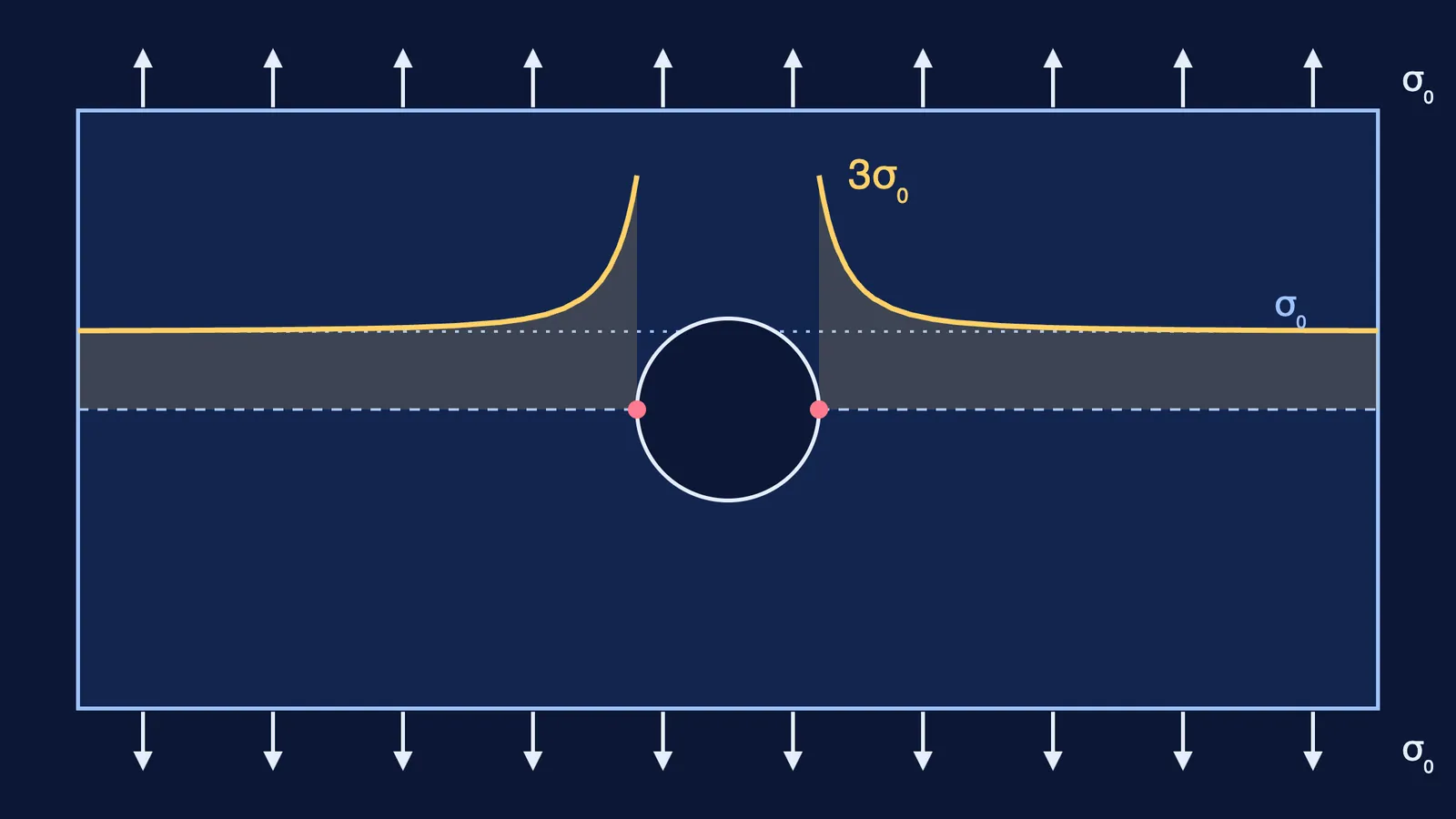
Force flowing through a plate crowds round any hole. In 1898 Ernst Kirsch showed that a small circular hole in a wide plate under tension triples the stress at the two edge points beside the load path, a stress concentration factor of 3 (fracturemechanics.org on Kirsch's solution).
In 1913 Charles Inglis worked out the stress at an elliptical hole: the peak is σ₀(1 + 2√(a/ρ)), where a is the half-width across the load and ρ is the radius of curvature at the tip (fracturemechanics.org on Inglis's solution). A sharp corner means a tiny ρ, so the peak shoots up. As the Wikipedia entry on stress concentration puts it, "Fatigue cracks always start at stress raisers".
Here is a worked example: the same opening with three different corners. Take an opening 200 mm wide across the load, so a = 100 mm, in skin carrying a nominal stress σ₀. Treating each corner as an ellipse tip is rough, but fine for comparing options:
Corner radius 4 mm: a/ρ = 25, √25 = 5, so the peak is σ₀(1 + 10) = 11σ₀.
Corner radius 25 mm: a/ρ = 4, √4 = 2, so the peak is σ₀(1 + 4) = 5σ₀.
Radius 100 mm, a full circle: a/ρ = 1, so the peak is 3σ₀, Kirsch's result.
Rounding the corner from 4 mm to 25 mm more than halves the peak stress, and on an S-N curve lower stress means more cycles before failure.
How can you spot a fatigue risk?
Does the load repeat? Cabin pressure, a pedal, a ceiling fan's wobble.
Is there a hole, notch, sharp inside corner or sudden change in thickness?
How sharp is the corner? Smaller radius, higher peak stress.
Was it tested fresh, the way it is actually used?
Is it inspected for cracks before they grow long?
Try a paperclip: one bend will not break it, but bending the same spot back and forth soon will.
For JEE and board exams, this builds on stress, strain and Young's modulus: start with reading the stress-strain curve of a wire and why breaking load depends on area. If elasticity is a gap, the Fermi Concept Library gives each concept its own lesson, and the Fermi Simulation Lab has interactive simulations for ideas that are easier to see than to read.
For the story of the first metal aeroplanes, read about Hugo Junkers and the all-metal J 1.