

On this page
In 1915, most aircraft were fabric-covered wooden frames braced with wires. That year, Hugo Junkers, an engineer and former professor of mechanical engineering, built something very different. His J 1 was made of steel, had a single wing on each side, and had no struts or wires holding those wings on.
What was the Junkers J 1?
The J 1 was an experimental single-engine monoplane, and it is widely described as the first all-metal aircraft to fly (Junkers J 1, Wikipedia). Its German nickname was *Blechesel*, the “tin donkey” or “sheet-metal donkey”.
Its skin was steel sheet only 0.1 to 0.2 mm thick (Encyclopædia Universalis). Junkers had wanted duralumin, a light aluminium alloy, but could not get it, so corrugated iron sheet was used instead (Store norske leksikon). The result was heavy: about 920 kg empty and 1,080 kg loaded, with a 120 hp Mercedes D.II engine (Junkers J 1, Wikipedia).
On 12 December 1915 the J 1 made a short hop at Dessau, reaching almost 3 m. Its first real flight came on 18 January 1916 at the army airfield at Döberitz, near Berlin. The only J 1 went on display at the Deutsches Museum in Munich in 1926 and was destroyed in a bombing raid in December 1944 (Junkers J 1, Wikipedia). Its top speed was 170 km/h (Encyclopædia Universalis).
Who was Hugo Junkers?
Junkers was born on 3 February 1859 in Rheydt, Prussia, and taught mechanical engineering at Aachen from 1897 to 1912 (Hugo Junkers, Wikipedia). In 1910 he patented the idea of carrying passengers inside a thick wing, and he built a wind tunnel to test his shapes.
After the war his company built the F 13 of 1919, an all-metal airliner. Junkers opposed Nazi rearmament, was placed under house arrest in 1934, and died in 1935 (Hugo Junkers, Wikipedia).
How can a wing stay on without struts or wires?
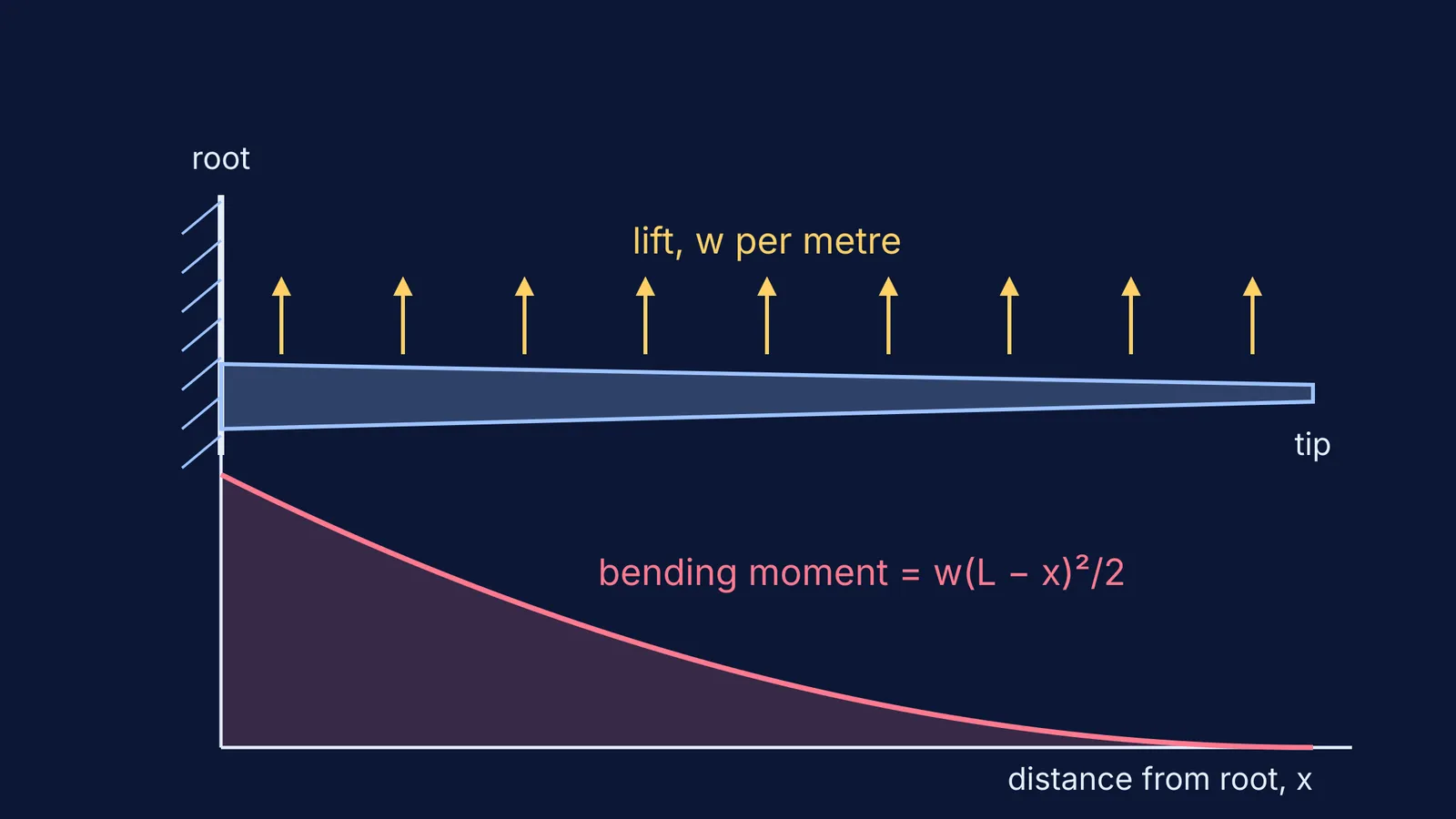
A wing with no outside bracing is a cantilever: a beam fixed at one end and free at the other, like a diving board. The J 1's cantilever wing was not joined to the fuselage by any strut or mast (Encyclopædia Universalis), so the wing alone had to carry its load back to the root.
Lift pushes up along the whole wing. For a cantilever of length L with a uniform load w per metre, the bending moment at the fixed end is wL²/2 (Engineering ToolBox). That moment is greatest at the root and falls to zero at the tip, which is the curve in the diagram above.
In a braced biplane, wires and struts turn the two wings into a stiff truss. Take them away and the wing must resist the bending by itself. A beam does this by pulling on one face and pushing on the other, and the force on each face is roughly the moment divided by the beam's depth. A deeper beam needs smaller forces. That is why Junkers made his wing thick.
A worked example: the J 1's wing root
These rough numbers give a sense of scale, not a design calculation.
Weight: the loaded J 1 was 1,080 kg (Junkers J 1, Wikipedia), so in level flight lift is about 1,080 × 9.81 ≈ 10,600 N, or about 5,300 N per wing.
Length: the span was about 12.9 m (Store norske leksikon). Ignoring the fuselage, call each wing a cantilever of about 6 m.
Load per metre: w ≈ 5,300 ÷ 6 ≈ 880 N/m, if lift is spread evenly.
Root moment: wL²/2 ≈ 880 × 36 ÷ 2 ≈ 15,900 N·m.
Face forces: for an imagined wing 0.1 m deep at the root, each face carries about 15,900 ÷ 0.1 ≈ 159,000 N. Make it 0.4 m deep and that falls to about 40,000 N.
A sharp turn multiplies the lift, and every number above with it. The lesson holds: depth buys strength. Forces and moments are often easier to see than to read, and the Fermi Simulation Lab has interactive simulations for ideas like these.
Why does the J 1 still matter?
Look out of the window on a flight from Delhi or Bengaluru. The wing has no struts or wires; it is a metal cantilever, deepest at the root, where the moment curve says the load is greatest. The material moved from steel to aluminium alloys, a story that began when electrolysis made aluminium cheap, and wing shapes were refined with ideas like Ludwig Prandtl's boundary layer. For contrast, read about the Wright brothers' first flight, worked out in numbers.
For JEE and board students, this is the torque and equilibrium you already study, applied to a beam. If the moment step feels shaky, the Fermi Problem Library works through problems with a step-by-step solver that explains the reasoning rather than printing an answer.


