On this page
The compass and gunpowder both first appear in Chinese texts, and neither has a single named inventor. Here is what the old texts say, then the physics and chemistry behind both, with a worked example.
Who invented the compass?
The earliest text is the Lunheng, written between 70 and 80 AD, which says that a south-pointing spoon thrown on the ground "comes to rest pointing at the south", according to the history of the compass compiled on Wikipedia. The passage never mentions magnetism, and the spoon is only speculated to be lodestone, but the device is widely considered the earliest form of the magnetic compass. Early compasses served geomancy and fortune-telling, not navigation.
Three Song dynasty texts follow, all described on the same page:
1040 to 1044: the military manual Wujing Zongyao describes an iron "south-pointing fish" floating in a bowl of water. It was magnetised by heating, an effect now called thermoremanence.
1088: Shen Kuo's Dream Pool Essays give the first incontestable account of a magnetised needle. Geomancers rubbed its tip with lodestone and hung it from a single strand of silk.
1111 to 1117: Zhu Yu's Pingzhou Ketan records ship's pilots who steer by the stars and sun, and "in dark weather they look at the south-pointing needle".
Shen Kuo described needles both floating and in mountings, and judged the suspended needle the best form, according to his biography on Wikipedia. He also recognised that magnetic north is not true north. The same history of the compass dates Europe's first description of a needle used by sailors to Alexander Neckam, writing around 1190. For how the idea may have moved west, read what travelled the Silk Road, from paper to the compass.
How does a magnetised needle find north?
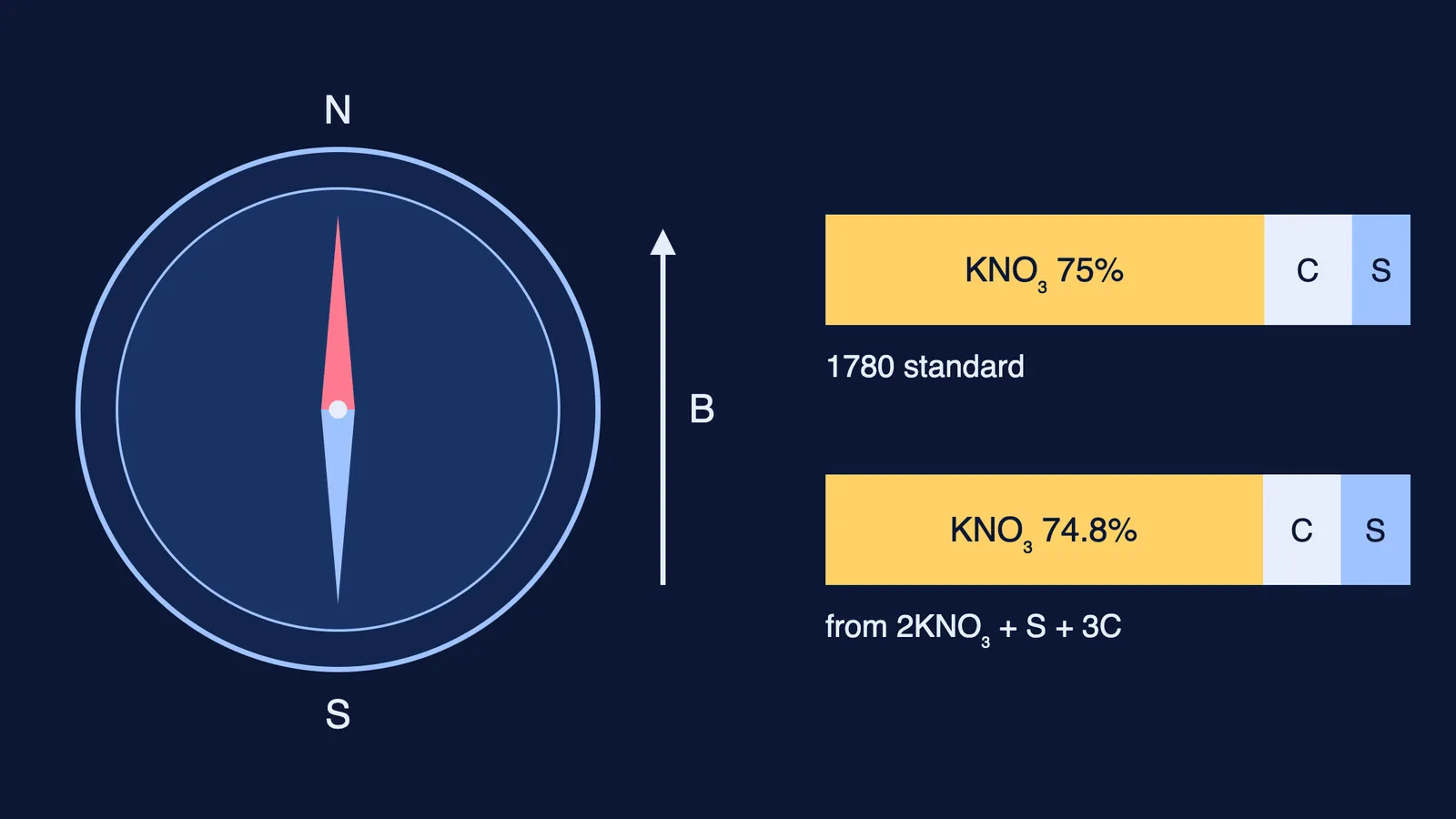
Rubbing steel with lodestone lines up the tiny magnetic regions inside it, so the needle becomes a weak bar magnet with a magnetic moment m. Earth's field B then twists it with a torque of mB sin θ, where θ is the angle between the needle and the field. The torque is zero at θ = 0 and at θ = 180°, but only θ = 0 is stable. So the needle comes to rest with its north end along the horizontal part of Earth's field.
Floating the needle or hanging it from one silk thread removes most friction, so a weak magnet can still turn.
The needle points to magnetic north, not true north. The angle between them is the declination, explained in dip, declination and Earth's horizontal field. Iron nearby bends the field too, as in why a compass points wrong near iron.
If torque on a magnet is hard to picture, the Fermi Simulation Lab has interactive simulations for ideas that are easier to see than read.
What is gunpowder made of, and why does it burn so fast?
Gunpowder is a mixture of sulfur, charcoal and potassium nitrate (saltpetre); the sulfur and charcoal are fuels and the saltpetre is the oxidiser, according to the Wikipedia article on gunpowder. Burning releases oxygen from the saltpetre, which speeds the burning of the other ingredients. Sulfur lowers the temperature needed to ignite the mixture.
The standard pyrotechnic recipe, adopted as long ago as 1780, is 75% potassium nitrate, 15% charcoal and 10% sulfur by mass.
A Daoist text from the mid-800s records that some who "heated together sulfur, realgar and saltpeter with honey" burnt their hands, faces and even a house. The Chinese name, huoyao, means "fire medicine". The 1040 to 1044 Wujing Zongyao gives the earliest written formulas, with at most 50% saltpetre: enough for an incendiary, not an explosion.
Where does the 75:15:10 recipe come from?
The Wikipedia article on gunpowder gives a simple, commonly cited equation: 2KNO₃ + S + 3C → K₂S + N₂ + 3CO₂. Check it balances: 2 K, 2 N, 6 O, 1 S and 3 C on each side. Real powder burns through many reactions, so treat this as a model.
Molar masses: KNO₃ = 101.1 g/mol, S = 32.06 g/mol, C = 12.01 g/mol.
Masses: 2 × 101.1 = 202.2 g; 32.1 g of sulfur; 3 × 12.01 = 36.0 g of carbon. Total 270.3 g.
Percentages: 202.2 ÷ 270.3 = 74.8% saltpetre, 13.3% carbon, 11.9% sulfur.
Gas: 270.3 g of solid gives 4 mol of gas (1 N₂ + 3 CO₂), about 90 litres at 0 °C and 1 atm.
The ratio from the equation lands within two percentage points of the real recipe, and the sudden gas is what pushes. The Fermi Problem Library has a step-by-step solver that explains the reasoning, if stoichiometry still trips you up.
How do you remember all this for an exam?
Spoon, fish, needle: south-pointing spoon (70 to 80 AD), heated iron fish (1040 to 1044), rubbed needle (1088).
Sea use: Zhu Yu, 1111 to 1117.
Physics: torque mB sin θ is zero along the field; only the north-pointing position is stable.
Chemistry: saltpetre is the oxidiser, charcoal and sulfur are fuels, and sulfur lowers the ignition temperature.
Next time you see a compass needle settle, ask yourself which way the torque is pushing it.