On this page
The Silk Roads were never one road. UNESCO describes them as "land and maritime routes along which silk and many other goods were exchanged between communities across the world", and says science, crafts and technologies were shared along them too (UNESCO, About the Silk Roads). Two of those travellers sit on your desk today: paper and the digits you write on it. A third, the compass, may have travelled too.
What ideas travelled on the Silk Road?
UNESCO names the manufacture of paper, followed by printing, as one of the most famous technical innovations spread along these routes (UNESCO). Indian numerals moved west too, through scholars and books written in Arabic. The magnetic compass is the doubtful case: it reached Europe, but nobody is sure how. None moved quickly.
How did paper get from China to Baghdad?
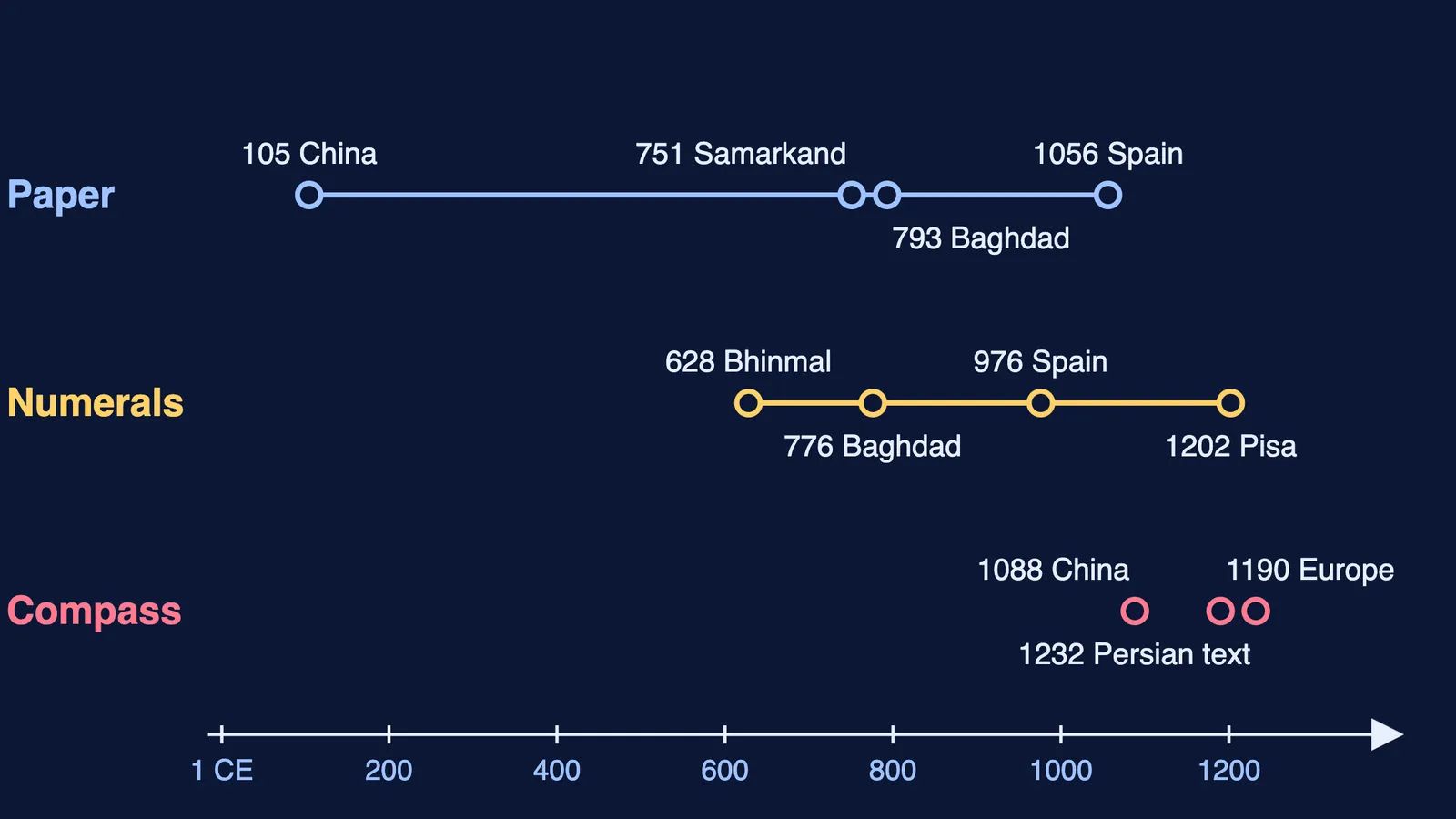
According to tradition, paper was first made in AD 105 by Cai Lun (Ts'ai Lun), an official at the Eastern Han court, who pulped fishing nets and rags and later plant fibres (British Association of Paper Historians). The same source says this account may not be correct.
Papermaking reached Central Asia about 750. Tradition holds that Chinese papermakers were captured by Arab forces in a battle near Samarkand in AD 751. By 793 a paper factory was working in Baghdad with Chinese workmen; paper appeared in Egypt around 800, and the earliest known mill in Spain, at Xativa, possibly dates from 1056 (BAPH).
Paper mattered for the next traveller too, because calculating with the new digits first needed a board covered in dust.
How did Indian numerals reach Europe?
In 628, Brahmagupta wrote the Brahmasphutasiddhanta at Bhillamala, today's Bhinmal in Rajasthan, and defined zero as the result of subtracting a number from itself (MacTutor: Brahmagupta). His rule: "When zero is added to a number or subtracted from a number, the number remains unchanged."
A twelfth-century account says a visitor from India, skilled in astronomy, came before the Caliph al-Mansur in 776; the historian Georges Ifrah argues that the text he brought was most likely Brahmagupta's (MacTutor: The Arabic numeral system). Al-Khwarizmi is credited with a book on the Indian system. The Arabic original is lost; a Latin version, Algoritmi de numero Indorum, gave us the word "algorithm". Early users calculated on dust boards, and in the mid-tenth century al-Uqlidisi adapted the methods so they "could be carried out with pen and paper". The numerals appear in a Spanish manuscript, the Codex Vigilanus, copied by a monk in 976.
The step that made them stick in Italy came from the son of a Pisan customs official. Fibonacci, educated in Bugia (now Bejaia, in Algeria), published Liber abaci in 1202 after returning to Italy, and wrote that in Bugia he had been introduced to "the art of the Indians' nine symbols" (MacTutor: Fibonacci). For another Indian technology with a long journey, read about wootz steel and Damascus blades.
Did the compass travel the Silk Road too?
The first incontestable reference to a magnetised needle in Chinese literature is from 1088, in Shen Kuo's Dream Pool Essays (History of the compass). Zhu Yu's Pingzhou Ketan, written between 1111 and 1117, records ship's pilots who "in dark weather" look at "the south-pointing needle". Alexander Neckam's De naturis rerum gives the first recorded use in Europe, around 1190, and a Persian story collection mentions it in 1232.
Some historians think Arab traders carried the compass from China to Europe; others propose an independent European invention (History of the compass). The honest answer: possibly carried by traders, possibly invented twice.
To see what that needle responds to, try plotting bar-magnet field lines with a compass. For other hard-to-picture ideas, the Fermi Simulation Lab has interactive simulations for ideas easier to see than read.
Why did place value win? A worked example
Multiply 47 × 23 the way the nine symbols allow:
Split by place value: 47 × 23 = 47 × 20 + 47 × 3.
47 × 20 = 940.
47 × 3 = 141.
Add: 940 + 141 = 1081.
In Roman numerals that is XLVII × XXIII = MLXXXI. A Roman symbol's position does not tell you whether it counts tens or hundreds, so there are no columns to line up and carry between. Place value turns multiplication into a written routine, and paper gives the routine somewhere to live.
How do you check an "it came from India" claim?
Use these five questions on any forward about ancient science:
What is the earliest surviving document, and its date?
Where was it written?
Who carried the idea, and in which language?
Does the source say "tradition holds", or give direct evidence?
Could two places have invented it separately?
Paper's 751 story rests on tradition (question 4); the compass is still being argued over question 5. If a step in the arithmetic trips you, the Fermi Problem Library has a step-by-step solver that explains the reasoning.