On this page
Long before modern steelworks, smiths in South India made steel a few hundred grams at a time inside sealed clay pots. Smiths to the west forged it into swords with a rippling, watered pattern that Europeans struggled to copy. That steel is wootz, and its story is a lesson in the chemistry you study for boards and JEE: how a little carbon changes iron completely.
What is wootz steel?
Wootz is an ultra-high carbon steel with 1-2% carbon, according to a review by S. Srinivasan and S. Ranganathan of the Department of Metallurgy, Indian Institute of Science (IISc), Bangalore (Wootz steel: an advanced material of the ancient world). The same review explains the name: wootz is an anglicised corruption of ukku, the word for steel in several South Indian languages, including those of Karnataka and Andhra Pradesh.
How was wootz made in South India?
The method is called the crucible process. Srinivasan and Ranganathan describe crucibles packed with wrought iron and carbon-rich material such as stems and leaves, then sealed and fired (IISc review). In a furnace sketched by the traveller Francis Buchanan, each conical crucible held up to 14 oz of iron, about 400 g, and about fifteen crucibles sat in rows in an ash-filled pit, blown by buffalo-hide bellows, with firing cycles of up to 24 hours. Inside, temperatures went above 1400 °C, hot enough to melt the iron as it soaked up carbon, and eyewitnesses stressed that the charge was then cooled slowly.
Srinivasan was given crucible fragments from an excavated megalithic site at Kodumanal in Tamil Nadu, a site dated to around the 2nd century BC, and collected surface finds at Mel-Siruvalur, also in Tamil Nadu (Srinivasan, MRS Proceedings, 1996). Iron droplets in the Mel-Siruvalur crucibles turned out to be high-carbon steel of about 1-1.5% carbon, with a structure consistent with the steels researchers have used to reproduce Damascus patterns in the lab.
Why did the carbon content matter so much?
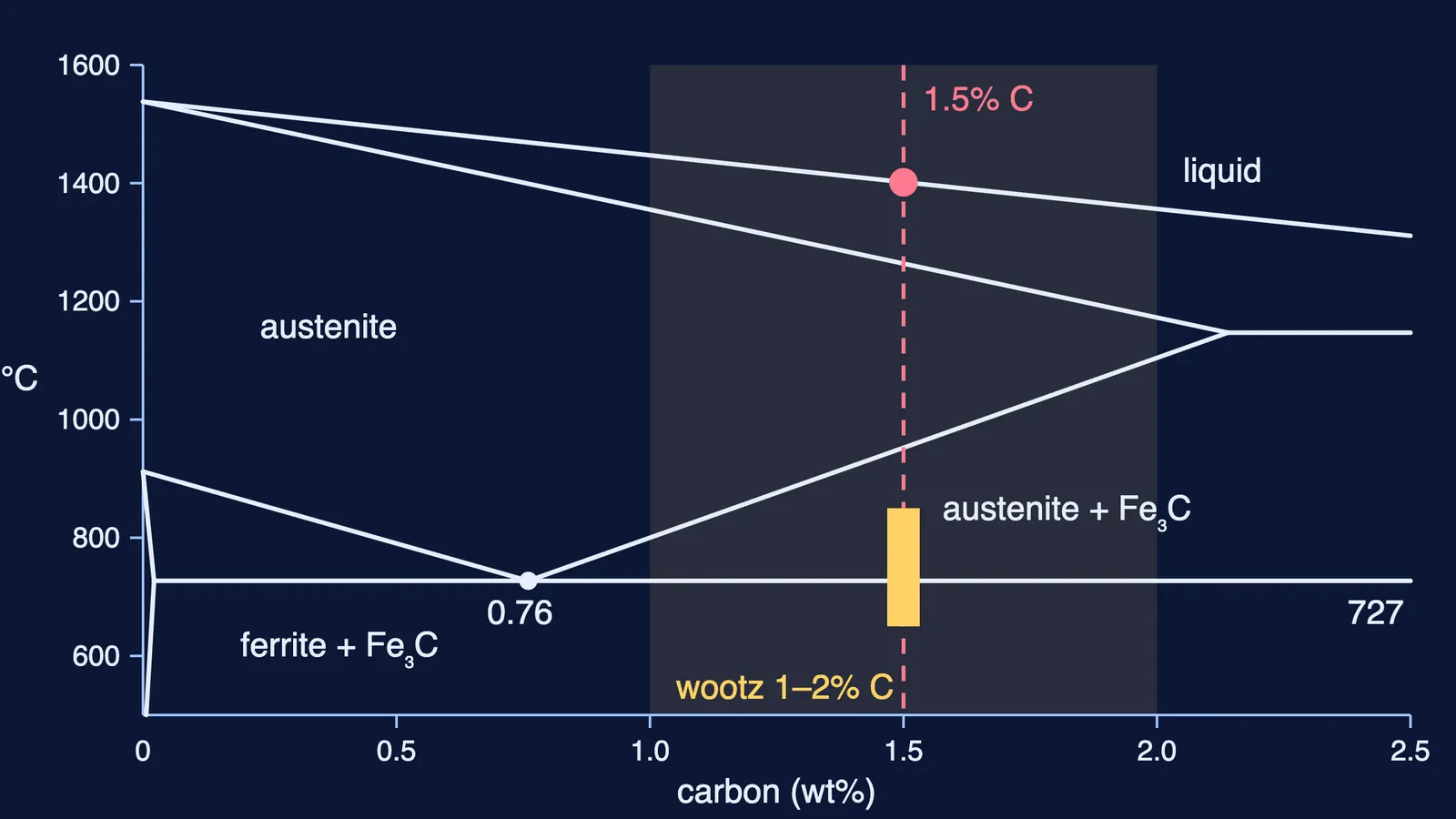
Open the iron-carbon phase diagram in a materials science textbook. Steel with 0.76% carbon cooled below 727 °C becomes pearlite, thin alternating layers of soft ferrite and hard cementite (Fe3C, which is 6.7% carbon) (University of Washington MSE 170 lecture notes). Steel with more carbon is called hypereutectoid; the extra carbon comes out as cementite at the grain boundaries. Wootz is hypereutectoid. Check it with the lever rule from those notes:
Take wootz with 1.5% carbon, cooled to just below 727 °C.
Extra cementite formed before the pearlite: (1.5 - 0.76) / (6.7 - 0.76) = 0.74 / 5.94, about 0.125, so roughly 12% of the steel.
Total cementite, including the layers inside pearlite: (1.5 - 0.022) / (6.7 - 0.022), about 0.22, so roughly 22%.
Repeat for an ordinary 0.40% carbon steel: (0.40 - 0.022) / 6.678, about 0.057, so under 6% cementite.
A 1.5% carbon wootz holds nearly four times as much hard carbide, and that cementite is the raw material of the pattern. If a step in a calculation like this trips you up, the Fermi Problem Library works through problems step by step and explains the reasoning, not only the answer.
Where do the Damascus blade patterns come from?
The light and dark ripples are bands of cementite particles in a darker steel matrix, revealed when the blade is polished and etched. Metallurgist John Verhoeven and bladesmith Alfred Pendray developed a process that produces blades matching the microstructure of the best museum-quality Damascus blades. They found that the banding needs two things: low levels of certain impurity elements in the high-carbon steel, with vanadium the most effective, plus a heat treatment of repeated heating and cooling (Verhoeven, Steel Research, 2002). Their earlier paper made the same point in its title, The key role of impurities in ancient Damascus steel blades. So the pattern depends on trace elements, not on carbon alone.
The IISc review notes that true Damascus steels were not replicated in Europe until 1821, even though scientists including Michael Faraday studied wootz, and that the steel had to be forged in a narrow range of 650-850 °C, not at the white heat of 1200 °C used for low-carbon steel (IISc review).
In 2006 M. Reibold and colleagues reported carbon nanotubes inside one Damascus sabre in Nature (Carbon nanotubes in an ancient Damascus sabre). It is a single blade, so treat it as a finding to follow, not settled history.
What can you take from wootz into your syllabus?
Use wootz as a revision thread:
Metallurgy: compare the crucible process with iron from a blast furnace, as in our guide to the reactions in a blast furnace, zone by zone.
Alloys: carbon in iron is an interstitial alloy; see why transition metals form alloys so easily.
Indian metallurgy: pair it with why the Delhi iron pillar doesn't rust.
Phase diagrams: redo the lever-rule example above for 1.0% and 2.0% carbon and see how the cementite share changes.
If pearlite, austenite or interstitial alloys are still fuzzy, the Fermi Concept Library covers each concept in chemistry and physics so you can fill the gap before your next test.