On this page
How was the Channel Tunnel built?
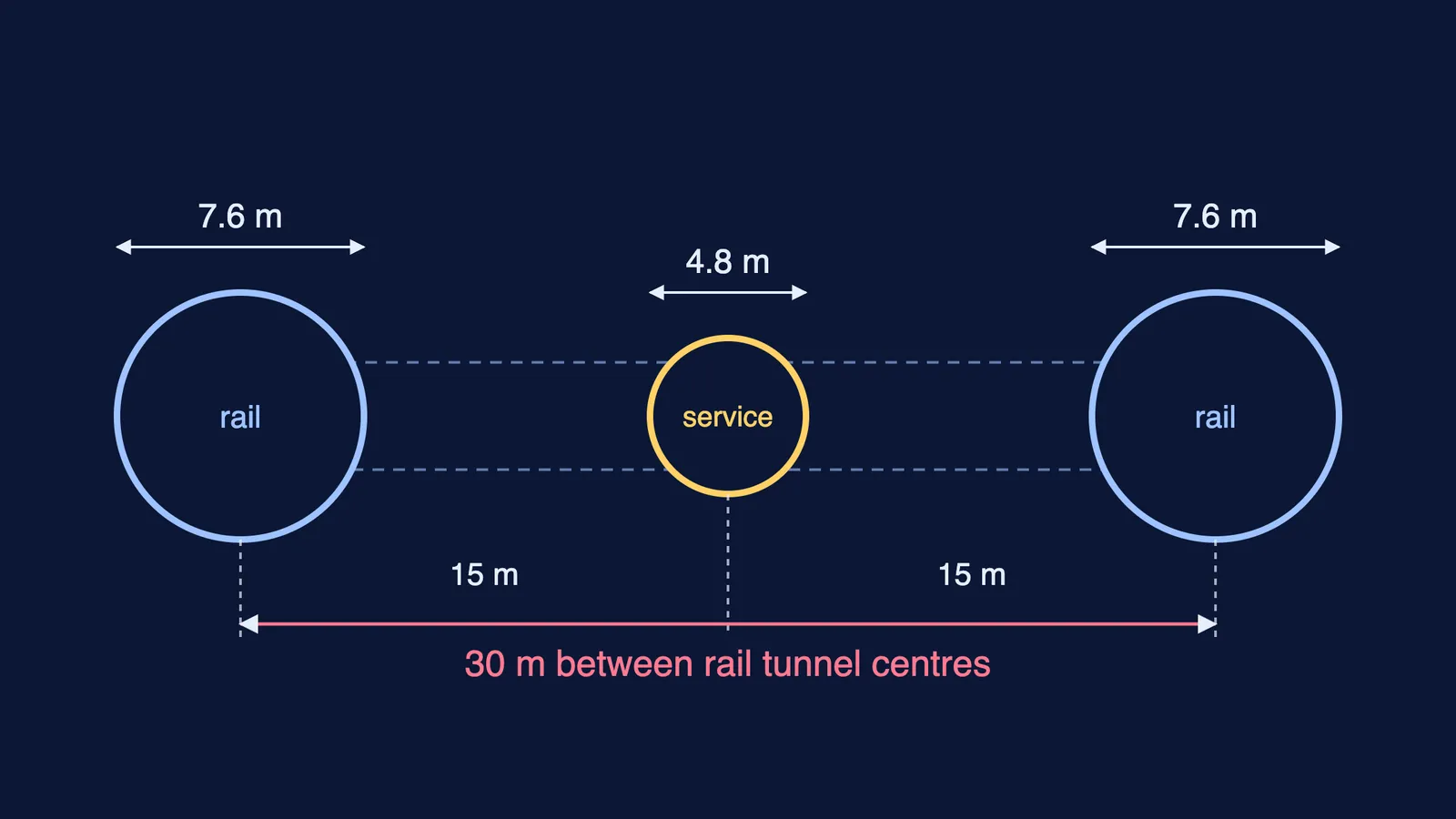
The Channel Tunnel is three tunnels side by side, not one. A 1992 paper by engineers C. D. Warren and P. M. Varley in the Quarterly Journal of Engineering Geology describes two running tunnels 7.6 m in diameter and 30 m apart, with a 4.8 m service tunnel between them. Each tunnel is about 50 km long, and 38 km of that lies under the seabed between Shakespeare Cliff in England and Sangatte in France.
Cross passages 3.3 m in diameter join all three tunnels every 375 m. Piston relief ducts 2 m across link the two running tunnels every 250 m. They let the pressure pulse of air pushed ahead of a train escape into the other tunnel, which reduces aerodynamic drag.
Work started from both coasts at once. Boring machines were deployed on both sides in December 1987, according to Robbins, which built five of them. Five tunnel boring machines dug from France and six from Britain, as The B1M explains. Queen Elizabeth II and President François Mitterrand officially opened the tunnel on 6 May 1994 (VINCI).
Why did they dig through chalk marl?
Chalk marl was the rock layer the engineers chose to follow under the sea. Writing in 1990, before the breakthrough, science writer Chet Raymo called it "soft and relatively impermeable to water" in his Boston Globe column (Science Musings). Soft rock means fast boring, and rock that lets little water through keeps the sea out while the lining goes in.
The layer was not perfect. Robbins notes that most of the tunnel passes through chalk marl, "much of it faulted", with a thin, permeable band of glauconitic marl beneath it. On the French side, the three seaward machines met water inflows almost at once and had to switch to their sealed mode much earlier than planned. On the British side, the Robbins machines averaged 873 m a month, with a best month of 1,719 m.
How did the two sides meet in the middle?
Before digging, surveyors fixed markers on both shores and linked the British and French grids with sight lines across the Channel. Underground, the tunnelling relied on "angle and distance measurements with lasers and computers" (Science Musings). The smaller service tunnel went first, so that any error could be corrected before the larger rail tunnels arrived.
The two halves of the service tunnel were joined on 1 December 1990 (VINCI). The running tunnels met on 22 May and 28 June 1991 (Robbins). The example below shows why even a small gap at the meeting point is remarkable.
Worked example: how straight is straight enough?
The undersea stretch is 38 km (Warren and Varley), so suppose each side drove about half of it, 19 km. Use the small-angle rule: sideways miss = distance × angle in radians.
Target: meet within 0.5 m sideways.
Allowed angle: 0.5 ÷ 19,000 ≈ 0.000026 radians.
In degrees: 0.000026 × 57.3 ≈ 0.0015°, about 5 arcseconds.
To picture it: at 1 km, 5 arcseconds covers about 2.6 cm.
No one can hold a tunnel boring machine on a heading like that by eye. That is why the drives were steered by laser angle and distance measurements tied to the surface grid, and why the service tunnel led the way.
Why does the Channel Tunnel need cooling?
Fast trains heat the air in a long, enclosed tunnel. When engineers studied the tunnel's aerodynamics they predicted temperatures as high as 50°C, so a cooling system was added, according to Cooling Post. The original design used two systems of 24-inch cooling-water pipes, supplied by eight chillers.
The cooling plants at Shakespeare Cliff in the UK and Sangatte in France feed that system (Getlink). A 2018 Honeywell press release says that without round-the-clock cooling, train heat would push temperatures above 35°C. It reports that new chillers, running at Sangatte since 2016 and at Shakespeare Cliff since late 2017, saved 33% of the energy after their first season, citing Eurotunnel's data.
The physics is the same as in your fridge: chilled water picks up heat as it warms, and a refrigeration cycle moves that heat outside. That cycle has a long history, told in our post on Jacob Perkins and the 1834 patent behind your fridge.
What can a student learn from the Channel Tunnel?
Geometry: small angles become big misses over long distances. For a survey done with far simpler tools, read how Kishen Singh mapped Tibet by counting his steps.
Geology: picking the right rock layer decided both speed and safety.
Thermodynamics: heat made inside a tunnel has to be pumped somewhere.
Careers: tunnels and metros are civil engineering work. See transportation engineering as a career.
If a refrigeration cycle is hard to picture, the Fermi Simulation Lab has interactive simulations for ideas that are easier to see than to read. For the small-angle maths, the Fermi Problem Library has a step-by-step solver that explains the reasoning rather than printing an answer.