On this page
The hum from your fridge is a compressor pushing a fluid round a sealed loop. That loop was first built in England in the 1830s, to a design by the American inventor Jacob Perkins.
Who was Jacob Perkins and what did he patent in 1834?
Perkins, born in Massachusetts in 1766, moved to England in 1819 to print banknotes designed to resist forgery, according to the ASME landmark brochure on the Perkins cycle.
His refrigeration patent was assigned on 14 August 1834 under the title "Apparatus and means for producing ice, and in cooling fluids", English patent number 6662 (ASME).
ASME describes it as the first working device that used a vapour-compression refrigeration system, a closed-cycle machine that could run continuously (ASME). In 2020 the society named the Perkins cycle a Historic Mechanical Engineering Landmark (ASME landmark page).
The idea was not new: Oliver Evans, who had worked with Perkins in America, described such a machine on paper in 1805, but there is no evidence he built one (ASME).
How did Perkins's ice machine work?
An engineer named John Hague built it. Frederick Bramwell, who helped, described it in 1882: a small apparatus about five feet long, with a copper pan of water inside a jacket of volatile liquid (ASME).
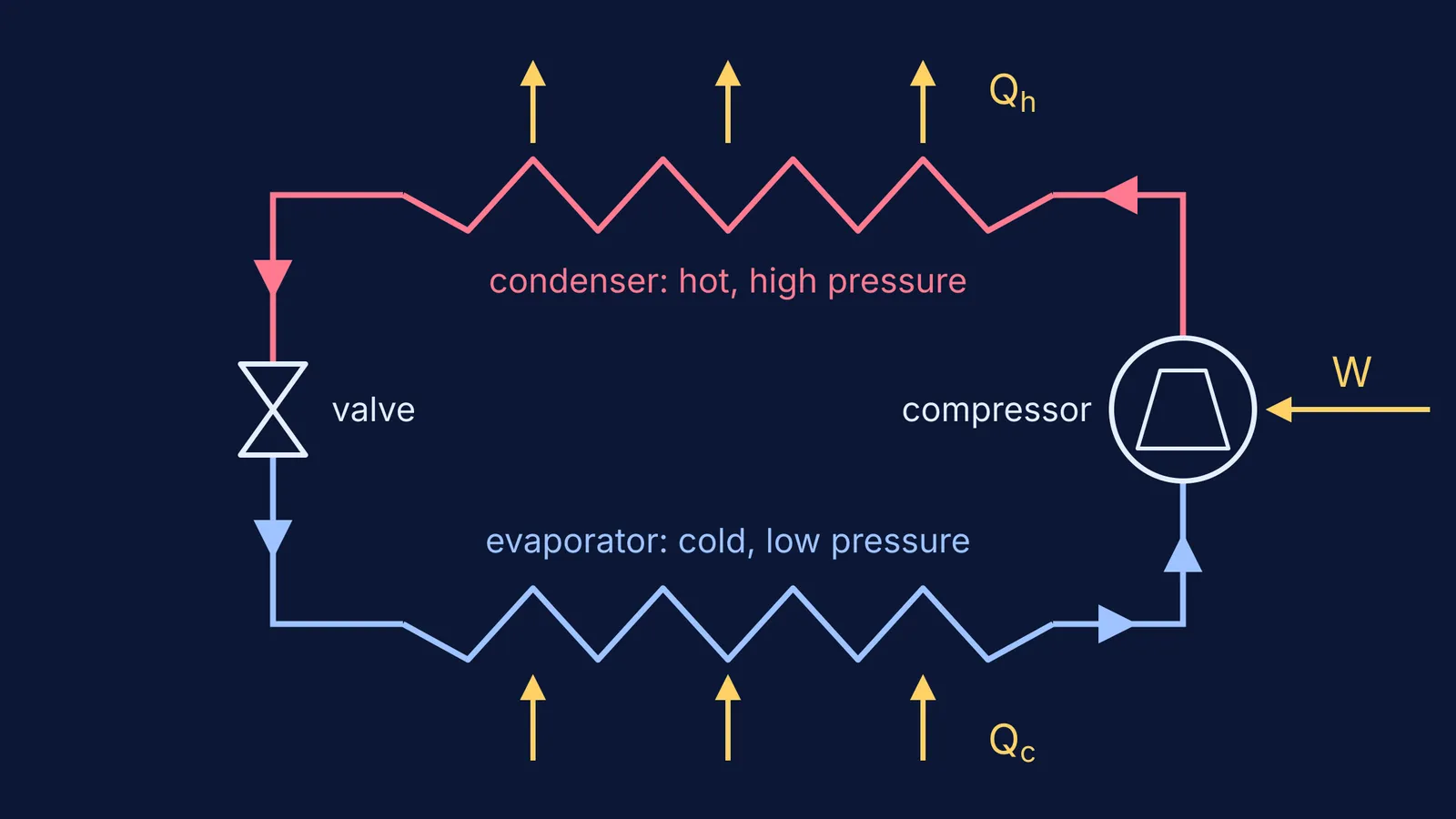
A pump pulled vapour off the jacket and pushed it into a coiled pipe, the "worm", standing in a tub of cold water. A valve loaded to about fifteen pounds to the inch held the pressure up, so the vapour "was subjected to this pressure, as well as to the cooling influence of the water, and by these means was brought back to a liquid condition", in Bramwell's words (ASME). The liquid flowed back to the jacket, and round it went.
Those are the four parts of your fridge today:
Evaporator: the cold fluid boils and takes heat from the food (Perkins's jacket).
Compressor: squeezes the vapour to high pressure (his pump).
Condenser: the hot vapour gives heat to the room and turns back to liquid (his worm in the tub).
Valve: the liquid drops back to low pressure, ready to boil again (his weighted valve).
Why does a boiling liquid make things cold?
A liquid needs energy to turn into vapour, and it takes that energy from whatever it touches: latent heat, the reason sweat cools you. The OpenStax university physics text describes a modern fridge the same way: the coolant "extracts heat from the refrigerator at the evaporator, causing coolant to vaporize", then is compressed and gives out heat through the condenser (OpenStax). For a slower walk through each part, read our explainer on how a refrigerator makes things cold.
If the loop is hard to picture from words, the Fermi Simulation Lab has interactive simulations for ideas that are easier to see than to read.
How much heat can a fridge move per joule?
The coefficient of performance (COP) of a refrigerator is the heat removed from the cold space divided by the work put in, K = Qc/W (OpenStax). For an ideal (Carnot) refrigerator, K = Tc/(Th - Tc), with temperatures in kelvin (OpenStax).
Here is a worked example for a freezer in an Indian kitchen:
Freezer at -18 °C, so Tc = 255 K.
Kitchen on a warm day at 35 °C, so Th = 308 K. The gap is 53 K.
Ideal COP = 255 / 53, about 4.8. At best, each joule of work moves 4.8 joules of heat out of the freezer.
On a 45 °C afternoon, Th = 318 K, the gap is 63 K, and the ideal COP = 255 / 63, about 4.0.
Real machines do worse, but the pattern holds: a bigger gap costs more work per joule. We go further in why a refrigerator works harder in summer.
If you keep slipping on steps like this, the Fermi Problem Library has worked problems with a step-by-step solver that explains the reasoning rather than printing an answer.
Why didn't Perkins's fridge catch on?
The machine showed that ice could be made continuously, but Perkins never developed a commercial version (ASME). Ice making became a business only with Alexander Twining's trials from 1848, James Harrison's machine of 1851 and, in the 1870s, Carl von Linde's ammonia systems; see our story on Carl von Linde and brewery refrigeration. Home fridges waited for small electric motors after 1900.
Try it at home: trace the loop
At home, find each part of Perkins's cycle in a fridge or split AC:
The warm coil at the back or bottom of the fridge, or the outdoor AC unit: the condenser giving heat away.
The humming box near the bottom: the compressor.
The cold plate in the freezer, or the indoor AC unit: the evaporator.
Then work out the ideal COP for your city's hottest day. It takes two minutes.