On this page
On 28 January 1986, the Space Shuttle Challenger broke apart 73 seconds after liftoff, and all seven crew members died (Rogers Commission report, chapter 3). On 1 February 2003, Columbia broke up during re-entry, also with seven aboard (Columbia Accident Investigation Board report). Both losses come down to physics you meet in Class 11: elasticity, heat and relative velocity.
Why did the Challenger explode?
The Rogers Commission concluded that the cause was "the failure of the pressure seal in the aft field joint of the right Solid Rocket Motor" (Rogers Commission report, chapter 4). Each solid rocket booster was built from stacked steel segments, and every joint was sealed by rubber O-rings. The boosters were dropped once spent, the same logic as why rockets have multiple stages.
At ignition, pressure flexed the steel and the joint gap opened by as much as 0.029 inches at the primary O-ring, with the opening essentially complete at about 600 milliseconds, the same chapter says. A seal works only if the rubber springs back fast enough to follow the metal.
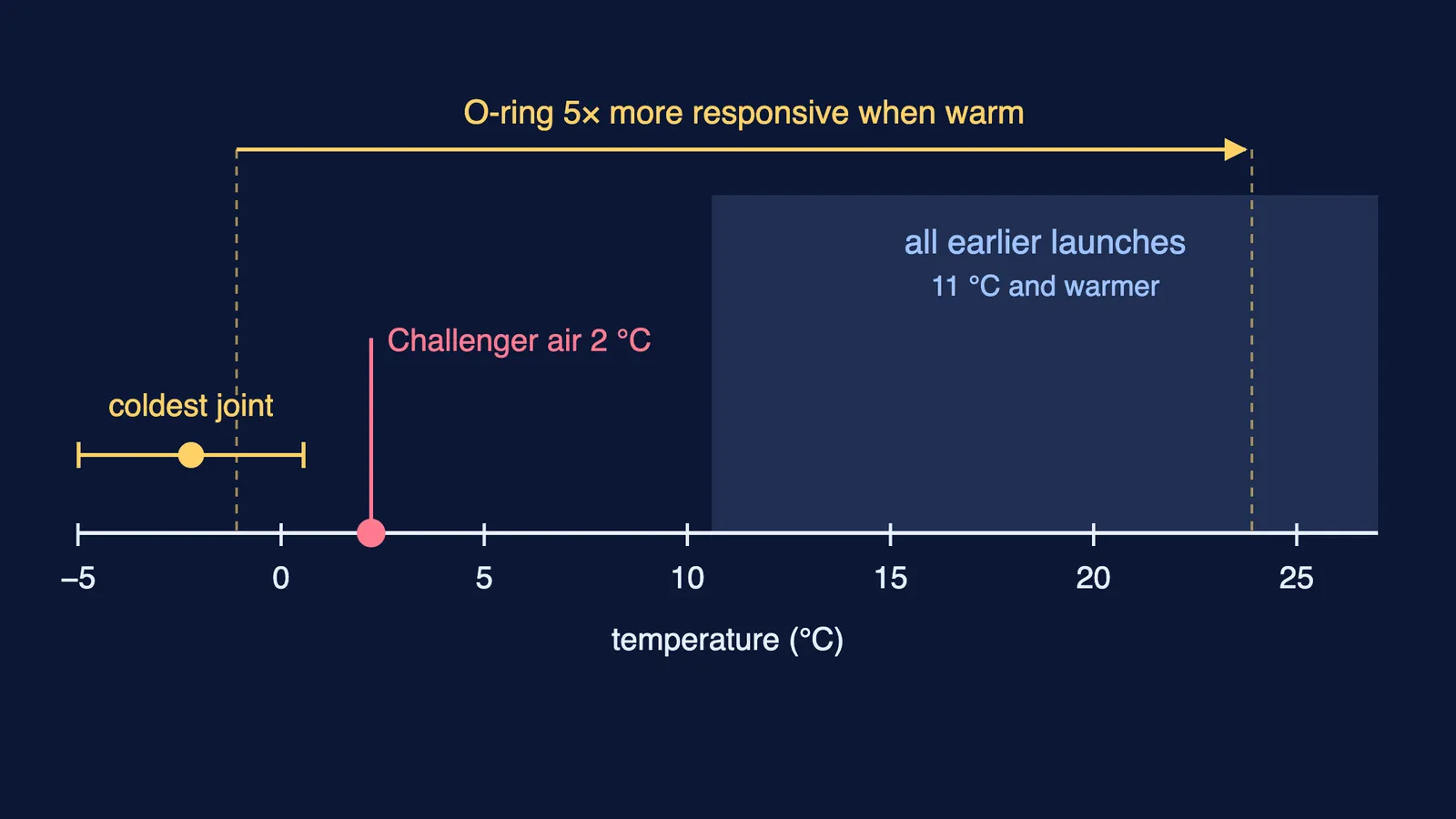
Cold stopped it. The air temperature at launch was 36°F (about 2°C), 15 degrees lower than the next coldest previous launch, and the coldest point on the joint was estimated at 28°F, plus or minus 5 degrees (chapter 4). The Commission found that a compressed O-ring at 75°F is five times more responsive in returning to its shape than a cold O-ring at 30°F. At 0.678 seconds after liftoff, cameras recorded a strong puff of grey smoke from that joint (chapter 3). Flame later burned through, and the external tank's hydrogen and oxygen burned explosively.
What did Feynman show with a glass of ice water?
Richard Feynman, the Caltech physicist on the Commission, made the problem visible. During a televised hearing he squeezed a piece of O-ring rubber in a C-clamp and dunked it in a glass of ice water for one minute. When he removed the clamp, the rubber stayed flat and regained its shape only several seconds later, Physics Today reported in August 1986. "I believe that has some significance for our problem," he said.
Several seconds is far too slow for a gap that opens in 0.6 seconds.
His appendix to the report ends: "For a successful technology, reality must take precedence over public relations, for nature cannot be fooled" (Rogers Commission, Appendix F). If you like how he explained things, try the Feynman technique on a Class 11 physics concept or read about his 1959 talk that imagined nanotechnology.
What happened to Columbia?
At 81.7 seconds after launch, a piece of insulating foam broke off the external tank's left bipod ramp and struck Columbia's left wing near Reinforced Carbon-Carbon panel 8, the Board found (CAIB report, executive summary). During re-entry, superheated air, probably above 5,000°F, entered the breach and melted the aluminium structure of the wing.
How can light foam break a wing? The foam left the tank moving with the shuttle at about 2,300 feet per second. Drag slowed it to about 1,500 feet per second in roughly 0.161 seconds, so the wing hit it at a relative speed of about 800 feet per second (545 mph), according to section 3.4 of the CAIB report. For its tests, the Board judged that a foam block weighing 1.67 pounds best represented the piece that struck the wing.
How much energy did the foam strike carry?
Convert the Board's figures to SI: 1.67 lb is 0.757 kg, and 800 ft/s is about 244 m/s.
Work in the wing's frame, where the foam arrives at 244 m/s.
Kinetic energy: KE = ½mv² = ½ × 0.757 × 244² ≈ 22,500 J.
Compare: a 1,000 kg car carries the same energy at v = √(2 × 22,500 ÷ 1,000) ≈ 6.7 m/s, about 24 km/h, but the foam delivered it to one patch of the wing's carbon-composite leading edge.
The Board tested this. A 1.67-pound foam block fired at 777 feet per second at a flown panel 8 made a hole roughly 16 by 17 inches (CAIB report, section 3.8).
If relative velocity feels slippery, the Fermi Simulation Lab has interactive simulations for ideas easier to see than read. For more problems like this one, the Fermi Problem Library has a step-by-step solver that explains the reasoning.
What can students learn from both failures?
Ask these five questions, drawn from the Rogers Commission findings, of any claim that something is safe:
What must the part do, and how fast? (Follow a gap opening in 0.6 seconds.)
Was it tested at the conditions it will really meet? (No launch had been as cold.)
Which frame am I measuring in?
Can a small physical test settle it? (One glass of ice water did.)
Is past success evidence, or luck?
On the last, Feynman wrote: "When playing Russian roulette the fact that the first shot got off safely is little comfort for the next" (Appendix F).