

On this page
On 29 December 1959, Richard Feynman spoke at the annual meeting of the American Physical Society at Caltech. His talk, “There's Plenty of Room at the Bottom”, carried the subtitle “An Invitation to Enter a New Field of Physics” and was printed in Caltech's Engineering and Science magazine in February 1960 (transcript; original magazine pages). In it he asked what we could build if we worked at the scale of single atoms.
What did Feynman say in “Plenty of Room at the Bottom”?
Early in the talk he asked a playful question: why can't we write the whole Encyclopaedia Britannica on the head of a pin? From there he moved to storing information in tiny cubes of atoms, building small machines, and finally arranging atoms themselves (transcript).
His central claim was plain: “The principles of physics, as far as I can see, do not speak against the possibility of maneuvering things atom by atom.” He added that this was “not an attempt to violate any laws” but something that could be done in principle (transcript).
Other ideas from the talk:
Atomic memory: one bit of information stored in a cube of 5 × 5 × 5, or 125, atoms.
All the world's books: he estimated 24 million volumes of interest, and worked out that, printed at pin-head scale, they would take up about the area of 35 pages of the Encyclopaedia.
Tiny surgeons: he credited Albert R. Hibbs with the idea that you might “swallow the surgeon”, a machine that works inside a blood vessel.
Can you really fit an encyclopaedia on a pin head?
Feynman did the arithmetic in the talk, and you can check it with school maths. Here is the worked example, using his numbers from the transcript.
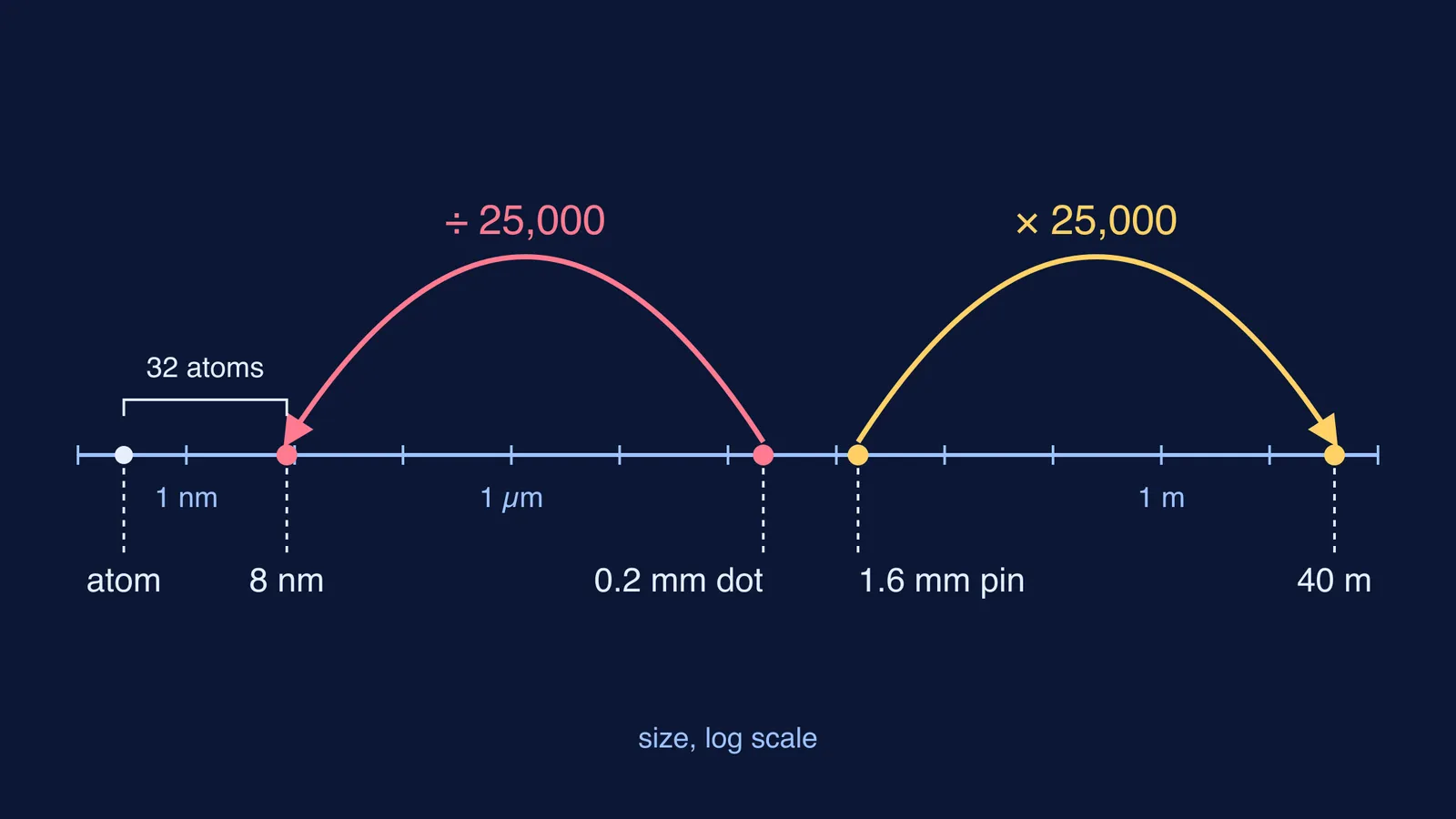
The pin: he took a pin head as 1/16 of an inch across. Since 1 inch is 25.4 mm, that is about 1.6 mm.
Scale it up: magnify the pin head 25,000 times. Its diameter becomes 1.5875 mm × 25,000 ≈ 39.7 m.
Find the area: a circle 39.7 m across has an area of π × (19.8 m)² ≈ 1,240 m².
Compare with books: at roughly A4 (0.06 m²) a page, 1,240 m² holds about 20,000 pages, the same order as the pages of the 24-volume encyclopaedia he named. That was his point.
Check the dots: your eye resolves about 1/120 of an inch, roughly one printed dot. Divide by 25,000 and you get about 85 angstroms; Feynman rounded it to 80 angstroms, or 8 nanometres, which he said was still “32 atoms across, in an ordinary metal”. So each shrunk dot is still built from plenty of atoms.
Did anyone win Feynman's $1,000 prizes?
Yes, both were won. Feynman offered $1,000 to the first person to build a working electric motor no bigger than a 1/64-inch cube, and another $1,000 to the first person to shrink a page of a book 25,000 times in linear scale so it could be read with an electron microscope (transcript).
According to the Caltech Library, William McLellan built the micromotor, the first prize-winner, and it went on display at Caltech in 1962. The tiny-print prize took 25 years: it was awarded in November 1985 to Thomas H. Newman, a Stanford graduate student who spent a month shrinking the first page of Dickens's A Tale of Two Cities.
Did Feynman's atom-by-atom idea come true?
To arrange atoms, you first need a tool that can find them. That tool arrived with the scanning tunnelling microscope, which you can read about in our post on how Binnig and Rohrer built a microscope that feels single atoms.
On 11 November 1989, Don Eigler's team at IBM used a custom-built microscope to spell the letters “IBM” with 35 xenon atoms (Phys.org). Eigler and Erhard Schweizer reported it in Nature in April 1990 under the title “Positioning single atoms with a scanning tunnelling microscope” (Nature, DOI).
What can you learn from how Feynman thought?
The habit worth copying is the scale check: before deciding something is impossible, do the arithmetic. Try it on any “tiny” claim:
Convert every size to metres.
Find the scale factor, as Feynman did with 25,000.
Divide the smallest feature by the size of an atom, about 0.25 nm on Feynman's numbers.
Ask whether any law of physics forbids it, or whether it is just hard.
Practise on his prize motor: 1/64 of an inch is about 0.4 mm, roughly 1.6 million metal atoms across. Then try our step-by-step estimate of how many atoms are in a grain of salt, and read why you cannot see an atom with a light microscope.
If atomic sizes, moles or units still feel shaky, the Fermi Concept Library gives each concept in physics and chemistry its own lesson. For ideas that are easier to see than to read, try the Fermi Simulation Lab.


