On this page
The water turbine became practical in the hands of a young French mine engineer. Benoît Fourneyron was born in Saint-Étienne on 31 October 1802 and trained at the new school of mines there, graduating at the top of its first class, according to the Complete Dictionary of Scientific Biography entry on Encyclopedia.com.
Who invented the first water turbine?
Fourneyron built the first commercial hydraulic turbine. The same Encyclopedia.com biography says he "had constructed by 1827 an operating unit of the outward-flow type", and that he measured its power (6 h.p.) and efficiency (80 percent) with the newly invented Prony brake. That is about 4.5 kW, the figure Wikipedia's Fourneyron article gives.
His former professor, Claude Burdin, had submitted a paper on hydraulic turbines to the Académie des Sciences, and both men competed for a prize from the Société d'Encouragement pour l'Industrie Nationale (Encyclopedia.com). Burdin gave us the word itself: turbine comes from the Greek for "whirling" or a vortex. Fourneyron won the society's 6,000-franc prize for developing the first commercial hydraulic turbine (Wikipedia).
The Science Museum Group holds a half-scale model of one of his turbines, built at Sankt Blasien in Germany in 1837, and notes that he completed his first machine in 1827 after four years of experiments. He patented the general design of his first three installations in 1832 and went on to build more than one hundred hydraulic turbines (Encyclopedia.com). In 1895, Fourneyron turbines were installed on the US side of Niagara Falls to generate electricity (Wikipedia).
How does an outward-flow turbine work?
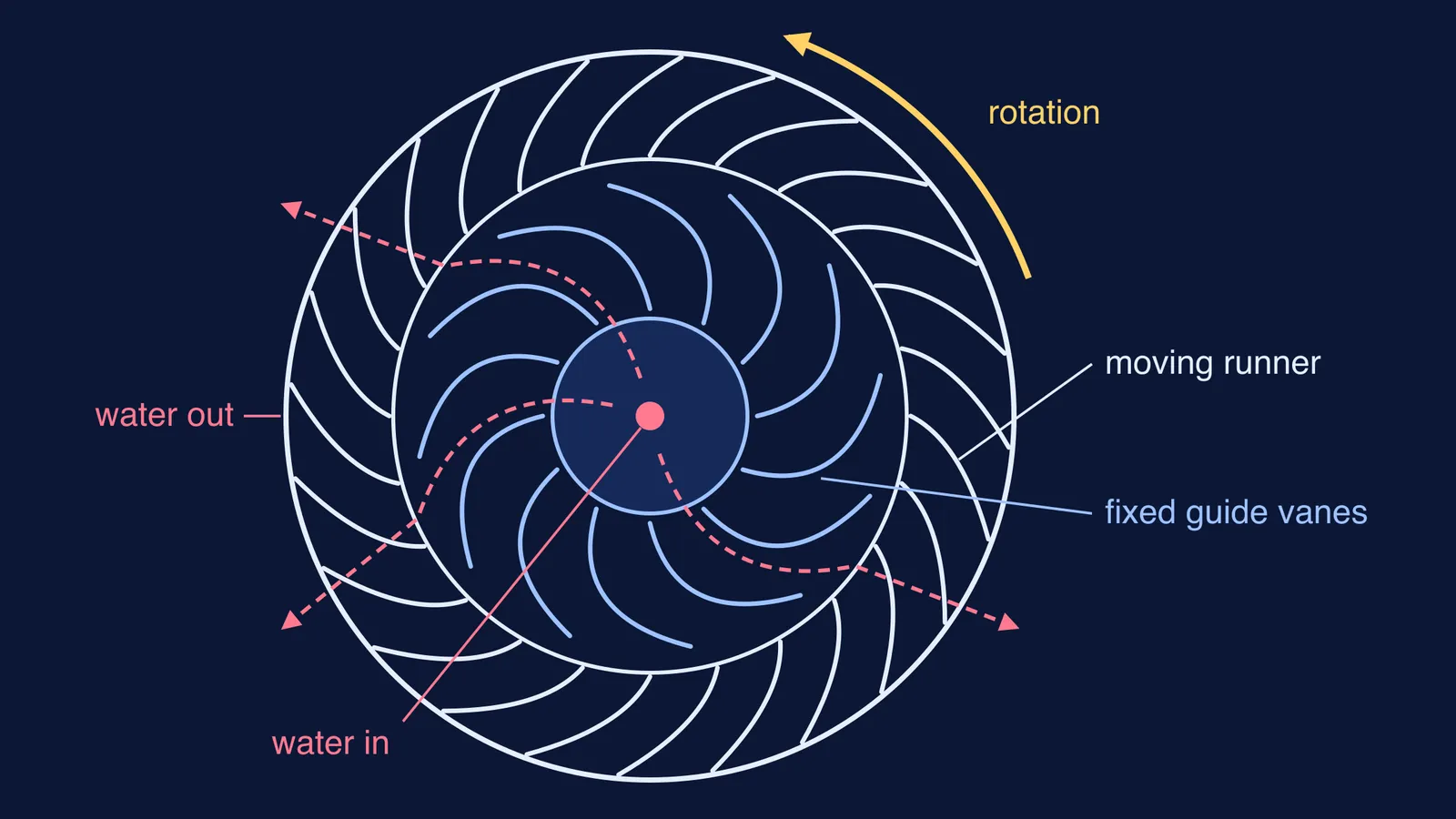
Unlike a traditional vertical waterwheel, Fourneyron's wheel was horizontal and used two sets of blades curved in opposite directions. The diagram at the top shows it from above.
Water falls into the centre of the machine.
A ring of fixed guide vanes turns the water so it spins as well as moves outward.
The water then passes through a ring of curved runner blades fixed to the shaft. The blades bend it backwards, so it leaves at the rim with much of its swirl gone.
Taking that swirl out of the water needs a torque on the water; by Newton's third law, which describes the energy transfer in reaction turbines, the water pushes the runner the other way, and the shaft turns.
Engineers sort turbines into two families. A reaction turbine generates power from the combined forces of pressure and moving water, while an impulse turbine generally uses the velocity of the water to move the runner. The swirl idea is angular momentum, the same quantity behind why a skater spins faster when pulling in their arms.
If flow through a spinning ring is hard to picture from a still drawing, the Fermi Simulation Lab has interactive simulations for ideas that are easier to see than to read.
How much water did a 6 horsepower turbine need?
Try this worked example with Class 11 physics. The power a turbine delivers is useful power = efficiency × density × flow × g × head, written P = ηρQgh (Wikipedia: Hydropower). The US Department of Energy puts it in words: the greater the flow and the higher the head, the more the electricity that can be generated.
The sources do not give the head at Fourneyron's 1827 site, so take an illustrative fall of 2 m.
Output: 6 hp is about 4,500 W.
Input water power: 4,500 ÷ 0.8 = 5,625 W. The other 1,125 W is lost inside the machine.
Flow: Q = 5,625 ÷ (1,000 × 9.8 × 2) ≈ 0.29 m³/s, or about 290 litres every second.
Double the head to 4 m and you need half the flow, about 145 litres per second, for the same output.
Now keep 0.29 m³/s and 2 m but drop the efficiency to 0.6: the shaft gets 0.6 × 5,625 ≈ 3,400 W instead of 4,500 W.
Step 5 shows why efficiency mattered: same river, same fall, more useful power. If you lose marks on sums like this because a factor slips in or out, the Fermi Problem Library has worked problems with a step-by-step solver that explains the reasoning rather than printing an answer.
How did later turbines change the design?
Use four questions to place any water turbine:
Where does the water enter and leave? Fourneyron: centre to rim, outward.
What is fixed and what moves? Guide vanes fixed, runner moving.
Reaction or impulse? The Department of Energy lists Francis turbines as reaction machines and Pelton wheels as impulse machines.
What head and flow suit it?
The Department of Energy calls the Francis turbine of 1849 the first modern hydropower turbine, and says Pelton turbines are generally used for very high heads and low flows. For low-head rivers, read how Viktor Kaplan's adjustable blades changed the design. And to follow a turbine's spin all the way to the grid, see William Rankine's cycle in steam power plants.
Next time you see a dam, try the four questions, then the P = ηρQgh sum with a head and flow you look up.