On this page
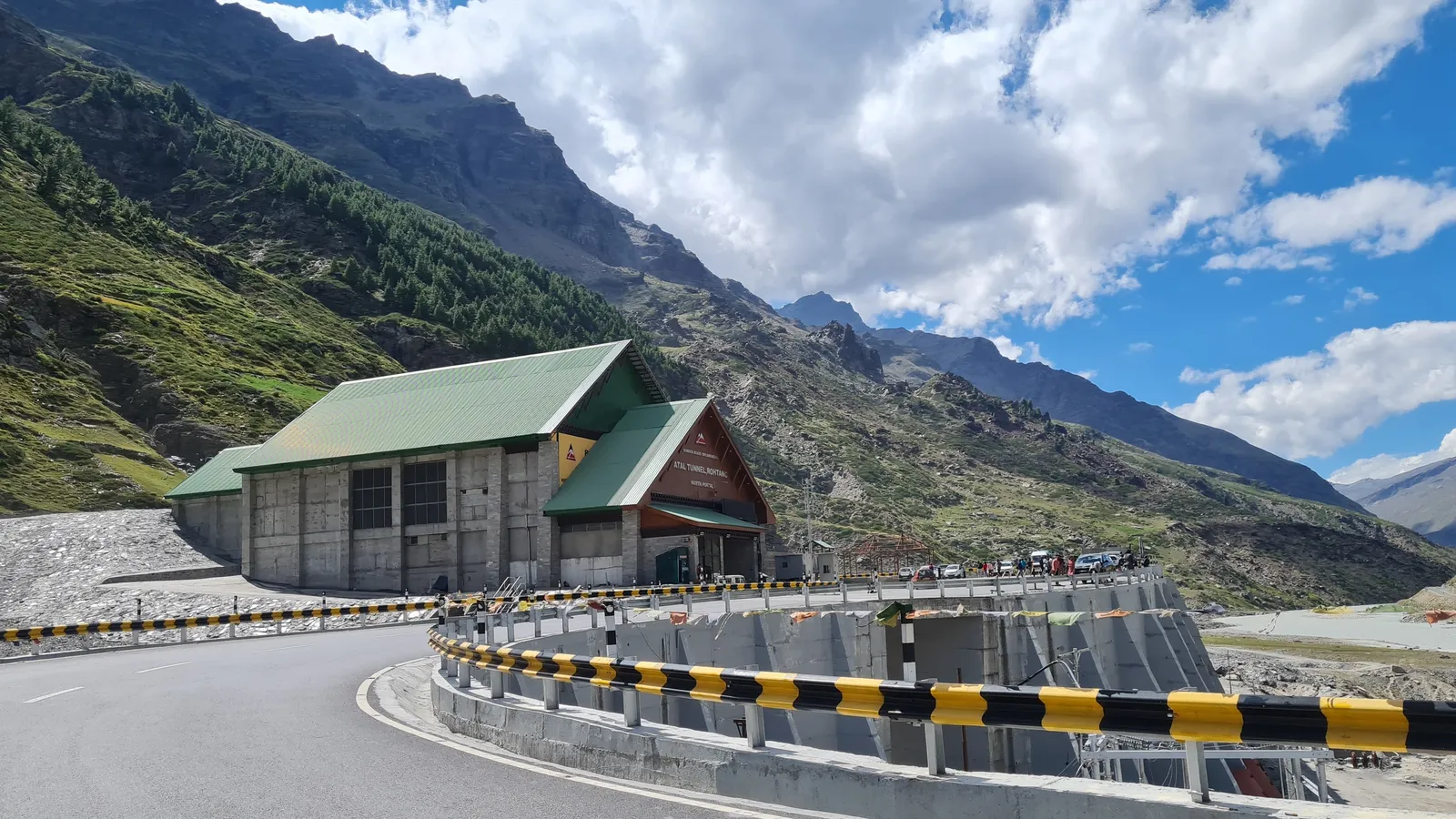
The Atal Tunnel runs 9.02 km under the Rohtang Pass in Himachal Pradesh at about 3,000 m above sea level, and it shortened the road from Manali to the Lahaul and Spiti valley by 46 km, according to Construction World's project report. Building it took a decade of work through shifting rock, a flooded fault zone and thin air.
How was the Atal Tunnel built?
The Border Roads Organisation (BRO) was the client and a Strabag-Afcons joint venture was the contractor, with construction starting in 2010, says Construction World. Drilling began at the south portal on 28 June 2010 and boring was completed on 12 October 2017, The Tribune reported.
SMEC, the consultant the BRO engaged in 2006 for design and engineering, says two methods were studied: a tunnel boring machine and drill and blast. The builders chose drill and blast because it let them switch between kinds of rock support as the ground changed. Construction World adds that the New Austrian Tunnelling Method (NATM) was adopted during excavation, with every deformation of the rock measured.
Every metre of a drill-and-blast tunnel comes from repeating one cycle:
Drill a pattern of holes into the rock face.
Load the holes with explosives and fire them.
Clear the fumes and dust from the heading.
Haul out the broken rock, called muck.
Support the fresh opening before the next round. Here that meant rock bolts, lattice girders and shotcrete, with forepoles and pipe roofs in weak ground (SMEC).
What happened at Seri Nallah?
About 1.5 km in from the south portal, the tunnel ran into the Seri Nallah fault zone, where water poured in at more than 100 litres per second owing to a glacial lake, says SMEC. Construction World puts the peak at 127 litres per second and says the stretch was only 526 m long but took around four years to excavate; SMEC says almost five.
Construction World describes the ground as sheared, weathered rock, mostly river-borne material, and says the tunnel face "literally used to flow like a river of mud and boulders." SMEC says this stretch was dug as a circle or oval instead of the usual horseshoe, under a pipe roof, in small steps. Our explainer on why the Himalayas are still rising covers the plate collision behind ground like this.
To feel 127 litres per second, multiply by 60: 7,620 litres a minute, enough to fill a 1,000-litre rooftop tank in under 8 seconds, at the face where crews were working.
How do you ventilate a 9 km tunnel at 3,000 m?
According to SMEC, the crown of the tunnel forms a large duct that supplies fresh air. A point extraction system with fire dampers pulls smoke out in a fire, sensors check the air inside and outside the tunnel, and an emergency escape tunnel under the road has its own ventilation. The tunnel was designed for up to 3,000 vehicles per day at up to 80 km per hour. The Tribune reported telephones every 150 m and an entry to the escape route every 500 m, and Construction World gives the escape tunnel as 3.6 m wide and 2.25 m high.
Altitude makes this harder: each cubic metre of air at 3,000 m holds less of everything, oxygen included.
Worked example: how thin is the air?
NASA Glenn's model of the lower atmosphere gives temperature, pressure and density from altitude h in metres (valid up to 11,000 m):
Temperature: T = 15.04 - 0.00649h, in degrees Celsius.
Pressure: p = 101.29 x [(T + 273.1)/288.08]^5.256, in kilopascals.
Density: p / [0.2869 x (T + 273.1)], in kilograms per cubic metre.
At h = 3,000 m: T is about -4.4 C, p is about 70.2 kPa, and density is about 0.91 kg/m³. At sea level the same formulas give about 1.23 kg/m³. So the air in the tunnel is roughly 26% thinner, and a fan must move about 35% more volume (1.23 divided by 0.91) to deliver the same mass of fresh air. Real design also handles exhaust, smoke and the pressure difference between the portals; this is only the density part.
For what thin air does to people, read how Paul Bert found the cause of altitude sickness. If pressure falling with height is hard to picture, the Fermi Simulation Lab has interactive simulations for ideas that are easier to see than read.
What can a student take from the Atal Tunnel?
The tunnel is a good set of Class 11 physics problems in disguise:
Flow rate: convert litres per second into tanks, swimming pools or rivers.
Gas laws: pressure and density at altitude, as in the worked example.
Stress in rock: why a curved roof carries load better than a flat one, and why the weakest stretch was dug rounder still.
If one of these ideas is shaky, the Fermi Concept Library covers every concept in physics, chemistry, biology, mathematics and computing. And if building things like this appeals to you, our guide to a career in transportation engineering: roads, railways and metros is a good next read.