On this page
Apollo 13 launched on 11 April 1970 with Jim Lovell, Jack Swigert and Fred Haise aboard, bound for a Moon landing it never made. NASA's mission summary records the crew splashing down in the Pacific near Samoa on 17 April. What happened in between is physics, chemistry and arithmetic under pressure.
What happened to Apollo 13?
The Apollo 13 Review Board report times the failure of oxygen tank no. 2 at 55 hours 54 minutes 53 seconds into the flight. NASA's mission details page puts the spacecraft about 200,000 miles from Earth and gives Swigert's words: "Houston, we've had a problem here."
The board found that the failure also damaged tank no. 1 or its lines and valves, and led to the loss of all three fuel cells, the command module's main source of electricity. The crew moved into the lunar module, Aquarius, and used it as a lifeboat.
Why did the oxygen tank explode?
The review board found that the tank's heater thermostatic switches were rated for the spacecraft's 28 V dc supply but could not open properly at the 65 V dc used by ground equipment. During an 8-hour heater run to empty the tank before launch, parts of the heater tube probably reached about 1000°F (around 540°C), severely damaging the Teflon insulation on nearby fan-motor wires. In flight, the tank's fans were switched on at 55:53:20; about 90 seconds later, the tank failed.
How did the free-return trajectory bring them home?
A free-return trajectory is a path on which the Moon's gravity swings a spacecraft around the far side and back towards Earth without a major engine burn (Apollo 13 Flight Journal). Apollo 13 had left it for better landing options, so it needed a correction.
At 61 hours 29 minutes, the crew fired Aquarius's descent engine for about 31 seconds, a velocity change of 38 ft/s (11.6 m/s), according to the journal. That set a closest approach about 252 km above the Moon and put them back on free return, which on its own would have brought them down in the Indian Ocean.
Two hours after passing the Moon came the "PC+2" burn, planned at 845.5 ft/s (257.7 m/s) over 4 minutes 20 seconds, retargeting splashdown to the mid-Pacific at around 142 hours.
Why not take the fastest route home?
The Flight Journal describes a faster PC+1 option: 4,728 ft/s, the descent engine's whole capacity, after first discarding the service module, for a landing at 118 hours. The chosen PC+2 burn used less than half of the 1,977 ft/s available with the service module attached:
Fraction used: 845 ÷ 1,977 ≈ 0.43, about 43%.
Left in reserve: 1,977 − 845 = 1,132 ft/s.
Price paid: 142 − 118 = 24 more hours in the lifeboat.
Controllers traded speed for margin.
How did they make the power and air last?
NASA's mission details page says the lunar module "was designed to support two men for two days and was being asked to care for three men for about four days." In person-days, that is 4 against 12: three times its design load. The lunar module's batteries held 2,181 ampere-hours, and power use was cut to a fifth; water fell to six ounces per person a day, and the cabin dropped to 38°F (about 3°C).
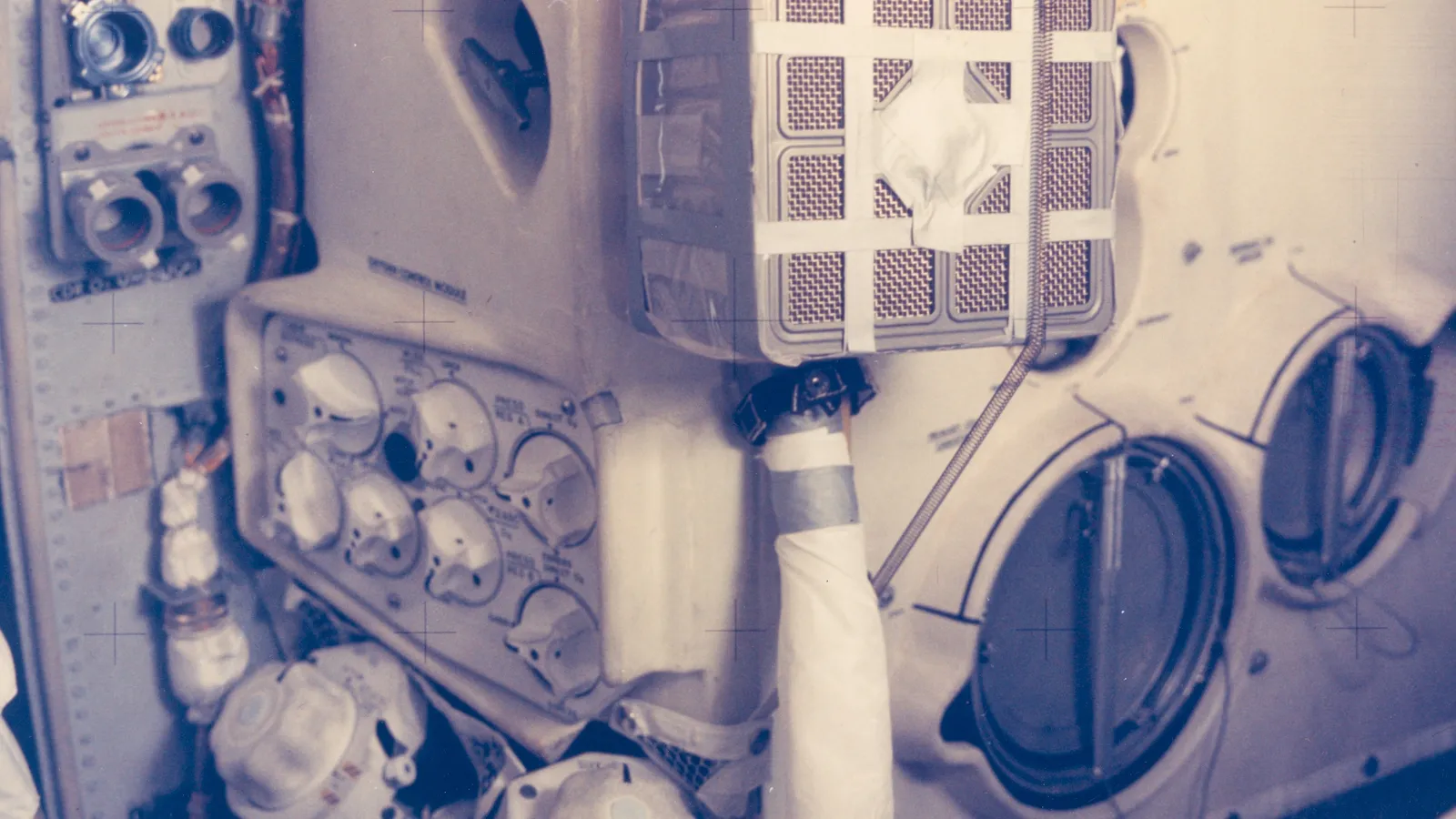
Air was the other limit. Lithium hydroxide canisters absorb exhaled carbon dioxide, but the command module's square canisters did not fit the lunar module's round openings (NASA). The Flight Journal notes the carbon dioxide warning was normally set at 7.6 mmHg, and medical officials agreed to let it rise to 15 mm. Engineers in Houston's Crew Systems Division, including Ed Smylie, Jim Correale and Jim LeBlanc, worked out an adapter from plastic bags, cardboard and tape that joined the square canisters to the lunar module's hoses, and the steps were read up to the crew.
The school-lab cousin of this chemistry is the experiment where KOH absorbs carbon dioxide to show plants need it. Today's crews use a different system: how the space station makes oxygen from water.
What can students learn from Apollo 13?
The method transfers to a paper that goes wrong:
Find what still works. List the questions you can do before staring at the one you can't.
Get on free return first. Bank the sure marks.
Budget the scarce thing. For Apollo 13 it was power and water; for you it is minutes.
Keep a reserve. Leave time to check units and signs.
Build from what you have. When a method fails, assemble an answer from formulas you trust.
If a path that loops around the Moon and back is hard to picture, the Fermi Simulation Lab has interactive simulations for ideas that are easier to see than to read. To practise laying out a budget like the one above, the Fermi Problem Library has worked problems with a step-by-step solver that explains the reasoning.
For more on the Apollo record, read three checks that show the Moon landings were real.