On this page
The question turns up in classrooms and family WhatsApp groups: did people really walk on the Moon, or was it filmed in a studio? "Because NASA says so" is a weak answer. A stronger one is that the Apollo missions left things behind that people outside NASA, including a French observatory and India's space agency, can still check decades later. Here are three, plus a sum and a checklist.
Can you still bounce a laser off the Moon?
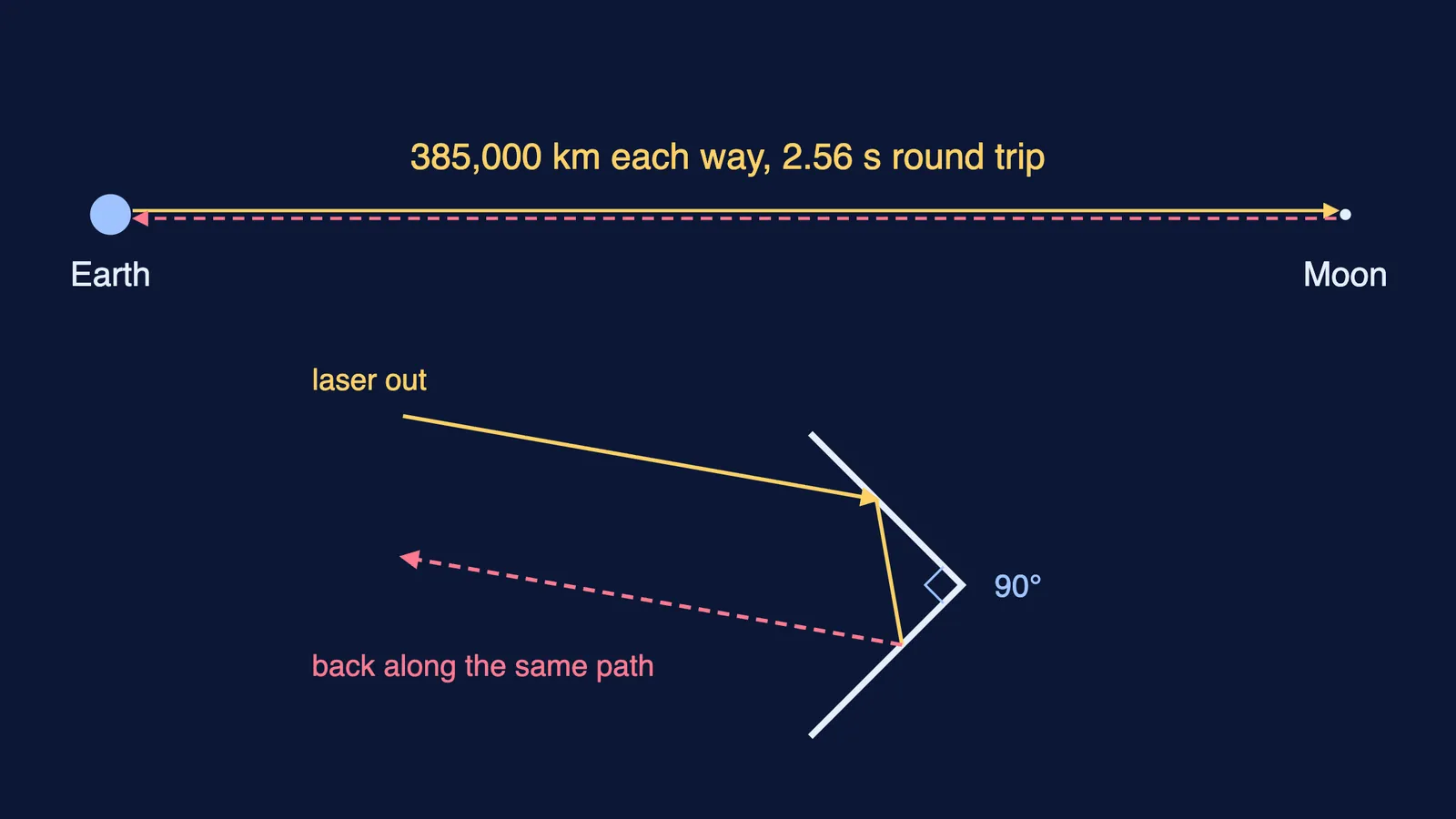
Yes. Apollo 11, 14 and 15 left arrays of corner-cube reflectors on the lunar surface, with 100, 100 and 300 reflectors respectively, according to physicist Tom Murphy's review Lunar laser ranging: the millimeter challenge. A corner cube sends light straight back the way it came, whatever angle it arrives at; we explain the geometry in how a corner reflector sends light back.
Observatories fire short laser pulses at these arrays and time the echo. Not all of them are American: Murphy's review says a French station at the Observatoire de la Côte d'Azur began collecting accurate ranges in 1984 and had contributed about half of all lunar range measurements by the time of the review. Murphy writes that range precision has improved "from a few decimeters initially to a few millimeters recently".
The returning signal is faint. By Murphy's estimate, a telescope with a 1 m aperture on Earth catches about one photon out of every 250 million that leave the Apollo reflector.
How long does a laser take to reach the Moon and back?
Murphy's review gives the average Earth-Moon distance as about 385,000 km, which corresponds to 2.56 s of round-trip light travel time. Check it using the speed of light, which is exactly 299,792,458 m/s according to NIST:
Round-trip distance: 2 × 385,000 km = 770,000 km.
Time: 770,000 km ÷ 299,792 km/s ≈ 2.57 s, in line with the review's 2.56 s.
Precision: moving the mirror 1 mm farther adds 2 mm to the path, so the echo arrives 0.002 m ÷ 299,792,458 m/s ≈ 6.7 × 10⁻¹² s later. Murphy gives the same conversion: 6.67 picoseconds per millimetre.
What do the Moon rocks prove?
Between 1969 and 1972, six Apollo missions brought back 382 kilograms of lunar rocks, core samples, pebbles, sand and dust, according to NASA's lunar sample curation office. The same page says the flights returned 2,200 separate samples from six different exploration sites. In the same period, three robotic Soviet spacecraft returned samples totalling 300 grams from three other sites.
That contrast is the point. 382 kg is more than a thousand times what the robotic missions brought home. The curation office says nearly 400 samples are still sent out each year for research and teaching. A forgery would have to fool every laboratory that receives them.
Can a satellite photograph the Apollo landing sites?
Yes, and spacecraft from two countries have done it. On 6 September 2011, NASA released images from its Lunar Reconnaissance Orbiter that it described as the sharpest ever taken from space of the Apollo 12, 14 and 17 sites, showing the paths the astronauts walked. In NASA's orbital view of the Apollo 11 site, the descent stage left on the surface is visible along with the trails of the astronauts' footprints.
India adds an independent check. ISRO's Chandrayaan-2 page describes the orbiter in a 100 km × 100 km orbit and gives its Orbiter High Resolution Camera a ground resolution of 0.32 m. Scientists at ISRO's Space Applications Centre in Ahmedabad used this camera's images of the Apollo 11 landing site in a study of West crater published in Planetary and Space Science. A different agency, a different camera, the same place.
For two more stories of a big claim tested by independent evidence, read about the Event Horizon Telescope's black hole image and the discovery of the cosmic microwave background.
How do you test a claim that the Moon landing was faked?
Ask five questions of any viral claim.
Who besides the people making the claim can check it? A French observatory and an Indian camera.
Is it still producing new data? The laser echoes are.
Do independent methods agree? Laser echoes come back from the Apollo reflectors, and orbiter photos show Apollo hardware at the landing sites.
Do the numbers work? Do the light-travel sum above yourself.
What would faking it require, and would that be easier than doing it?
If someone at home is sure it was staged, try asking: "Which one piece of evidence would change your mind?" Then look at that piece together. You will learn more from that conversation than from winning it.
If the corner-reflector geometry is still hard to picture, the Fermi Simulation Lab has interactive simulations for ideas that are easier to see than to read. For the laws of reflection behind it, the Fermi Concept Library gives every physics concept its own lesson.
Next time the question comes up, start with the light-travel sum.