On this page
Shine a torch at a road sign at night and it glows back at you, not at the car in the next lane. Below, we change the angle of the incoming ray and show why it always comes back parallel.
What is a corner reflector?
A corner reflector is a retroreflector made of three mutually perpendicular, flat reflecting surfaces (Wikipedia: Corner reflector). The two-mirror version you can draw on paper is called a roof mirror; the same article notes it sends light back only in the plane of your drawing.
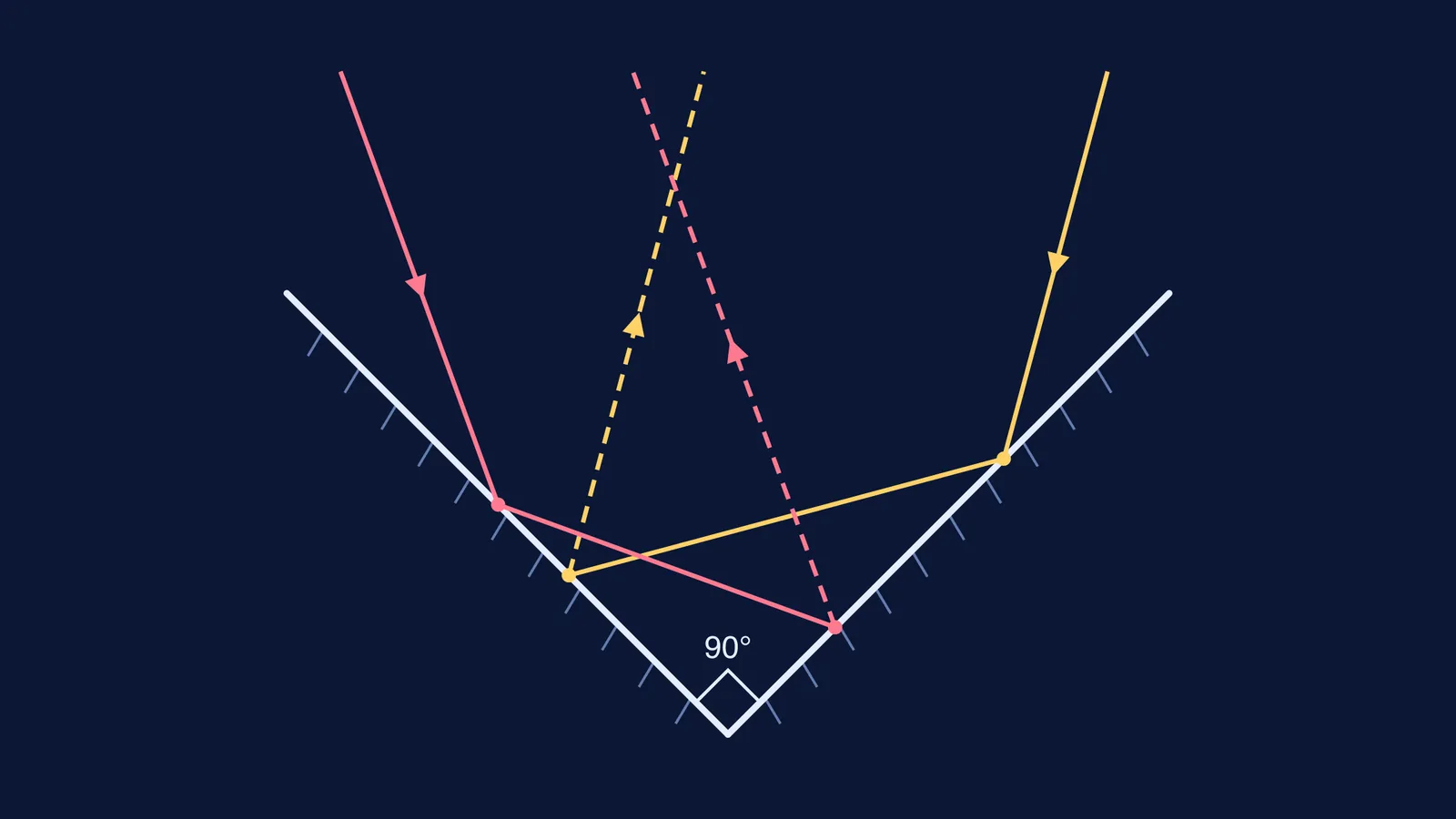
So start on paper: two plane mirrors at 90°, like the floor and wall of a room seen from the side. Call the floor M1 and the wall M2.
Why does the reflected ray come back parallel?
Proof 1: components. Split the ray's direction into a horizontal part and a vertical part.
M1 (the floor) flips the vertical part and leaves the horizontal part alone.
M2 (the wall) flips the horizontal part and leaves the vertical part alone.
After both, both parts are flipped, so the direction is exactly reversed.
Nothing here depends on the incoming angle, which is why the reflector still works when tilted.
Proof 2: angles. Let the ray strike M1 at glancing angle α (the angle between ray and mirror surface). A plane mirror turns a ray with glancing angle g through 2g, so M1 turns it through 2α. The floor, the wall and the middle segment make a right-angled triangle, so the middle segment meets M2 at glancing angle 90° − α, and M2 turns it through 180° − 2α.
Total turn: 2α + 180° − 2α = 180°, so the outgoing ray is parallel to the incoming one, pointing back. This is the two-mirror rule, total deviation 360° − 2θ, with θ = 90°; see angle of deviation by a plane mirror and two inclined mirrors.
Worked example: change the incoming angle.
α = 20°: M1 turns the ray by 40°. It meets M2 at 70°, which turns it by 140°. Total 180°.
α = 45°: M1 turns it by 90°, M2 by 90°. Total 180°.
α = 70°: M1 turns it by 140°, M2 by 40°. Total 180°.
The returning ray is also shifted sideways: parallel to the incoming ray, not on top of it, as the diagram at the top shows.
When does a two-mirror corner fail?
The ray must hit both mirrors. A shallow ray striking M1 far from the corner can miss M2 entirely.
It only works in one plane. A ray with a component along the line where the mirrors meet keeps that component, so in 3D it is not sent straight back.
A third perpendicular mirror fixes this: each mirror flips one of the three components, so a direction [a, b, c] becomes [−a, −b, −c] (Wikipedia: Corner reflector). That three-mirror corner is called a corner cube.
Where do road reflectors use this?
The US Federal Highway Administration explains that retroreflectivity "redirects vehicle headlamp illuminance back toward the driver" (FHWA report FHWA-RD-03-082). The same report describes two kinds of sign sheeting: one uses microsized glass beads, the other microsized prisms. Prismatic sheeting is a sheet of tiny corner-cube structures (Wikipedia: Corner reflector). Each one sends light back towards your headlights, and your eyes sit close enough to them to catch the returning light, so the sign looks bright.
Car and bicycle tail lights are moulded with arrays of small corner reflectors, and plastic with microscopic corner reflectors is used as tape, on signs and on clothing (Wikipedia: Corner reflector).
The Apollo 11 array on the Moon holds 100 fused-silica corner cubes, each 3.8 cm across, and the Apollo 15 array holds 300 (UCSD APOLLO project). Laser light from Earth makes the same 180° turn in each cube and heads back towards the telescope that sent it.
How can you test a corner reflector at home?
Stand two small mirrors on a table at 90°, checked with a set square.
In a dim room, shine a torch (not a laser) into the corner from about a metre away, eye just beside the torch. The corner glows.
Move to a different angle: it still glows. Step to one side of the torch: it looks darker.
Open the mirrors to about 100°. The total turn is now 360° − 200° = 160°, so the beam comes back about 20° off course.
On paper, pick α = 30°, trace the ray with a protractor, and check the two rays are parallel.
The Fermi Simulation Lab has interactive simulations for the ideas that are easier to see than to read. For deviation numericals, the Fermi Problem Library has worked problems with a step-by-step solver that explains the reasoning rather than printing an answer.
The same "twice the glancing angle" rule explains why rotating a plane mirror by θ turns the reflected ray by 2θ, and the corner you just built also makes images: see how many images two inclined mirrors form.