

On this page
Deviation is the angle through which a ray is turned from its original direction. For plane mirrors you need only one law and one triangle, and both results fall out in a few lines.
What is the angle of deviation for one plane mirror?
The law of reflection states that the angle of reflection equals the angle of incidence, both measured from the normal (OpenStax University Physics, Vol. 3).
A ray arriving at angle i to the normal makes 90° − i with the mirror, and leaves at 90° − i on the other side. The angle between the reflected ray and the straight-on direction is the two surface angles added: (90° − i) + (90° − i). That gives:
δ = 180° − 2i for a single plane mirror.
Check the extremes. At normal incidence (i = 0°) the ray comes straight back, so δ = 180°. At grazing incidence (i close to 90°) the ray barely touches the mirror, so δ is close to 0°.
A corollary: rotate the mirror by α with the incident ray fixed, and i changes by α, so δ changes by 2α. The reflected ray turns through twice the mirror's rotation.
Why do two inclined mirrors give 360° − 2θ whatever the angle of incidence?
Now let the ray hit mirror 1 at incidence i₁, then mirror 2 at incidence i₂. Each reflection turns the ray the same way round, so the deviations add:
δ = (180° − 2i₁) + (180° − 2i₂) = 360° − 2(i₁ + i₂)
The triangle does the rest. The two points of incidence and the corner where the mirrors meet form a triangle. Its angle at the corner is θ. Its angles at the two points of incidence are the angles the ray makes with each mirror, 90° − i₁ and 90° − i₂. The angles of a triangle add to 180°, so θ + (90° − i₁) + (90° − i₂) = 180°, which gives i₁ + i₂ = θ.
Substitute, and the angle of incidence disappears:
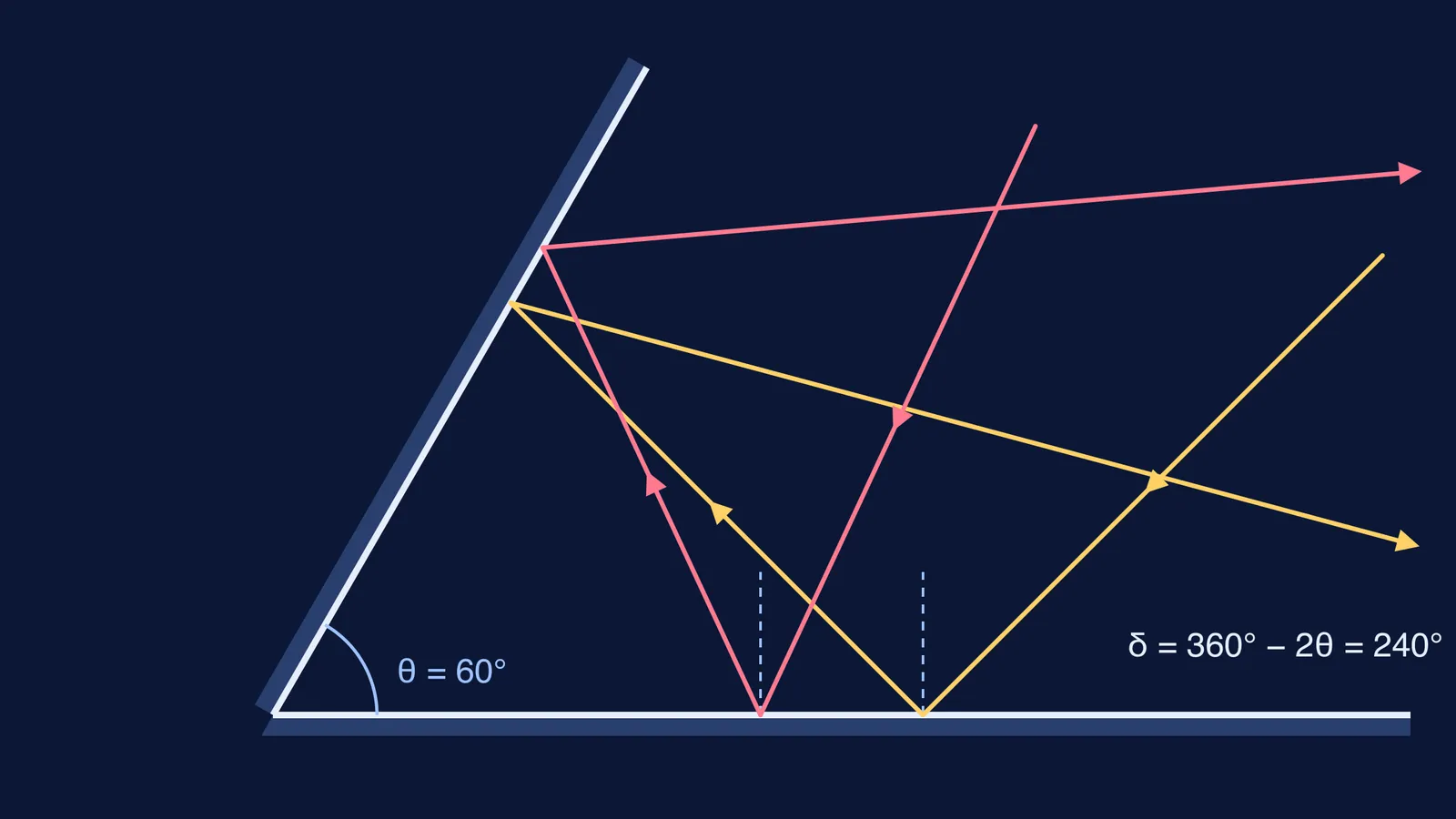
δ = 360° − 2θ for a ray reflected once from each of two mirrors inclined at θ.
Tilt the incoming ray and i₁ grows, but i₂ shrinks by the same amount. In the diagram above, with mirrors at 60°, one ray meets the mirrors at 45° then 15°, another at 25° then 35°, and both turn through 240°.
For two vertical mirrors at 60° with a ray reflected first from one and then the other, the worked solution on IIT Kanpur's SATHEE portal gives δ = 360° − 2 × 60° = 240° (SATHEE, Optics Question 514).
The special case θ = 90° gives δ = 180°: the ray comes back parallel to where it came from. A pair of mutually perpendicular mirrors returns light exactly parallel to its incoming direction, whatever the angle of incidence. Corner reflectors on bicycles, and the one Apollo astronauts placed on the Moon, build on this idea (OpenStax University Physics, Vol. 3). The same 180° turn shows up with glass instead of mirrors in a total reflecting prism that turns light through 90° or 180°.
How do you solve deviation questions without mixing up the formulas?
Use this three-step check before you write a number down:
Count the reflections. One mirror means 180° − 2i. One reflection from each of two mirrors means 360° − 2θ. If the ray hits more than twice, add 180° − 2i for each reflection instead.
Find the right angle. i is measured from the normal, not the mirror. If the question gives the angle with the mirror surface, subtract it from 90° first.
Sanity-check an extreme. Normal incidence must give 180° for one mirror; perpendicular mirrors must give 180° for two.
Try these, then check your answers below:
A ray meets a plane mirror at 30° to the normal. Deviation?
A ray makes 20° with the mirror surface. Deviation?
Two mirrors are inclined at 45°. Deviation after one reflection from each?
Two mirrors are at 30°, and the ray meets the first at 10°. What is i₂, and what is δ?
At what angle should two mirrors be set to send a ray back parallel to itself?
Answers: 120°; 40° (since i = 70°); 270°; i₂ = 20° and δ = 300°; 90°.
If you missed the second, you measured from the surface instead of the normal. To see that step worked through on more questions, the Fermi Problem Library has worked problems with a step-by-step solver that explains the reasoning rather than printing an answer. If the law of reflection itself feels shaky, the Fermi Concept Library gives each concept its own lesson.
Where does this lead next?
The next questions usually ask about the image rather than the ray, such as whether a plane mirror can ever form a real image. Then comes refraction, where a prism has its own minimum angle of deviation.


