On this page
In 1958, two scientists in London grew mouse embryos in a glass dish, transferred them into female mice, and those mothers gave birth to live young. Anne McLaren and John Biggers reported it in Nature, volume 182, pages 877 to 878. Twenty years later, the first IVF baby was born. Here is the experiment, and where it meets your Class 12 syllabus.
What did Anne McLaren and John Biggers do in 1958?
Their paper's title says it plainly: "Successful Development and Birth of Mice cultivated in vitro as Early Embryos" (Crossref record).
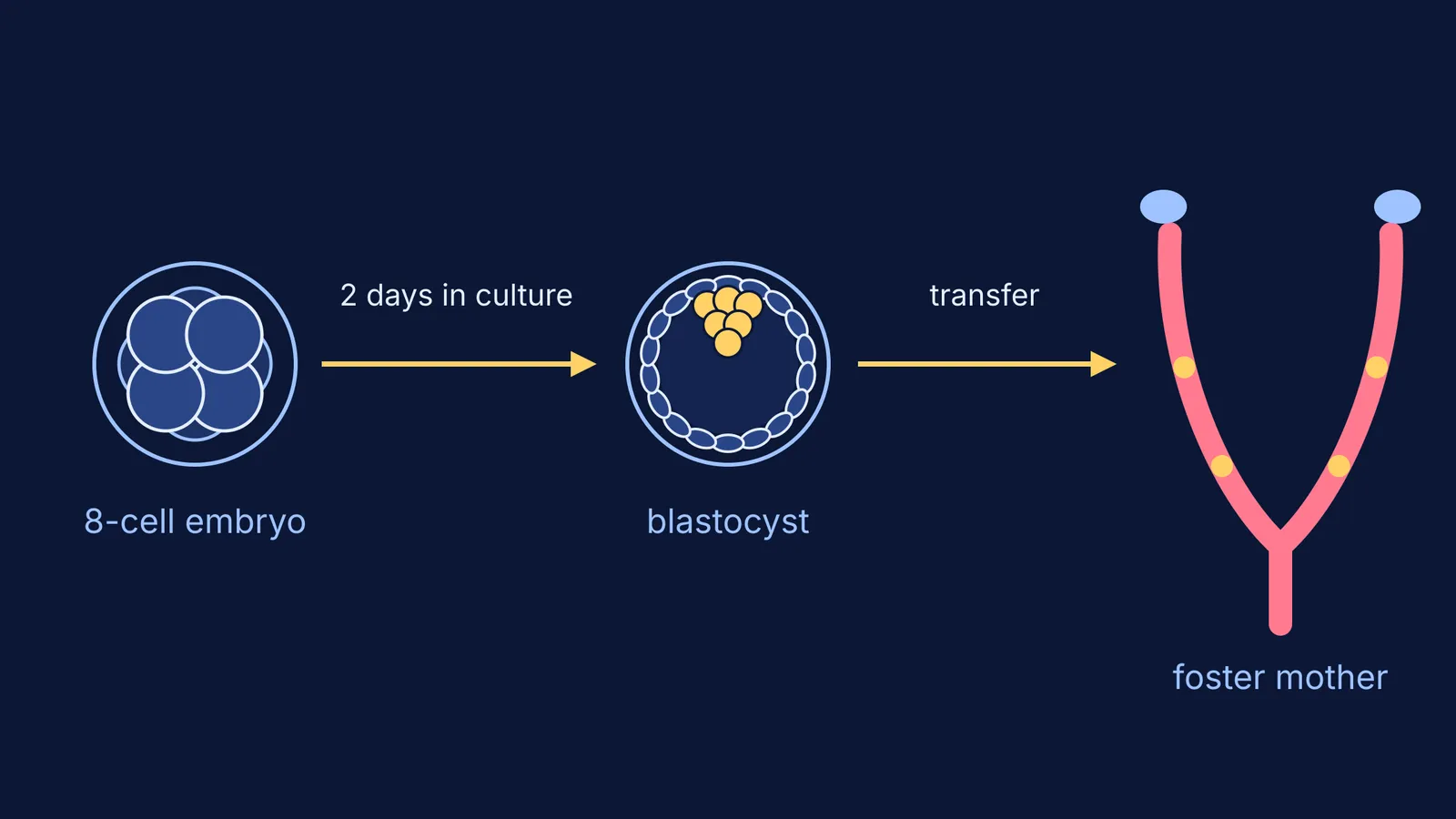
The method had three steps, as summarised on Anne McLaren's Wikipedia page, which cites the paper:
Take embryos from naturally mated female mice at the 8 to 16 cell stage.
Grow them in a culture medium for two days, until they become blastocysts (a hollow ball of cells with an inner cluster that becomes the body).
Transfer the blastocysts into the uterus of foster mothers and wait for birth.
The medium mattered. Jay Baltz notes in a 2013 review in the Journal of Assisted Reproduction and Genetics that the pair used Whitten's defined medium, while most earlier embryo culture had relied on complex biological fluids. Baltz calls the paper a milestone in experiments on "clearly viable preimplantation mammalian embryos".
Notice what the experiment did not do. Fertilisation still happened inside the mother. What McLaren and Biggers showed was that the next stage, two days of early growth, could happen in a dish and still end in birth.
Why did growing embryos in a dish matter for IVF?
The open question was whether a mammal embryo that had spent time outside the body could still become a normal animal. Columbia University's Virginia Papaioannou describes the McLaren and Biggers mice as the first adult mice produced by embryo transfer in which part of the preimplantation stages occurred in vitro. She writes that it paved the way for removing embryos, studying them and returning them to foster mothers.
Human IVF relies on the same step. Louise Brown, the first person conceived by IVF, was born on 25 July 1978 at Oldham General Hospital in England, after work by Patrick Steptoe, Robert Edwards and Jean Purdy. Edwards later received the 2010 Nobel Prize in Physiology or Medicine for helping to develop IVF.
Henry Leese, emeritus professor at Hull York Medical School, called the 1958 paper "one of the most significant papers in the history of reproductive biology and medicine". In his memoriam for Biggers, he notes that McLaren's lab notebook recording the result was on display at the British Library.
McLaren (1927 to 2007) went on to shape the rules for this science too. According to Cambridge's Department of Zoology, she sat on the Warnock Committee, whose work led to the UK's 1990 Human Fertilisation and Embryology Act, and served for 10 years on the Human Fertilisation and Embryology Authority. For India's own chapter of this story, read how Subhash Mukhopadhyay made India's first IVF baby in 1978.
Where does this show up in Class 12 biology?
The NCERT Class 12 Biology chapter on Reproductive Health describes IVF followed by embryo transfer, the "test tube baby" programme. It says early embryos with up to 8 blastomeres can go into the fallopian tube (ZIFT), and embryos with more than 8 blastomeres go into the uterus (IUT).
Here is a worked example using exercise 12(d) from that chapter, which asks you to correct: "In E.T. techniques, embryos are always transferred into the uterus."
Spot the absolute word: "always".
Recall the rule: up to 8 blastomeres goes to the fallopian tube (ZIFT); more than 8 goes to the uterus (IUT).
Write the correction: "In E.T. techniques, embryos with up to 8 blastomeres are transferred into the fallopian tube (ZIFT), and those with more than 8 into the uterus (IUT)."
Link it to history: McLaren and Biggers started with 8 to 16 cell embryos and transferred blastocysts, which have more than 8 cells, into the uterus. Their mice were an IUT-style transfer, decades before the term existed.
How can you read a famous experiment like a scientist?
Use these five questions on any landmark study, starting with this one:
What was the question? Can an early mammal embryo grown outside the body still develop normally?
What was changed? Where two days of early growth happened: a dish instead of the oviduct and uterus.
What was kept natural? Fertilisation, which still happened inside the mother.
What counted as success? Live, normal young born to foster mothers.
What did it make possible? Later experiments on embryos outside the body, and the case that human IVF could work.
Then practise on how Hans Driesch separated sea urchin embryo cells in 1891 or Martin Evans and the embryonic stem cells that became any tissue. A question you cannot answer marks the gap to read up on.
If terms like blastocyst, blastomere or implantation still feel shaky, the Fermi Concept Library has every concept in biology with its own lesson and its place in the map, so you can fill one gap at a time.