On this page
On 3 October 1978, a baby girl named Durga (Kanupriya Agarwal) was born in Kolkata, then Calcutta. She was India's first baby conceived by in vitro fertilisation (IVF), and the second in the world, made by a team led by Dr Subhash Mukhopadhyay, according to a 2024 profile in the journal Cureus. The world's first IVF baby, Louise Brown, had been born in Britain on 25 July 1978, so Durga came about ten weeks later. Instead of praise, Mukhopadhyay met official disbelief. Here is what he did, why he was doubted, and how the record was corrected.
How did Subhash Mukhopadhyay create India's first IVF baby?
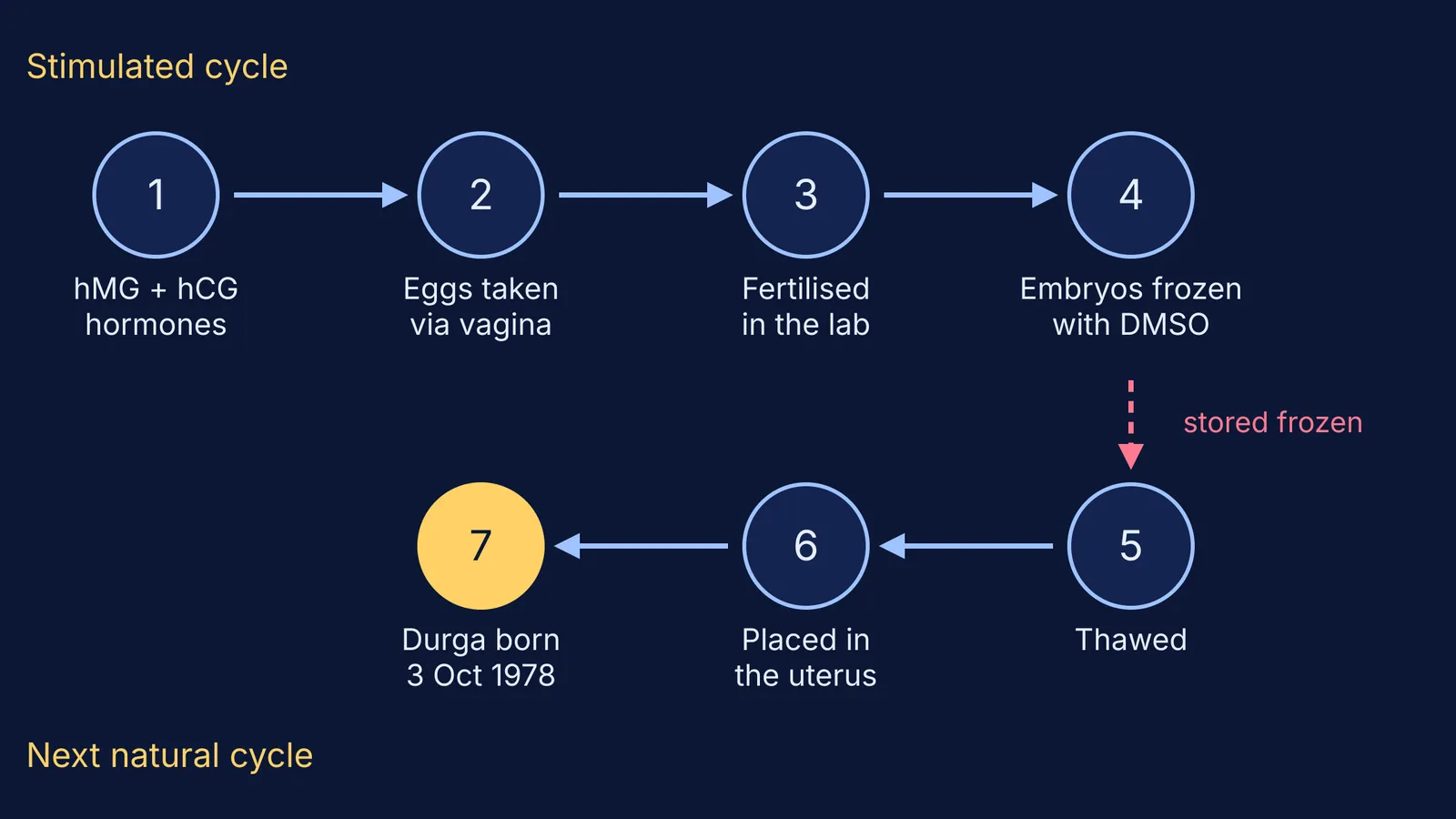
Mukhopadhyay held a PhD in reproductive physiology from Calcutta University, and his patient had damaged fallopian tubes, according to a 2014 history note in the Chettinad Health City Medical Journal. He worked with cryobiologist Sunit Mukherjee and gynaecologist Saroj Kanti Bhattacharya, says the Cureus profile. The two papers describe these steps:
Stimulate the ovaries with two hormones, human menopausal gonadotropin (hMG) and human chorionic gonadotropin (hCG), so that several eggs ripen.
Collect the eggs through a small cut in the back wall of the vagina (posterior colpotomy), not through the abdomen.
Mix the eggs with processed sperm in the lab and let the embryos grow.
Freeze the embryos gradually, protected by a chemical called DMSO.
Wait for the woman's next natural cycle, then thaw the embryos and place them in her uterus.
That fourth step is the surprise. The Chettinad note says he was the first to freeze and thaw human embryos using a cryoprotectant, and the first to transfer thawed embryos in a later natural cycle. His team described the freezing in a short pilot report in the Indian Journal of Cryogenics.
How was his method different from the British one?
Patrick Steptoe and Robert Edwards reported Louise Brown's birth in The Lancet in August 1978. The Cureus profile notes that the British team collected eggs by laparoscopy, through the abdomen, while Mukhopadhyay's vaginal route was simpler and more direct. According to the Chettinad note, credit for using hMG in IVF later went to Howard Jones in the US, and credit for freezing embryos went to an Australian team in the 1980s.
Why did officials refuse to believe him?
The West Bengal government set up a committee in 1978 to examine his claim. Its members were a radiophysicist, a neurologist, a gynaecologist and a physiologist, none with expertise in IVF, and it labelled his work "bogus", according to the Cureus profile. In 1981 he was transferred to the Regional Institute of Ophthalmology at Medical College, Calcutta.
Instead of recognition he faced social ostracism, reprimand and insult from the state government, and he took his own life in 1981, as Indian Pediatrics recorded in 2010. If you or someone you know is struggling, you can call Tele MANAS, the government's toll-free, 24x7 mental-health helpline, on 14416.
When was he finally recognised?
India's first "scientifically documented" IVF baby, Harsha, was born on 6 August 1986 at KEM Hospital, Mumbai, as gynaecologist Indira Hinduja wrote in BioSpectrum. According to the Chettinad note, Dr T. C. Anand Kumar, who led that team, later gathered Mukhopadhyay's handwritten lab notes, papers and letters. In 1997 he published "Architect of India's first test tube baby" in Current Science, and he convinced a committee of the Indian Council of Medical Research (ICMR) to accept Durga as India's first IVF baby. ICMR officially recognised Mukhopadhyay's contribution in 2002, per the Cureus profile.
How does this case connect to Class 12 biology?
The NCERT chapter on Reproductive Health defines IVF as fertilisation outside the body followed by embryo transfer. It says a zygote or early embryo with up to 8 blastomeres can go into the fallopian tube (ZIFT), while an embryo with more than 8 blastomeres goes into the uterus (IUT). GIFT places an egg in the fallopian tube. Try this worked example with the Durga case.
Question: Why could Mukhopadhyay's patient not have had ZIFT or GIFT?
Step 1: Both methods put the egg or zygote into the fallopian tube.
Step 2: Her fallopian tubes were damaged.
Answer: The embryos had to go straight into the uterus.
You can link this to other chapters too. The hormones in step 1 are gonadotropins, so revise FSH and LH in our list of anterior pituitary hormones, and the tubes in the four parts of the fallopian tube. For the science that came before human IVF, read how Min Chueh Chang pioneered IVF and the pill.
If terms like ZIFT, GIFT, IUT and ICSI blur together, the Fermi Concept Library gives each biology concept its own lesson and shows its place in the map.
Next time you revise assisted reproductive technologies, picture that Kolkata lab in 1978, and remember that careful records protect good science.