

On this page
In 1891, a biologist working in Naples overturned a rigid theory of how living things—and, by extension, how we—develop and learn. His work fundamentally changed our understanding of potential and adaptability.
What was the mosaic theory of development?
In the late nineteenth century, the prevailing idea in embryology was the "mosaic" theory. Biologists believed that a fertilised egg was a strict blueprint, with each part pre-programmed to form a specific piece of the adult body.
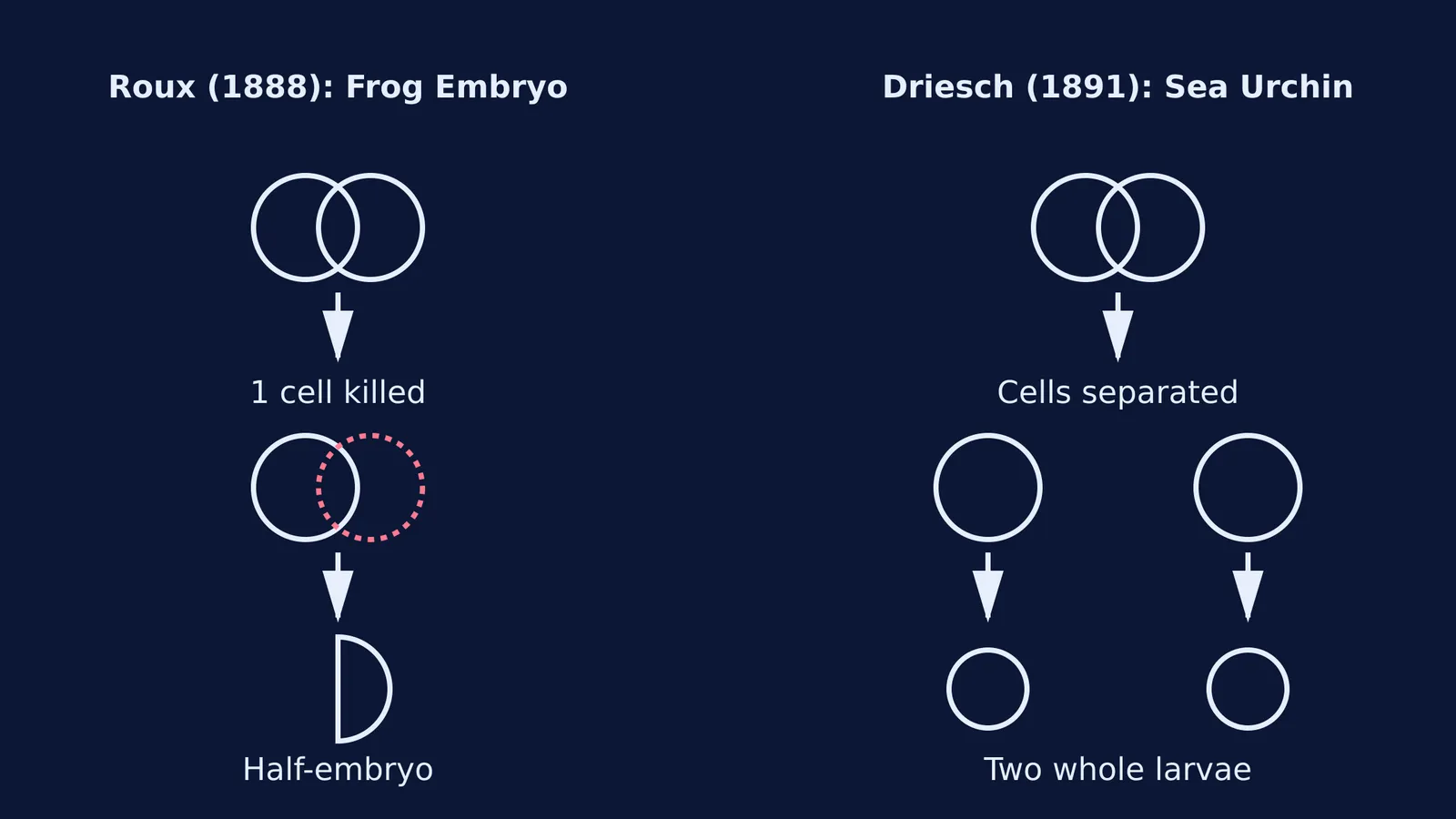
In 1888, the German zoologist Wilhelm Roux tested this idea on frog embryos. Roux published the results of a series of defect experiments in which he took two-cell and four-cell frog embryos and killed half of the cells of each embryo with a hot needle.
The surviving live cell continued to divide, but Roux reported that it only grew into a half-embryo. He surmised that the separate function of the two cells had already been determined by that early stage. Roux concluded that development is indeed a mosaic: if a piece is lost, the corresponding part of the adult simply never forms. After a few cell divisions, the embryo was thought to be like a mosaic, with each cell playing its own unique part in the entire design.
How did Hans Driesch separate sea urchin embryo cells?
Three years later, working at the Marine Biological Station in Naples, Hans Driesch decided to test Roux's conclusion. Under the influence of his teacher Ernst Haeckel, Driesch tested the mechanistic embryological theories of Roux using sea urchin embryos.
Instead of killing one cell and leaving it in place, Driesch took embryos at the two-cell stage and completely separated the cells after the first cell-division. He expected each cell to grow into the corresponding half of the animal, matching the prediction based on Roux's earlier work with frog embryos.
Instead, each separated cell developed into a complete sea urchin. Driesch found that this also happened at the four-cell stage: entire larvae ensued from each of the four cells. The only difference was that these larvae were smaller than usual. Driesch's experiments even showed that it was possible to shuffle the blastomeres of the early embryo without affecting the resulting larva.
These findings suggested that any single cell in the early embryo was capable of forming any part of the developing larva. This proved that early embryonic cells are "totipotent". They are not fixed mosaic pieces, but cells that can adjust their fate to form a complete organism.
Why did Wilhelm Roux get a half-embryo?
If a single embryonic cell has the potential to form a whole organism, why did Roux's experiment only yield a half?
The answer lay in his method. Roux killed half of the cells with a hot needle but left them attached. When Driesch completely removed the other cell instead of just killing it, the remaining one was free to express its full, totipotent capacity. Driesch's findings brought about the adoption of the terms "totipotent" and "pluripotent" cell, referring to a cell that can generate every cell in an organism and one that can generate nearly every cell.
This refutation of the mosaic theory caused friction among Driesch, Roux and Haeckel, but it set a new course for biology.
What does the sea urchin experiment mean for learning?
There is a powerful parallel between Driesch's embryo and the way you learn a difficult subject like physics or mathematics.
Many students treat their abilities as a mosaic. If they struggle with a topic, they assume they simply lack the "piece" of intelligence required for it. However, the limitation is rarely a lack of fundamental capacity. More often, a student is carrying a "dead cell" — a lingering misconception, an anxious memory of a failed exam, or a habit of rote memorisation that holds their reasoning back.
When you strip away those constraints and look at the foundations of a subject afresh, your brain acts like a totipotent cell. You have the capacity to grasp the entire picture.
To help shed these rigid habits, Fermi's AI tutor works out what you already know, builds a plan for the session, and teaches through it. Rather than just printing an answer and leaving a bad habit attached, the tutor holds a line of reasoning across a session, noticing where you are stuck and deciding whether to explain, ask, or show. This ensures you develop a complete, independent grasp of the subject.
Hans Driesch's proof of totipotency set the stage for later breakthroughs in biology, such as the discovery of the Spemann and Mangold embryo organizer and the work of John Gurdon and the frog cloned from a gut cell. But his 1891 experiment is also a reminder for every student: your potential is not a fixed mosaic, but a whole waiting to develop.


