On this page
On 16 September 1977, at University Hospital Zurich, Andreas Grüntzig pushed a thin catheter into a man's narrowed heart artery and inflated a tiny balloon inside it. The narrowing opened, without the bypass operation the patient had been booked for. Here is how he got there, what his first results showed, and why a little widening helps so much.
Who was Andreas Grüntzig?
Grüntzig was born in Dresden, Germany, on 25 June 1939 (Wikipedia). He built on the work of the American radiologist Charles Dotter, who in 1964 described pushing rigid catheters through blocked leg arteries: of 11 limbs treated, six showed marked improvement (Dotter and Judkins, Circulation 1964).
Grüntzig wanted something gentler than stiff tubes: a balloon that goes in flat and is inflated only where the artery is narrow. Working with polyvinyl chloride on his kitchen table, he and his helpers built first a single-lumen and then a double-lumen balloon catheter. The double-lumen version was used on a narrowed iliac artery in the pelvis on 23 January 1975 (EuroIntervention, 40 years of percutaneous cardiac intervention). He presented early work at the American Heart Association meeting in 1976, and in May 1977 he and Richard Myler dilated coronary arteries in patients already undergoing bypass surgery in San Francisco (EuroIntervention, remembering patients and pioneers).
What happened in the first coronary angioplasty in 1977?
The patient, Adolf Bachmann, had chest pain (angina) from a short narrowing in the left anterior descending artery, a main artery feeding the heart muscle. He had been booked for bypass surgery and agreed instead to be the first patient (EuroIntervention). He was awake while the catheter was threaded in through an artery and the balloon inflated inside the narrowing (Wikipedia).
Grüntzig reported the case in a short letter to The Lancet in February 1978 (Grüntzig, Lancet 1978). Ten years later the patient was still free of angina (Hektoen International), and in 2017 EuroIntervention noted that he remained alive and well. Hektoen also records that Grüntzig moved to Emory University Hospital in Atlanta in 1980 and died when his plane crashed in stormy weather near Forsyth, Georgia, on 27 October 1985.
What did Grüntzig's first 50 patients show?
The full report appeared in the New England Journal of Medicine in July 1979 (Grüntzig, Senning and Siegenthaler, NEJM 1979). Over 18 months the Zurich team treated 50 patients:
The balloon worked in 32 of the 50 patients.
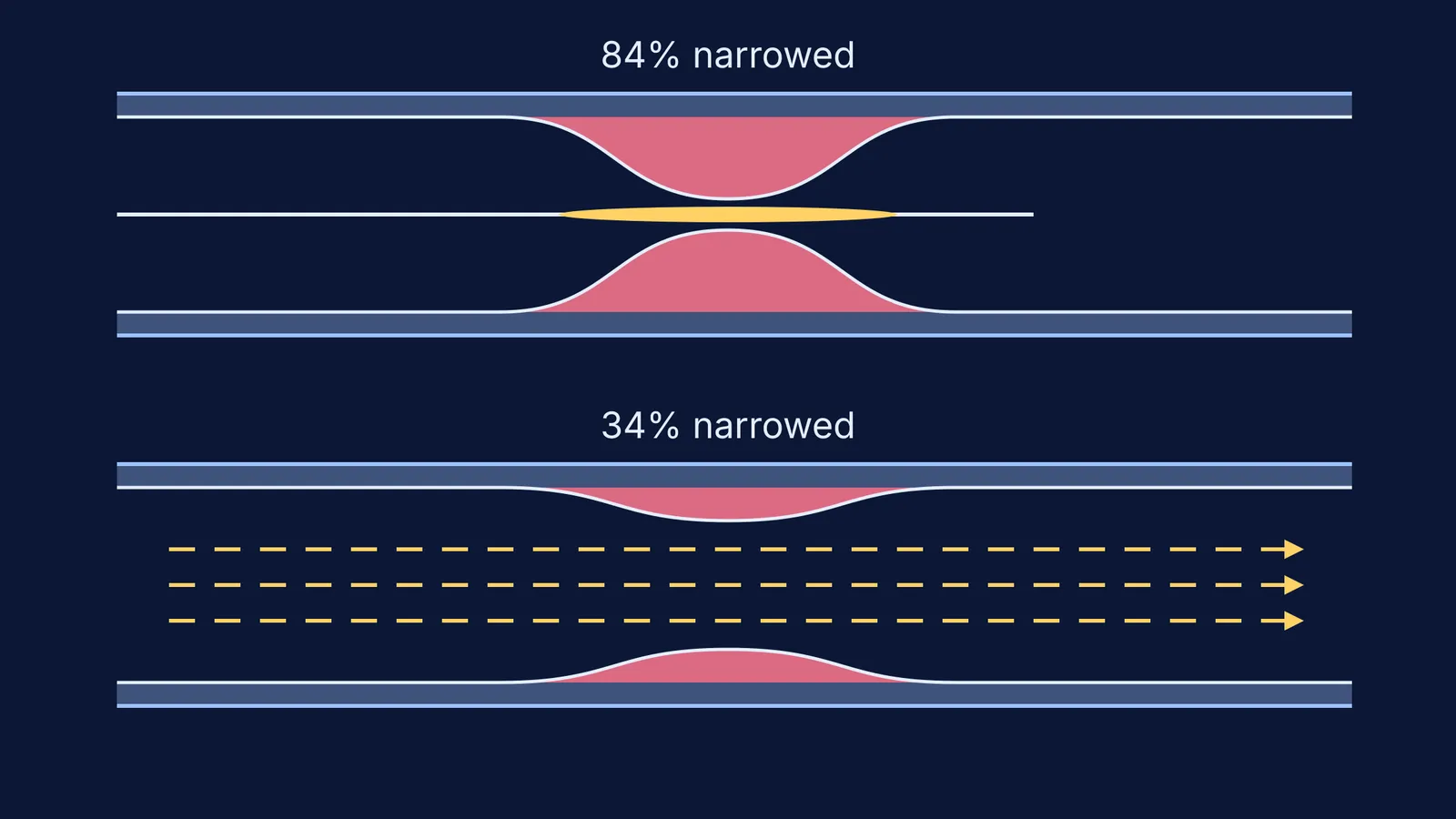
In those 32, the average narrowing fell from 84% to 34%.
The pressure drop across the narrowing fell from an average of 58 to 19 mm Hg.
29 patients showed better heart function at follow-up.
5 patients needed emergency bypass surgery, and 3 showed ECG signs of a heart attack.
The authors estimated that only about 10 to 15% of people being considered for bypass surgery had narrowings suitable for the balloon, and said a randomised trial would be needed to compare it with surgery and medicines.
Why does widening an artery a little help so much?
Poiseuille's law says that for steady, smooth flow through a tube, flow rate Q = (P2 − P1)πr⁴/8ηl, so flow depends on the fourth power of the radius (OpenStax College Physics 2e). OpenStax works through a coronary artery whose flow plaque has cut to half: that takes only a 16% drop in radius, because 0.84⁴ is about 0.5.
Now try it with the averages from the 1979 NEJM report:
Treat the percentages as how much of the artery's width is blocked. Before the balloon, the open channel was 0.16 of normal width; after, 0.66.
Before: 0.16⁴ ≈ 0.00066. A segment that narrow resists flow about 1,500 times as much as an equally long healthy segment.
After: 0.66⁴ ≈ 0.19. The segment now resists flow about 5 times as much as healthy artery.
Before against after: (0.66 ÷ 0.16)⁴ ≈ 290. Making the channel about four times wider cut that segment's resistance roughly 290-fold.
Reality check: Poiseuille assumes steady flow through a long, uniform tube; blood pulses and a narrowing is short, so treat these figures as a rough guide, not a measurement. What was measured is the pressure drop, which fell from 58 to 19 mm Hg.
Narrowing also makes blood speed up, as this Bernoulli simulation of a narrowing pipe shows. If r⁴ still feels abstract, the Fermi Simulation Lab has interactive simulations for ideas that are easier to see than to read.
How can you learn from a scientific first like this?
Ask four questions of any breakthrough story:
What problem was it solving? A narrowed artery that otherwise needed bypass.
What did it build on? Dotter's rigid catheters.
What was measured, and how many failed? 32 of 50 succeeded; 5 needed emergency surgery.
What did the authors admit they did not know? How it compared with surgery and medicines.
Try the same four questions on Domingo Liotta and the first total artificial heart or on the Frank-Starling law of the heart.