On this page
When a patient's heart fails completely, a transplant is the only permanent solution. But finding a donor heart takes time. For decades, surgeons wondered if a machine could pump blood through the body while the patient waited.
On 4 April 1969, that idea became a reality. Dr Denton Cooley implanted a total artificial heart designed by Dr Domingo Liotta into 47-year-old Haskell Karp at the Texas Heart Institute in Houston (American Journal of Cardiology90460-3)). The device kept Karp alive for nearly three days until a donor heart arrived, marking a turning point in cardiovascular medicine.
Who was Domingo Liotta?
Domingo Santo Liotta (1924–2022) was an Argentine surgeon who dedicated his career to cardiac prostheses (Wikipedia). After earning his medical degree in Argentina and training in France, he began experimenting with artificial hearts in 1958. His early prototypes were tested in small animals.
In 1961, he was hired as the Director of the Artificial Heart Program at Baylor College of Medicine by Dr Michael DeBakey. Liotta's work on mechanical circulatory support led him to design devices that could take over the pumping action of the heart's ventricles.
What was the 1969 artificial heart implant?
By 1969, heart transplants were possible, but the waiting lists were perilous. Haskell Karp was in end-stage heart failure, and no donor was immediately available. Dr Denton Cooley, alongside Liotta, made the decision to implant Liotta's artificial heart design.
This surgery was the first time a mechanical device completely replaced the human heart in a clinical setting (American Journal of Cardiology90460-3)). The procedure was intended as a "bridge to transplant" — a way to sustain life just long enough for a human heart to be sourced.
The device successfully pumped blood and kept Karp alive for 64 hours. Once a donor heart was available, the artificial heart was removed, and the biological heart was transplanted.
How did the Liotta-Cooley artificial heart work?
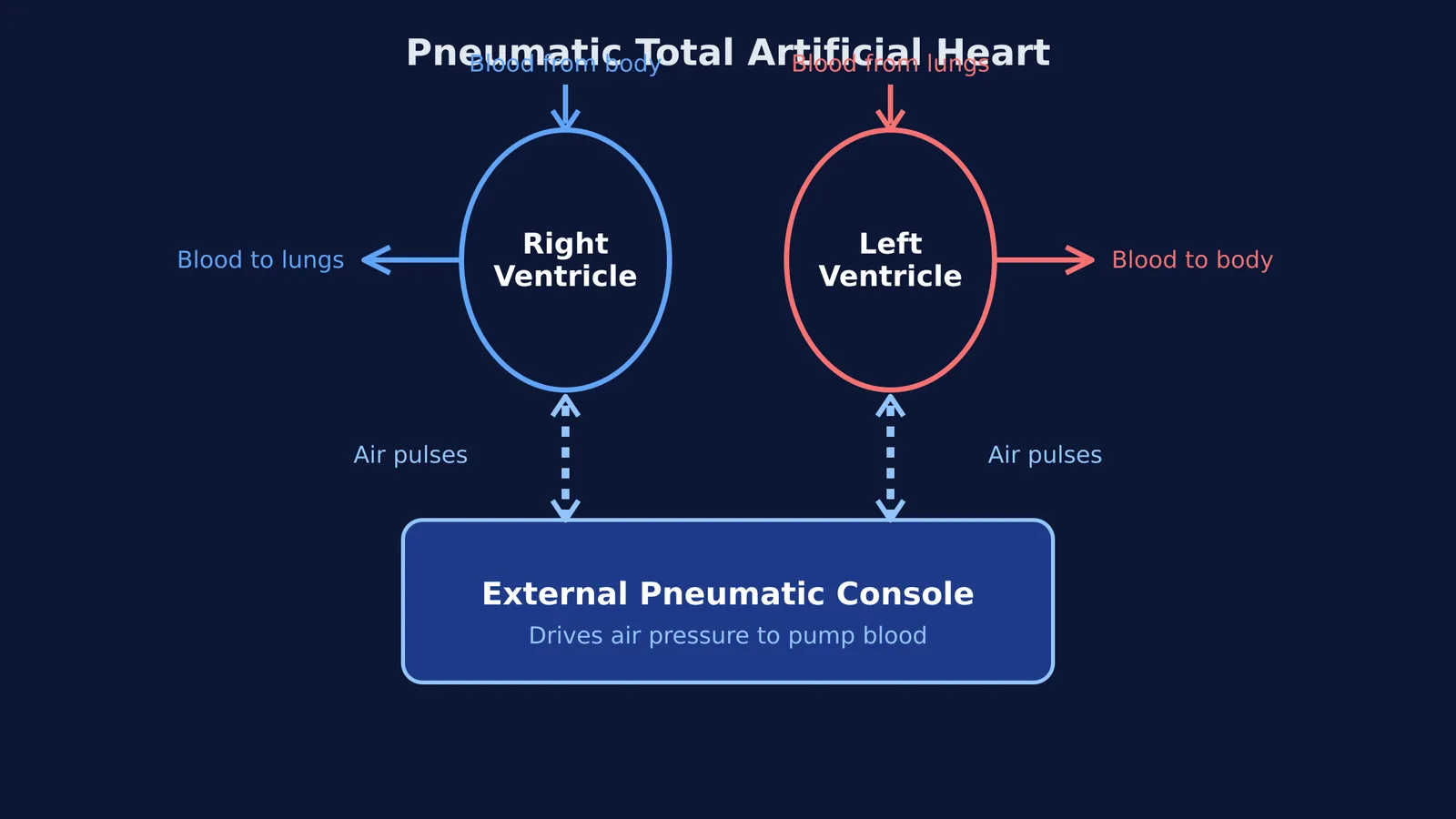
The artificial heart was a double-ventricle pump made of Dacron fabric and Silastic plastic. It was pneumatic, meaning it was driven by air pressure.
Instead of an internal motor, the heart was connected by tubes to a large external console. The console pumped air in and out of the artificial ventricles, pushing blood through the body. Hingeless valves controlled the direction of the blood flow, ensuring it moved correctly from the atria to the ventricles, and out to the lungs and the rest of the body.
When studying the circulatory system, understanding how pressure changes drive blood flow is essential. If you have trouble picturing how these pressure waves move through valves, the Concept Library on Fermi's AI tutor breaks down the mechanics of the heart step by step, asking questions to check your understanding of systole and diastole as you go.
What is the legacy of the 1969 artificial heart?
Although Karp passed away 32 hours after receiving the human donor heart due to complications (such as pneumonia and kidney failure), the initial 64-hour mechanical support was a breakthrough (American Journal of Cardiology90460-3)). The operation confirmed that a machine could temporarily replace the human heart's pumping function.
The event also sparked a famous controversy. Dr Michael DeBakey argued that the device was an experimental model from his laboratory, used without his permission or official approval. Despite this, the implant paved the way for modern ventricular assist devices (VADs) and later total artificial hearts, which now sustain patients for months or even years.
Today, the original Liotta-Cooley artificial heart is preserved in the Smithsonian Institution in Washington, D.C.
Read more: