On this page
In the 1500s, surgeons poured boiling oil into gunshot wounds and sealed bleeding stumps with red-hot irons. Ambroise Paré, a French army surgeon, stopped doing both. What changed his mind first was not a theory but a comparison he saw with his own eyes.
Why did surgeons pour boiling oil into gunshot wounds?
Paré was born in 1510 and died in Paris on 20 December 1590, after serving as surgeon to four French kings, Henry II, Francis II, Charles IX and Henry III, according to his Wikipedia biography.
In his time, surgeons believed gunpowder poisoned a wound. The standard method, taught by the Italian surgeon Giovanni da Vigo, was cauterisation with boiling oil, as Bhadriraju and Goodwin describe in a 2024 Cureus review. Burning was meant to destroy the poison. Paré came to question whether the poison existed at all.
What did Paré see the morning after he ran out of oil?
In 1537, on campaign in Piedmont near Turin, Paré ran out of boiling elder oil. He used a mild dressing of egg yolk, oil of roses and turpentine instead (Wikipedia). The next morning, the soldiers with the mild dressing had rested well, with little pain or swelling, while those treated with boiling oil were feverish and in pain, their wounds swollen, as Drucker recounts in the Yale Journal of Biology and Medicine. Paré gave up the boiling oil, and in 1545 published his first book, on treating wounds from arquebuses and other firearms (Wikipedia).
Why did Paré use ligatures instead of cautery?
After an amputation, surgeons pressed hot irons onto the stump to stop the bleeding. A ligature is a thread tied tightly around a blood vessel to close it.
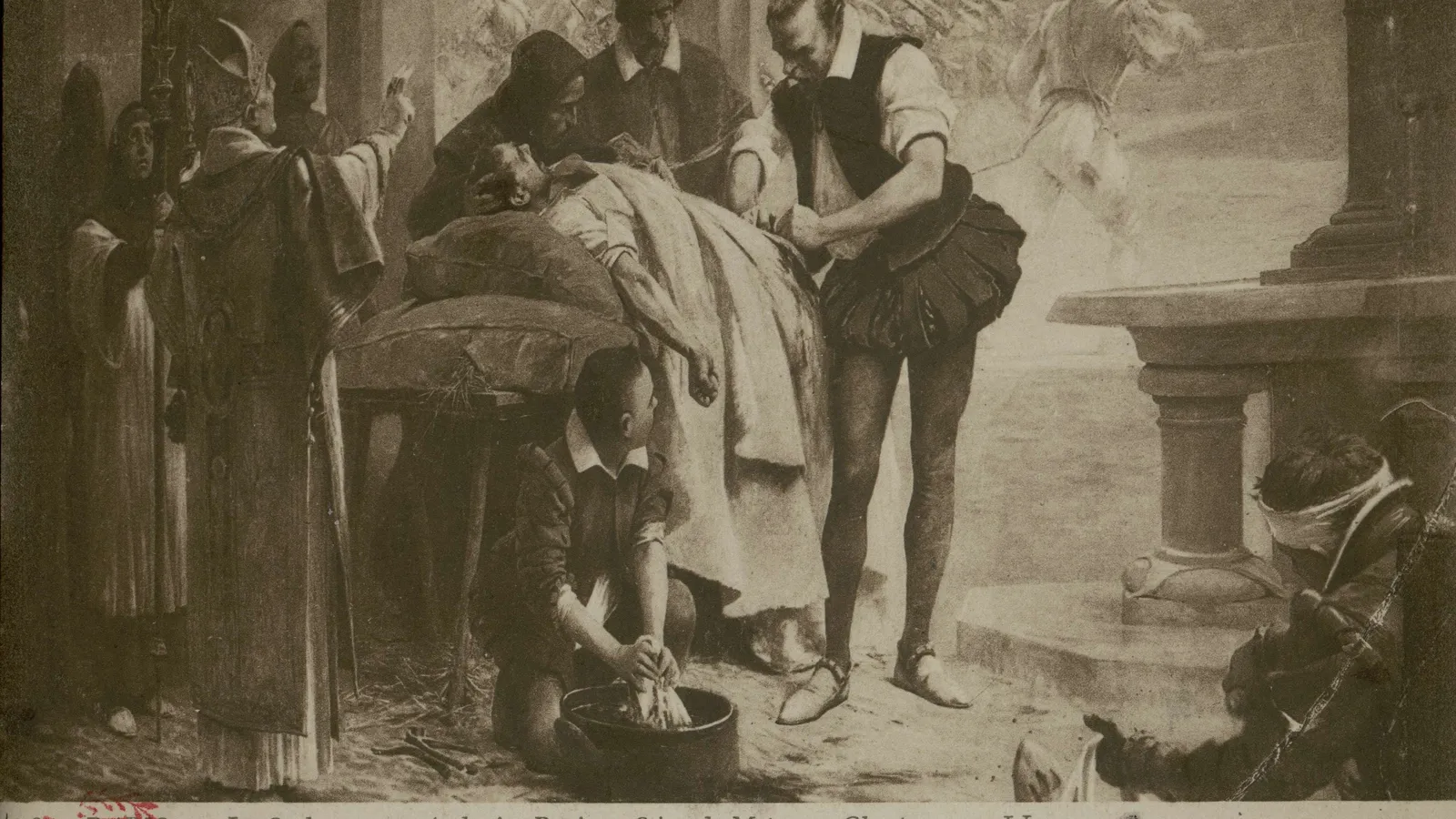
In 1552, at the siege of Metz, Paré amputated an officer's leg and tied off the blood vessels instead of burning them, according to orthopaedic surgeon Philippe Hernigou's history in International Orthopaedics. The method Paré defended was to pinch the artery or vein with a pincer called a crow's beak, then tie it with strong thread. In the English translation Hernigou quotes, Paré wrote: "I dressed him and God healed him." The officer went home on a wooden leg, glad not to have been "miserably burned to staunch the bleeding."
Hernigou explains why this mattered: burning also destroyed the flaps of skin needed to cover the stump, which raised the risk of infection. Paré set out the ligature method in his 1564 book Dix livres de la chirurgie (Hernigou).
Was Paré the first, and did everyone agree?
No on both counts. Paré himself cited Celsus and Galen, who had described tying vessels centuries earlier (Hernigou). What Paré added was using it in amputations in place of the hot iron, and publishing the method for other surgeons.
Others pushed back. Etienne Gourmelen attacked the ligature, warning that if the needle pricked a nerve while the vessel was being tied, inflammation, convulsion and death would follow (Hernigou).
How can you run a Paré-style test on your own study habits?
Paré's habit works beyond surgery: compare two methods fairly, look at the result the next day, and change what you do if the evidence says so.
Name the method you were taught. For example: "I reread the NCERT chapter on body fluids and circulation three times."
Pick one alternative. For example: close the book, write down everything you remember, then check.
Split fairly. Use method A on one topic and method B on a similar topic of the same length and difficulty, in the same week.
Check the next morning, not straight away. Paré judged by how the soldiers were the next day. Test yourself on both topics a day later with questions you have not seen.
Write the result down and act on it. If B wins two or three times in a row, switch, even if A feels more comfortable.
A worked example: Riya, in Class 11, revises the heart by rereading and blood vessels by recall-and-check. The next morning she gets 4 of 10 questions right on the heart and 7 of 10 on blood vessels. One round proves little, so she swaps the methods on the next two topics. If recall still wins, she switches.
If step 4 shows a gap in the biology itself, say how arteries differ from veins, the Fermi Concept Library has a lesson for each concept in biology, so you can fix the idea before testing again. If you don't know which topic to start with, Fermi's AI tutor works out what you already know and builds a plan for the session.
More surgeons who changed what patients went through: how James Young Simpson brought in chloroform anaesthesia in 1847, how Carl Koller found the first local anaesthetic for eye surgery and how Theodor Kocher made thyroid surgery safe.