On this page
In the nineteenth century, people living in alpine valleys frequently suffered from severe goitres—massive swellings of the thyroid gland in the neck. In high mountain regions where glacial meltwater leached iodine from the soil, thyroid enlargement was an endemic condition that often compressed the trachea, causing suffocating shortness of breath. As later proved by the Kangra valley iodised salt study, iodine deficiency was the primary trigger, but nineteenth-century medicine had no understanding of nutritional trace elements or thyroid physiology.
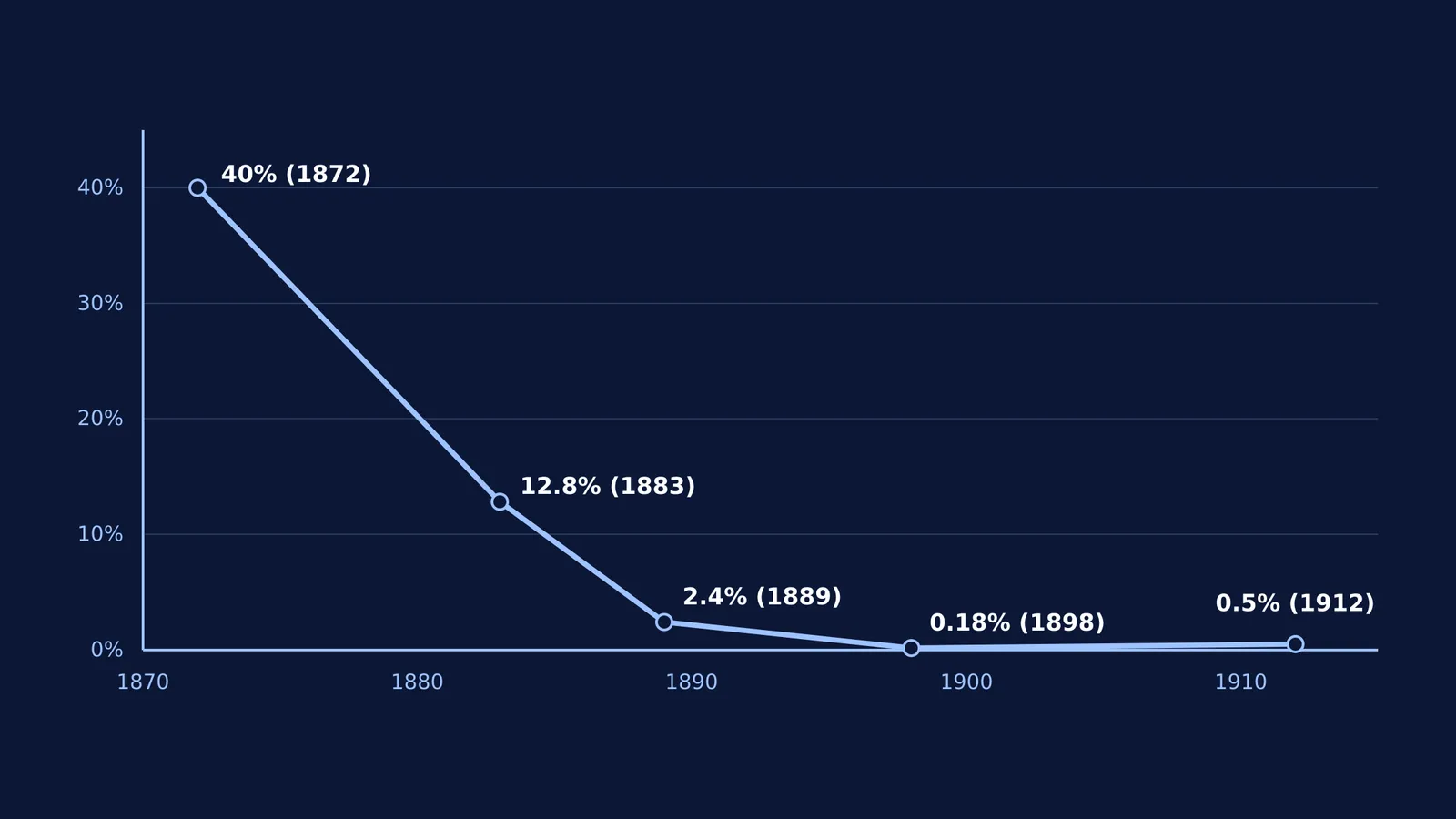
Desperate patients sought surgery, but operating on the thyroid was so dangerous that the French Academy of Medicine had banned it in 1850. The thyroid is exceptionally vascular, fed by four large arteries that pour blood through spongy tissue. In an era before hemostatic clamps and sterile fields, surgeons attempting thyroidectomy faced catastrophic hemorrhage that obscured anatomy within seconds. Across European clinics, thyroidectomy carried a mortality rate of roughly 40%. Surgeons operated with frantic speed, yet patients routinely died on the table from blood loss or days later from wound sepsis.
Why was thyroid surgery once considered deadly?
Early thyroid surgery failed because surgeons prioritized raw speed over anatomical delicacy. Slashing through neck tissues to remove the swollen mass before the patient bled to death often tore deep veins and severed the recurrent laryngeal nerve, permanently destroying the voice.
When Swiss surgeon Theodor Kocher was appointed Director of the University Surgical Clinic at Bern's Inselspital in 1872, he decided to completely redesign the operation, as detailed in his Nobel biographical profile. Having studied under European pioneers, Kocher adopted the antiseptic principles described in Joseph Lister's development of antiseptic surgery and moved toward strict asepsis, requiring sterilized linen, boiled instruments, and spotless operating theatres.
More importantly, Kocher replaced haste with calm, deliberate dissection. As reviewed in the World Journal of Surgery, he invented specialized artery forceps—the toothed "Kocher clamp"—to seize and ligate every vessel before cutting. By performing capsular dissection, he peeled the gland away from deep neck structures in a clean, bloodless field, protecting both the recurrent laryngeal nerve and the parathyroid glands.
How did Theodor Kocher cut surgical mortality below 1%?
Kocher's methodical technique transformed surgical outcomes. In his first series of 101 thyroidectomies reported between 1872 and 1883, his mortality rate dropped to 12.8%, as documented in the Journal of the Royal Society of Medicine.
Over the following decades, his results became the gold standard of modern surgery:
In his next 250 cases reported by 1889, mortality dropped to 2.4%, according to the British Journal of Hospital Medicine.
By 1898, in a series of over 600 operations for benign goitre, his mortality rate reached 0.18%, noted in his Nobel Lecture.
Over his 45-year career in Bern, Kocher performed more than 5,000 personal thyroidectomies, maintaining an overall mortality rate below 0.5%, according to the British Journal of Hospital Medicine.
What did cachexia strumipriva reveal about thyroid hormones?
Despite this surgical success, Kocher uncovered an unexpected tragedy. In 1874, he had completely removed the thyroid gland of an eleven-year-old girl named Maria Bichsel. Years later, general practitioner August Fetscherin alerted Kocher that the previously bright, energetic child had become physically stunted, bloated, sluggish, and mentally dull, as recounted in the Journal of the Royal Society of Medicine.
Kocher responded by auditing 102 former patients. The findings were stark: patients with partial thyroidectomies were thriving, but among 34 patients who underwent total thyroidectomy for benign goitre, nearly all suffered severe physical and intellectual decline. Kocher named this condition *cachexia strumipriva*—wasting caused by the removal of a goitre.
As Count K.A.H. Mörner noted in the Nobel Award Ceremony Speech, textbooks had long treated the thyroid's function as a "complete mystery." Kocher's clinical follow-up proved that the thyroid was an essential endocrine organ whose secretions controlled human metabolism. In April 1883, Kocher declared that total thyroidectomy for benign disease was "reprehensible" and insisted that functional glandular tissue must always be left behind. This clinical insight founded modern endocrinology, linking symptoms directly to hormone loss as taught today in chemical coordination for NEET.
How do you analyze endocrine deficiency?
Kocher's discovery shows how surgical deficits reveal normal physiology. When analyzing endocrine glands and deficiency states in biology, you can use this four-step checklist:
Verify anatomical boundaries: Distinguish total organ removal from subtotal resection, noting whether adjacent glands (such as the parathyroids) or nearby nerves were preserved.
Identify the missing hormones: Map lost secretions—such as thyroxine (T4) and triiodothyronine (T3)—to their physiological roles in basal metabolic rate and cellular respiration.
Trace deficiency symptoms: Connect hormonal absence to physical signs, such as cold intolerance, sluggish reflexes, and myxedema resulting from impaired cellular metabolism.
Evaluate endocrine feedback: In the absence of circulating hormones, negative feedback to the pituitary fails, causing elevated thyroid-stimulating hormone (TSH) levels.
When mapping complex feedback loops or tracing how endocrine systems interact, the Fermi Concept Library organizes every concept in biology, chemistry, and physics with its own lesson and its place in the map. For students working through multi-step physiology scenarios where feedback loops break down, Fermi's AI tutor holds a line of reasoning across a whole session, notices where a student is stuck, and decides whether to explain, ask, or show.